- Animals
- ›Chordates
- ›Vertebrates
- ›Ray-finned Fishes
- ›Carps, Characins, Catfishes and Allies
- ›Catfishes
- ›Siluroidei
- ›North American Freshwater Catfishes
- ›Noturus
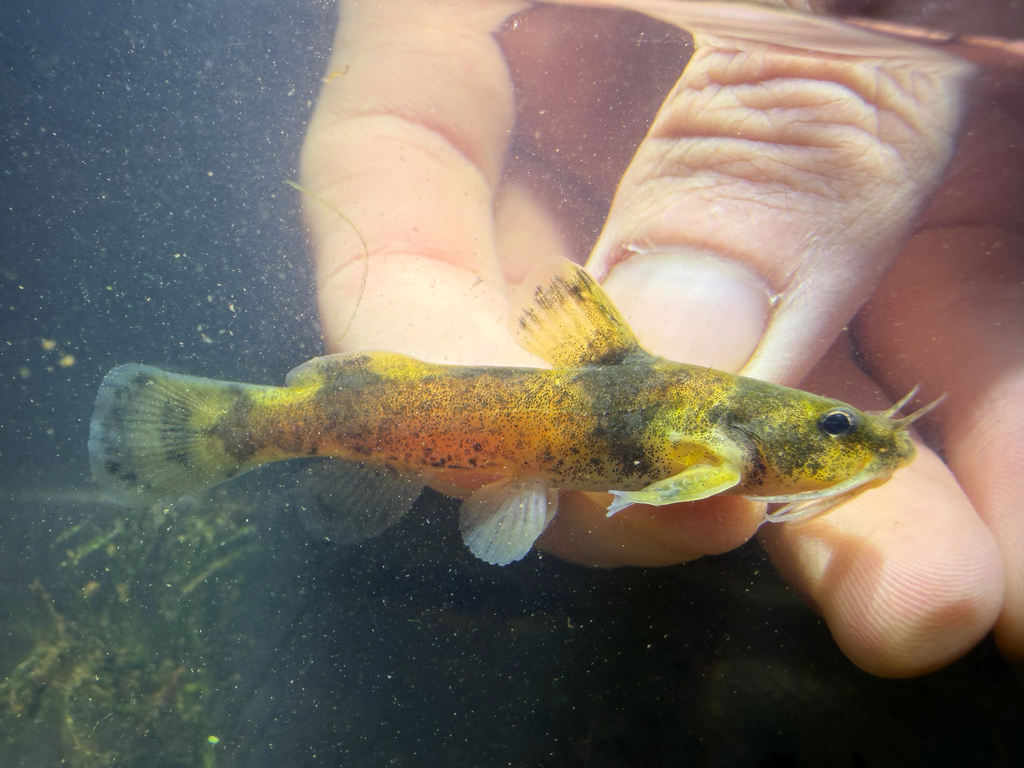
Frecklebelly Madtom
Noturus munitus
The frecklebelly madtom (Noturus munitus) is a species of fish in the family Ictaluridae endemic to the United States. Madtoms are in the genus Noturus, which is a group of catfish prevalent in North America. In 2023, the Upper Coosa River distinct population segment (DPS) of N. munitus was listed as federally threatened under the Endangered Species Act of 1973.
From the article Frecklebelly madtom on Wikipedia (CC BY-SA), quoted section by section
Description
The frecklebelly madtom is a robust, boldly patterned member of the monophyletic saddled madtom subgenus Rabida. Historically, the population thrived in large rivers in the Mobile Basin and Pearl River drainages in the southeastern United States. However, it is currently limited to the Gulf Coastal Plain rivers. The species lives exclusively in medium to large rivers free of sedimentation and over gravel shoals. They spawn between June and August while producing 50 to 75 mature eggs in a single clutch. All madtom species, including N. munitus have experienced decline since the 1950s due to channelization, gravel mining, dredging, and siltation, which reduce the ability for the species to properly breed and survive.
Range & habitat
N. munitus is a diminutive catfish with a disjunct distribution across the southeastern United States. It is historically known from the Pearl River drainage and the Upper Tombigbee River drainage in Mississippi and Louisiana, and the Alabama River and Cahaba River drainages in Alabama. However, it has been extirpated from the main channel of the Tombigbee and Alabama Rivers, and is currently limited to the Coastal Plain rivers. The species lives exclusively in medium to large rivers free of sedimentation and over gravel shoals. N. munitus has declined rapidly since the mid-1950s when river modification began. The loss of gravel substrates and increased levels of sedimentation due to poor agricultural practices have also affected the species. It is now reliably found in high numbers in only a few locations and is considered threatened with extinction.
Wikipedia: “Distribution”
What it does
The habitats of N. munitus and other Noturus species are very specific. They must have moving, cool water, with no sedimentation. Dams interrupt the water flows, and sedimentation can cover eggs, preventing them from hatching. Several large-river specialists were frequently collected with N. munitus, including Macrhybopsis sp.cf. aestivalis (speckled chub), Macrhybopsis storeriana (silver chub), Notropis uranoscopus Suttkus (skygazing shiner), Crystallaria asprella (crystal darter), Percina lenticula (freckled darter), and P. vigil (saddleback darter). Since N. munitus is an opportunistic insectivore, like most of these fish, competition for food may be present in the ecology of the species. A diet analysis showed Bactidae nymphs (31%), Hydropsychidae larvae (20%), and Simuliidae larvae (20%) provided most of the food for N. munitus. Consequently, in the long run, managing for N. munitus would also benefit other species. However, another reason for decline that should be assessed is predators, but predators were hard to find. Like all madtoms, they are known for their pectoral spines that contain saw-like teeth and a neurotoxin gland. These spines and toxins produce a painful sting when used, and indicate the presence of predators.
Life history. N. munitus reproduction is similar to those of other madtom species. …
Wikipedia: “Ecology”
Where it lives
Recorded sightings
—
geo-referenced records in GBIF, from museums, herbaria and field observers.
Drag the globe to turn it. Dots are where records exist, not a range map; darker means more records.
In the stacks
Searching the stacks…
Every page naming Noturus munitus in the Biodiversity Heritage Library →
This page is assembled live from iNaturalist, GBIF, Wikipedia, the Source Library and the Internet Archive. It is not yet part of the hand-edited codex. iNaturalist taxon 107292.