- Animals
- ›Chordates
- ›Vertebrates
- ›Birds
- ›Perching Birds
- ›Ovenbirds and Woodcreepers
- ›Miners and Leaftossers
- ›Geositta
On eBird ↗
Dark-winged Miner
Live sightings near you, the range map, bar charts of when it is seen, and Macaulay Library photos and recordings.
Dark-winged Miner
Geositta saxicolina
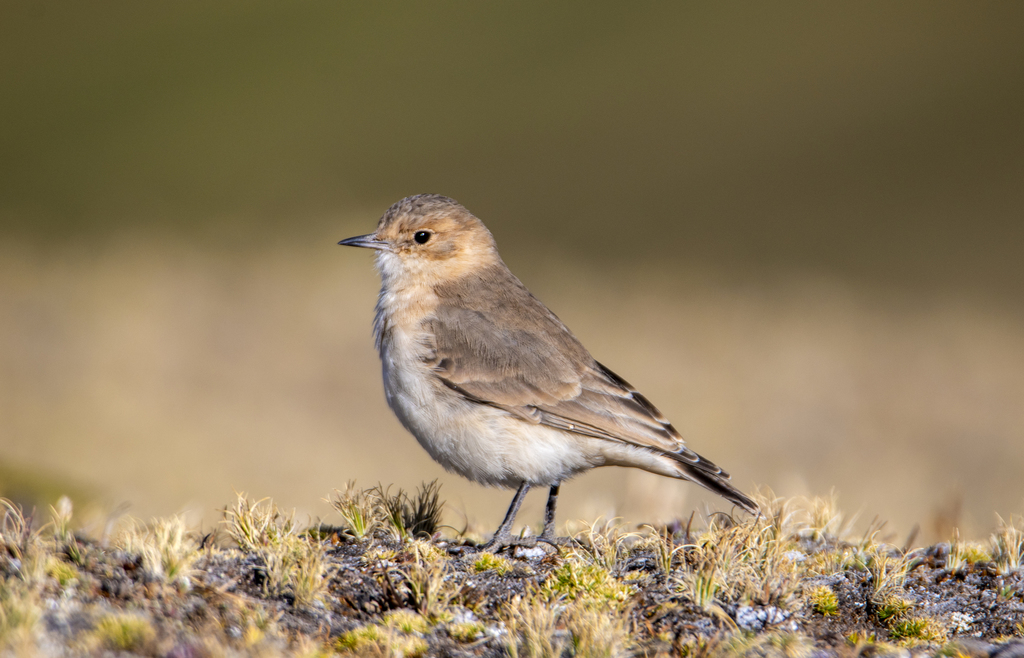
The dark-winged miner (Geositta saxicolina) is a species of bird in the subfamily Sclerurinae, the leaftossers and miners, of the ovenbird family Furnariidae. It is endemic to Peru.
From the article Dark-winged miner on Wikipedia (CC BY-SA), quoted section by section
Description
The dark-winged miner is a medium size member of its genus. It is 15 to 16.5 cm (5.9 to 6.5 in) long and weighs about 31 g (1.1 oz). The sexes are alike. Adults have a cinnamon buff forehead and face with a pinkish buff supercilium. Their crown and back are medium brown and their rump and uppertail coverts bright pale buff. Their tail's innermost pair of feathers are black with a small length of creamy buff at their bases; the rest have progressively more creamy buff. The outermost pair has whitish buff outer webs and pale cinnamon buff inner webs with a dusky band near the end. Their wing coverts are brown with wide paler edges and their flight feathers dusky brown. Their underparts are buff or pinkish buff that is brighter on the sides of the breast. Their iris is brown, their short bill is black with a gray base to the mandible, and their legs and feet are black. Juveniles have a warm buffy tinge overall and dusky scaling on the breast.
Range & habitat
The dark-winged miner is found only in the Andes of central Peru, between the departments of Pasco and Huancavelica. It inhabits the Altiplano, where it favors gently sloping grasslands with a rocky substrate. In elevation it ranges from 3,700 to 4,900 m (12,100 to 16,100 ft).
Wikipedia: “Distribution and habitat”
What it does
The dark-winged miner forages on the ground, singly, in pairs, and possibly in small family groups. Its diet has not been described but is known to include insects; it is assumed to also eat other arthropods and seeds.
Wikipedia: “Feeding”
Listen
Looking for field recordings…
Where it lives
Recorded sightings
—
geo-referenced records in GBIF, from museums, herbaria and field observers.
Drag the globe to turn it. Dots are where records exist, not a range map; darker means more records.
In the stacks
Searching the stacks…
Every page naming Geositta saxicolina in the Biodiversity Heritage Library →
This page is assembled live from iNaturalist, GBIF, Wikipedia, the Source Library and the Internet Archive. It is not yet part of the hand-edited codex. iNaturalist taxon 10738.