- Animals
- ›Chordates
- ›Vertebrates
- ›Reptiles
- ›Snakes and Lizards
- ›Lizards
- ›Skinks and allies
- ›Skinks
- ›Eugongyline skinks
- ›Oligosoma
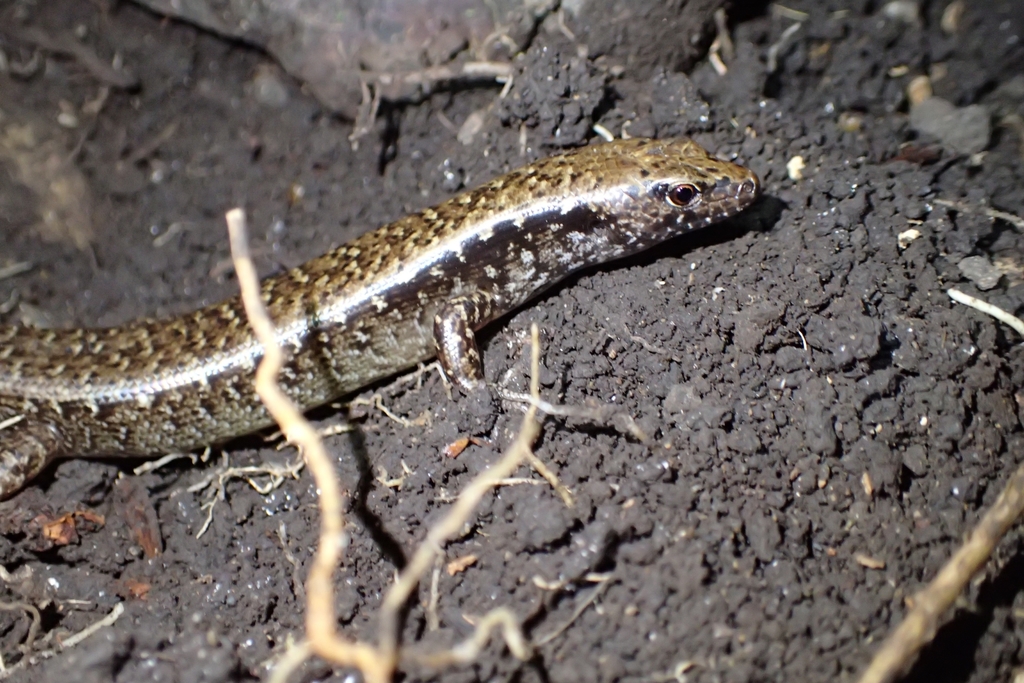
Hauraki Skink
Oligosoma townsi
The Mokohinau skink (Oligosoma townsi), also known commonly as Towns' skink and the Hauraki skink, is a species of lizard in the family Scincidae. The species is endemic to New Zealand.
From the article Mokohinau skink on Wikipedia (CC BY-SA), quoted section by section
Description
O. townsi reaches a maximum snout-vent length of up to 95 mm (3.7 in). It can be distinguished from other species due to the black-edged teardrop and alternating balack and white patterning on the species' lower jaw.
Range & habitat
In New Zealand O. townsi is found on offshore island in the eastern Northland Region and Auckland Region including Three Kings Islands, the Poor Knights Islands, Hen and Chicken Islands, Great Barrier Island, Little Barrier Island and the Mokohinau Islands.
Wikipedia: “Geographic range”
What it does
O. townsi is viviparous and is believed to be nocturnal. The species primarily eats insects, and will occasionally consume fruit.
== References ==
Wikipedia: “Reproduction and behaviour”
In human culture
The species was first described as Cyclodina townsi by David G. Chapple, Geoff B. Patterson, Dianne M. Gleeson and Charles H. Daugherty in 2008, who identified the species as being phylogenetically and morphologicaly distinct from the marbled skink. It was placed in its modern genus, Oligosoma, in 2009. The specific name, townsi, is in honor of Kiwi herpetologist David Towns.
Wikipedia: “Taxonomy and etymology”
Where it lives
Recorded sightings
—
geo-referenced records in GBIF, from museums, herbaria and field observers.
Drag the globe to turn it. Dots are where records exist, not a range map; darker means more records.
In the stacks
Searching the stacks…
Every page naming Oligosoma townsi in the Biodiversity Heritage Library →
This page is assembled live from iNaturalist, GBIF, Wikipedia, the Source Library and the Internet Archive. It is not yet part of the hand-edited codex. iNaturalist taxon 107498.