- Animals
- ›Chordates
- ›Vertebrates
- ›Ray-finned Fishes
- ›Salmons, Pikes and Mudminnows
- ›Salmons, Trouts, and Whitefishes
- ›Salmons, Trouts, and Whitefishes
- ›Salmons and Trouts
- ›Oncorhynchus
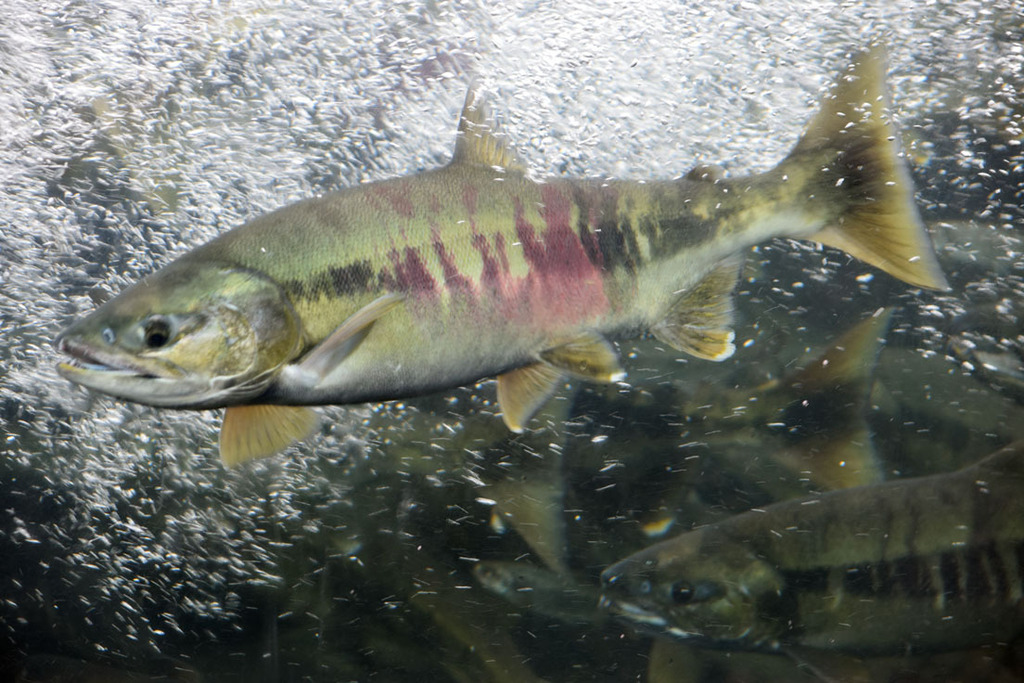
Chum Salmon
Oncorhynchus keta
The chum salmon (Oncorhynchus keta), also known as dog salmon or keta salmon, is a species of anadromous salmonid fish from the genus Oncorhynchus (Pacific salmon) native to the coastal rivers of the North Pacific and the Beringian Arctic. The English name "chum salmon" comes from the Chinook Jargon term tsəm, meaning "spotted" or "marked"; while keta in the scientific name comes from Russian, which in turn comes from the Evenki language of Eastern Siberia.
In Japan, chum salmon is also known as the white salmon (白鮭 シロサケ, shiro sake), autumn salmon (秋鮭 アキサケ, aki sake) or simply "the salmon" (鮭 サケ, sa ke), while historically it was known in kun'yomi as "stone katsura fish" (石桂魚 さけ, sa ke) up until the Meiji period. In Greater China, it is known academically as the "hook-snout salmon" (Chinese: 钩吻鲑), but is more often called the damaha fish (simplified Chinese: 大马哈鱼; traditional Chinese: 大麻哈魚), which is borrowed from dawa ịmaχa, the Nanai name of the fish used by the Hezhe minority in northern Northeast China.
From the article Chum salmon on Wikipedia (CC BY-SA), quoted section by section
Description
The body of the chum salmon is deeper than most salmonid species. In common with other species found in the Pacific, the anal fin has 12 to 20 rays, compared with a maximum of 12 in European species. Chum have an ocean coloration of silvery blue green with some indistinct spotting in a darker shade, and a rather paler belly. When they move into fresh water the color changes to dark olive green and the belly color deepens. When adults are near spawning, they have purple blotchy streaks near the caudal peduncle, darker towards the tail. Spawning males typically grow an elongated snout or kype, their lower fins become tipped with white and they have enlarged teeth. Some researchers speculate these characteristics are used to compete for mates.
Sizes. Adult chum salmon usually weigh from 4.4 to 10.0 kg (9.7 to 22.0 lb) with an average length of 60.0 cm (23.6 in). The all-tackle world record for chum recognized by the IGFA is 35 lb (15.88 kg) and 112.0 cm (44.1 in) caught by Todd Johansson on July 11, 1995 at Edye Pass (a channel between Prescott and Porcher Islands in the Hecate Strait) in the North Coast region of British Columbia; while the all-tackle length world record is 71.0 cm (28.0 in) caught by Vicki D. Martin on October 20, 2021 at Wynoochee River in Washington.
Range & habitat
Chum salmon have the largest natural range of any Pacific salmon. Chum are found all around the North Pacific, off the coasts of Japan, Korea, the Russian Far East, British Columbia in Canada, and from Alaska to California in the United States. They undergo the longest migrations within the genus Oncorhynchus, far up the Yukon River in Alaska and Canada, and deep into the Amur River basin in Northeast China and Russia. In lesser numbers they migrate thousands of kilometers up the Mackenzie River. In the Arctic Ocean they are found in limited numbers from the Laptev Sea to the Beaufort Sea. In North America chum salmon spawn from the Mackenzie River in the Arctic to as far south as the Umpqua River, Oregon, although they were also reported in the San Lorenzo River near Santa Cruz, California in 1915 and the Sacramento River in northern California in the 1950s. In fall 2017 a half dozen chum salmon were counted in Lagunitas Creek about 25 miles (40 km) north of San Francisco, California. In the open ocean, chum salmon stay fairly high on the water column, rarely diving below 50 m (160 ft). Their typical swimming depths are 13 m (43 ft) from the surface during the day, and 5 m (16 ft) during the night.
Wikipedia: “Distribution”
What it does
Chum live for an average of three to five years, and chum in Alaska mature at the age of five years.
Spawning. Most chum salmon spawn in small streams and intertidal zones. Some chum travel more than 3,200 km (2,000 mi) up the Yukon River. Chum fry migrate out to sea from March through July, almost immediately after becoming free swimmers. They spend one to three years traveling very long distances in the ocean. These are the last salmon to spawn (November to January) in some regions. In Alaska they are the first to spawn in June and August and are then followed by pink and coho salmon. They die about two weeks after they return to the freshwater to spawn. They utilize the lower tributaries of the watershed, tend to build nests called redds, really little more than protected depressions in the gravel, in shallow edges of the watercourse and at the tail end of deep pools. The female lays eggs in the redd, the male sprays milt on the eggs, and the female covers the eggs with gravel. The female can lay up to 4000 eggs.
Diet. Juvenile chum eat zooplankton and insects. Recent studies show that they also eat comb jellies. As adults, they eat smaller fish.
Wikipedia: “Life cycle”
Where it lives
Recorded sightings
—
geo-referenced records in GBIF, from museums, herbaria and field observers.
Drag the globe to turn it. Dots are where records exist, not a range map; darker means more records.
In the stacks
Searching the stacks…
Every page naming Oncorhynchus keta in the Biodiversity Heritage Library →
This page is assembled live from iNaturalist, GBIF, Wikipedia, the Source Library and the Internet Archive. It is not yet part of the hand-edited codex. iNaturalist taxon 107572.