On eBird ↗
Australian Bustard
Live sightings near you, the range map, bar charts of when it is seen, and Macaulay Library photos and recordings.
Australian Bustard
Ardeotis australis
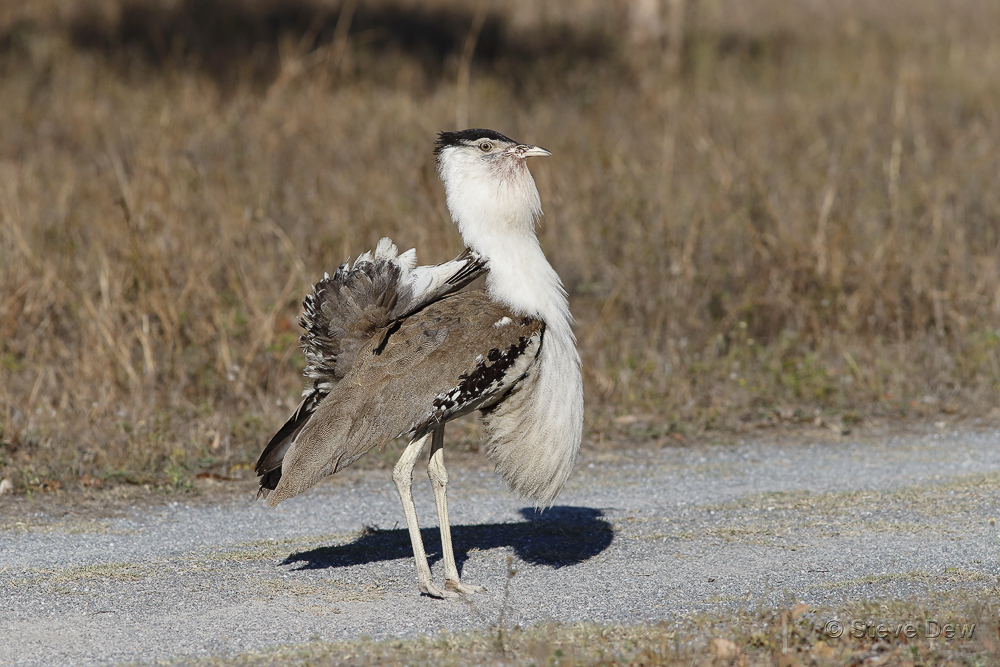
The Australian bustard (Ardeotis australis) is a large ground-dwelling bird that is common in grassland, woodland and open agricultural country across northern Australia and southern New Guinea. It stands at about one metre (3 ft 3 in) high, and its wingspan is around twice that length. The species is nomadic, flying to areas when food becomes plentiful, and capable of travelling long distances. They were once widespread and common to the open plains of Australia, but became rare in regions that have been used for farming. The bustard is omnivorous, mostly consuming the fruit or seed of plants, but also eating invertebrates such as crickets, grasshoppers, smaller mammals, birds and reptiles.
The species is also commonly referred to as the plains turkey, and in Central Australia as the bush turkey, particularly by Aboriginal people, who hunt it, although the latter name may also be used for the Australian brushturkey, as well as the orange-footed scrubfowl.
From the article Australian bustard on Wikipedia (CC BY-SA), quoted section by section
Description
The only Australian species of Ardeotis, a genus occurring in the African, Indian and Australasian regions, this bustard is a large terrestrial bird that resembles an American turkey in its form and behaviour. It is readily distinguished by its large size, long legs and habits while slowly striding across open plains. The general coloration of A. australis is black at the crown and nape, the long neck is pale grey at the front, and brown plumage cover the wings and upper body. The sexes are similar in appearance, females are smaller in stature, wingspan and weight than the males. The abdomen is white and separated from the light grey of the neck by a black band of feathers. The wing coverts are patchily coloured with black and white patterning, which is visible while at rest or especially in flight. The iris is white, and their beak is variously whitish to brown in colour. The legs are long and yellow to cream coloured. Males are up to 1.2 m (47 in) tall with a 2.3 m (7.5 ft) wingspan. The average weight for males is 6.3 kg (14 lb), with a range of 4.3 to 12.76 kg (9.5 to 28.1 lb). The female is quite a bit smaller at 80 cm (31 in) tall, with a 1.8 m (5.9 ft) wingspan and an average body mass of 3.2 kg (7.1 lb) in a range of 2.4 to 6.35 kg (5.3 to 14.0 lb) but is similarly coloured. The largest male recorded was 14.5 kg (32 lb), a specimen obtained in Victoria. …
Range & habitat
The distribution range of the species includes a wide area of the Australian continent and occasionally extends to southern parts of Papua New Guinea and Indonesia. The occurrence in the southeast of Australia has contracted and it no longer occurs in areas where it once recorded. Individual range has been studied by tracking of the birds, via satellite and tagging or community derived surveys, indicating that local populations in wetter regions are more permanent and localised than the greater range of those inhabiting more arid regions. The birds may become locally abundant after land clearing or during outbreaks of grasshoppers. The greatest fidelity to a local region is reported in areas of high rainfall in the north and northwest of Australia. The habitat favoured by the species is open grasslands, perhaps with some trees, spinifex plains and low shrublands. This bustard will enter denser areas of vegetation after fire, and is observed on artificial cleared areas such as golf courses and farmland. The historical range in Southwest Australia included the dunes and alluvial flats of the Swan Coastal Plain, as far south as Busselton, and at the interior in what became the Wheatbelt. Vagrants were seen in other areas associated with the higher rainfall forest of the southwest region, although the species avoided forest and densely vegetated areas. …
Wikipedia: “Distribution and habitat”
What it does
The species is mostly terrestrial and usually seen walking slowly alone or in pairs. When disturbed, Australian bustards often adopt a cryptic pose with neck erect and bill pointed skywards. They may stalk gradually away or run if alarmed, taking flight as a last resort. When leaving the ground they take to the air with heavy beats of the wings. A brooding female will crouch and move away if disturbed, flightless juveniles will remain still and rely on the camouflage of their plumage to evade detection. Despite the apparent labour in flying, they have strength and stamina that allows them to travel long distances. The roost is at a high point on an open plain or in trees when they are available. Greater numbers of the bird are seen during the breeding season. The habits of the bird are usually discreet and shy of disturbance, however, the display of males during the breeding season is a conspicuous performance that is accompanied by loud booming. …
Wikipedia: “Behaviour”
Listen
Looking for field recordings…
Where it lives
Recorded sightings
—
geo-referenced records in GBIF, from museums, herbaria and field observers.
Drag the globe to turn it. Dots are where records exist, not a range map; darker means more records.
In the stacks
Searching the stacks…
Every page naming Ardeotis australis in the Biodiversity Heritage Library →
This page is assembled live from iNaturalist, GBIF, Wikipedia, the Source Library and the Internet Archive. It is not yet part of the hand-edited codex. iNaturalist taxon 108.