- Animals
- ›Chordates
- ›Vertebrates
- ›Ray-finned Fishes
- ›Smelts and Allies
- ›Northern Hemisphere Smelts
- ›Smelts
- ›Osmerus
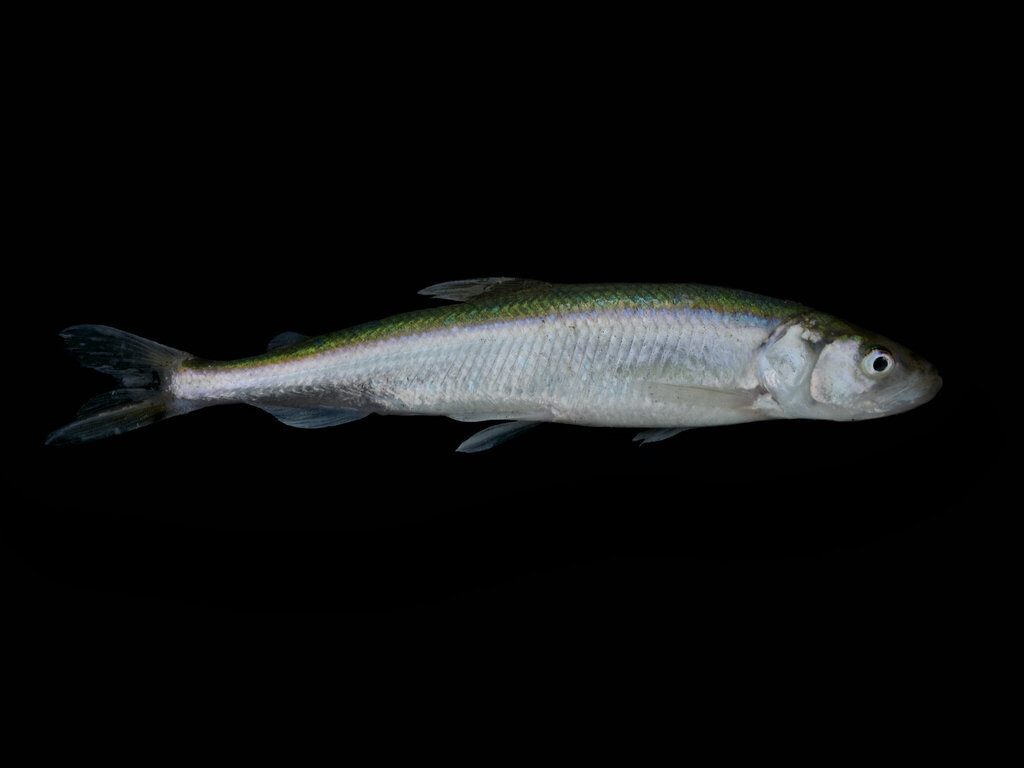
European Smelt
Osmerus eperlanus
The smelt, cucumber smelt, or European smelt (Osmerus eperlanus) is a small species of fish in the family Osmeridae, native to coastal areas in Western Europe. They are a regional specialty in some countries, and are also known as sparling within Scotland.
From the article European smelt on Wikipedia (CC BY-SA), quoted section by section
Description
The body of the European smelt is long and slim with a pointed head, with the dorsal fin behind the pectoral fin. The back of the fish is olive green, and the underside is white. The smelt has a distinctive silver stripe on its flanks. Its length is typically around 13 cm (5.1 in) when it first reaches maturity, and its average length is approximately 16.5 cm (6.5 in). The largest individuals can reach up to 45 cm (17.7 in) in length. They have a distinctive smell, reminiscent of cucumber.
Range & habitat
The European smelt inhabits the western coasts of Europe, including the Baltic Sea, living in large lakes and estuaries in various Nordic countries but can be found as far south as the north-west of Spain. Smelt survive best in pelagic areas of oligotrophic lakes, but can inhabit much more polluted habitats, such as the lower Elbe river, and are tolerant of a wide salinity range. Within Scotland, they are found only within the rivers Cree, Forth, and Tay, but were previously recorded in 15 Scottish rivers. In the Volga River basin, the European smelt is considered a "northern" invasive species that entered the reservoir system from Lake Beloye. However, due to long-term climate warming and changing thermal dynamics, its population has significantly declined, and its range is currently regressing. In the local food web, it has been largely replaced by the invasive Black and Caspian Sea sprat (Clupeonella cultriventris).
Wikipedia: “Distribution and habitat”
What it does
European smelt are opportunistic hunters that feed on copepods and cladocerans. As the fish grow, they change their diet from small zooplankton to larger crustaceans, and in rare cases will eat other fish, sometimes of their own species. They also consume the young of vendace.
Wikipedia: “Diet”
At the table
Smelt is an important food fish in many European countries, as the bones do not need to be removed during preparation due to their softness; the fish can simply be cooked and eaten whole, and the head does not need to be removed. The fish is typically fried in margarine or butter, and it is considered a regional delicacy in parts of Germany and Russia, along with parts of eastern Europe. Sometimes the smelt is soaked in milk and rolled in flour before frying. Deep-frying is also another common cooking method, although smelt is sometimes also boiled, smoked, pickled, or prepared au gratin. The fish is typically served with lemon, parsley, and potatoes. In northern Germany, the fish is coated in rye flour and then fried in butter and bacon. It is served with fried potatoes, potato salad, and applesauce. A traditional dish in Sweden is slompannkaka or 'smelt pancake', particularly in the provinces of Värmland and Södermanland. This may be an actual pancake using the fried fish and batter, or in other cases it may just be fish filling up the frying pan, sometimes with an added egg custard.
Wikipedia: “Regional culinary aspects”
Where it lives
Recorded sightings
—
geo-referenced records in GBIF, from museums, herbaria and field observers.
Drag the globe to turn it. Dots are where records exist, not a range map; darker means more records.
In the stacks
Searching the stacks…
Every page naming Osmerus eperlanus in the Biodiversity Heritage Library →
This page is assembled live from iNaturalist, GBIF, Wikipedia, the Source Library and the Internet Archive. It is not yet part of the hand-edited codex. iNaturalist taxon 108016.