- Animals
- ›Chordates
- ›Vertebrates
- ›Cartilaginous Fishes
- ›Sharks and Rays
- ›Sharks
- ›Squalean Sharks
- ›Squaliform Sharks
- ›Rough Sharks
- ›Oxynotus
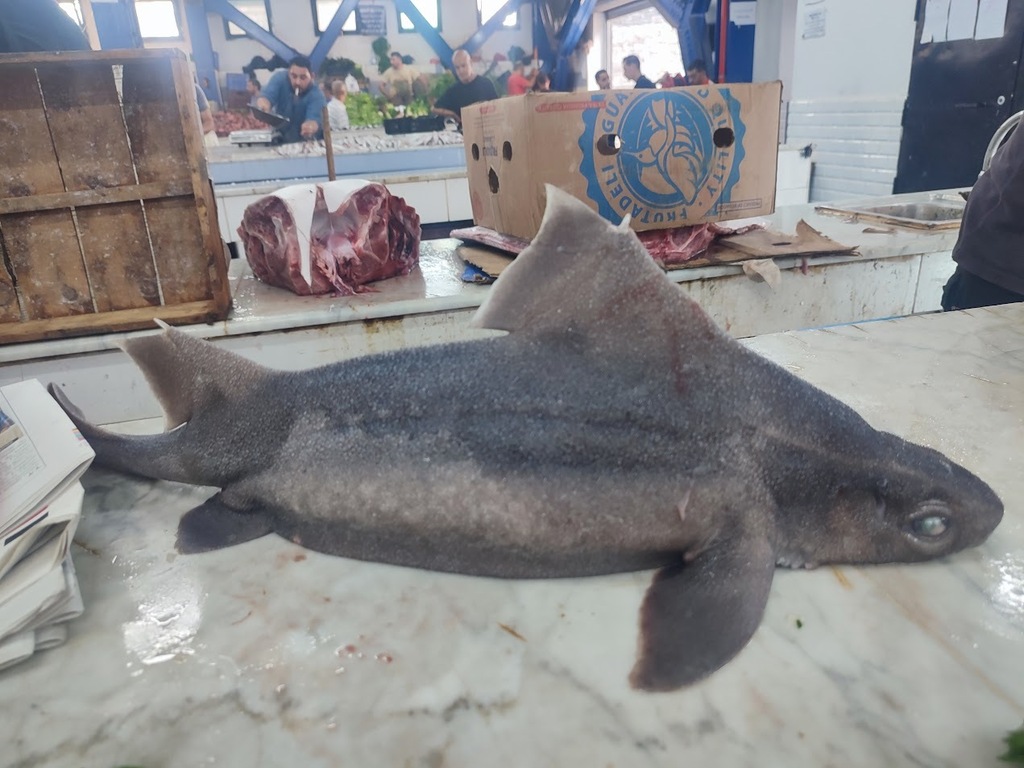
Angular Roughshark
Oxynotus centrina
The angular roughshark (Oxynotus centrina) is a rough shark of the family Oxynotidae.
From the article Angular roughshark on Wikipedia (CC BY-SA), quoted section by section
Description
At birth, they are less than 25 cm (9.8 in) and they mature at about 50 cm (20 in). Most records are of individuals less than 1 m (3.3 ft), but they can reach about 1.5 m (4.9 ft). Individuals from the Mediterranean Sea usually measure less than 80 cm (2.6 ft). Their litter size is seven or eight pups off Angola to 23 in the Mediterranean. They have ridges over their eyes that expand into large, rounded knobs, which are covered with enlarged denticles – these are absent in other species of rough sharks. They possess very large spiracles that are vertically elongated, being almost as high as the length of their eyes. Their first dorsal spine is oriented slightly forward. They feed on worms, crustaceans, and mollusks. Oxynotus centrina has a compressed body, triangular in cross section, with a broad and flattened head. The snout is flat and blunt. Just like all of the Oxynotus species, they have two relatively large dorsal fins that are sail-like, and no anal fin. It has very rough skin and is typically a uniform black to dark grey-brown. Adults generally display darker coloration, often featuring darker blotches on the head and sides, though these blotches can sometimes be indistinct. One identifying feature is the light horizontal line below the eyes on the cheek. …
Range & habitat
Oxynotus centrina is a bathydemersal shark typically found on the outer continental shelves and upper slopes of the eastern Atlantic, ranging from Norway to South Africa and throughout the entire Mediterranean, with additional occurrences reported off the coast of Mozambique. It prefers coralline algal and muddy bottoms at depths of 50 to 660 m (160 to 2,170 ft), primarily inhabiting areas below 100 m (330 ft), though they have been recorded at depths of up to 1,300 m (4,300 ft). Studies of these sharks in the Mediterranean indicate they prefer to occupy depths of 60 to 600 m (200 to 1,970 ft).
Wikipedia: “Range and habitat”
What it does
Male and female angular roughsharks are reported to mature at about 50–70 cm. Although, some studies have shown that females mature at a slightly larger size than males. Being an ovoviviparous species, O. centrina produces 10–12 pups usually between 21 and 24 cm in length.
Wikipedia: “Reproduction”
Where it lives
Recorded sightings
—
geo-referenced records in GBIF, from museums, herbaria and field observers.
Drag the globe to turn it. Dots are where records exist, not a range map; darker means more records.
In the old herbals & bestiaries

In the stacks
Searching the stacks…
Every page naming Oxynotus centrina in the Biodiversity Heritage Library →
This page is assembled live from iNaturalist, GBIF, Wikipedia, the Source Library and the Internet Archive. It is not yet part of the hand-edited codex. iNaturalist taxon 108112.