- Animals
- ›Chordates
- ›Vertebrates
- ›Ray-finned Fishes
- ›Carps, Characins, Catfishes and Allies
- ›Catfishes
- ›Siluroidei
- ›Schilbid Catfishes
- ›Parailia
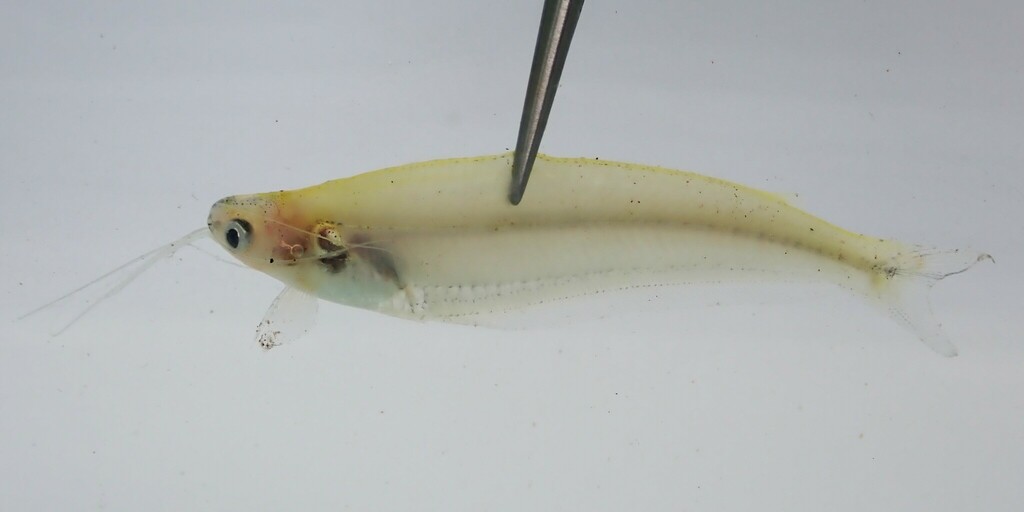
Glass schilbid
Parailia pellucida
Parailia pellucida, the African glass catfish, is a small, transparent species of catfish that is generally found in the lakes and rivers of West Africa. Though it closely resembles the Asian glass catfish (Kryptopterus vitreolus), with the difference of a dark line running along its length and a typically cloudier body, they are not related and belong to different families. The glass-like body in both species just shows an example of convergent evolution. The African glass catfish comes from the Schilbeidae family, the genus Parailia (formerly referred to as Physailia) and the species pellucida. The African glass catfish typically feeds on small insects and crustaceans, spending its feeding time near the surface. This species is known to be a schooling fish, both in the wild and in the aquarium hobby. Other than its use in the aquarium trade, it also serves as food despite its small size, as well as playing a role in various research. The African glass catfish, due to being one of the smaller catfish species, is prey to other larger fish, one commonly known species being the African electric catfish.
From the article Parailia pellucida on Wikipedia (CC BY-SA), quoted section by section
Range & habitat
The African glass catfish is a freshwater fish found primarily inland in deep lakes, rivers, and deltas found in West Africa. The geographic distribution of where they reside span the bodies of water of Nigeria, Ivory Coast, and Mali. Some of the known places include the Lower Nun River, the Niger Delta, Lake Kainji, Ikpa River, Lake Sélingué, the Dadin Kowa Dam reservoir, Oramiriukwa River, the Upper Jebba Reservoir, the Aby Lagoon, and the Aghien Lagoon. The tropical climate, where this species is found, consists of both rainy and dry seasons, with many of the habitats of the African glass catfish being freshwater swamps and swamp rubber forests. Other habitats, like the Aghien Lagoon, where the African glass catfish is found in high percentages (>50%), are fed by rivers and are rich in various flora and fauna. Man made reservoirs, like the Kainji reservoir, in which the African glass catfish is the second most common family, are described as shallow and rocky. These reservoirs also contain heavy sediment that gets upset due to often flooding from rainfall and overflowing rivers. Whereas, in the Dadin Kowa Reservoir, the Schilbeidae family (including P. pellucida), only makes up 16.06% of the fish population. …
Wikipedia: “Distribution”
In human culture
Though different environmental conditions can affect the growth rate, size, and reproduction of the African glass catfish, there are still general observations that can be noted. The African glass catfish shows a rapid early growth rate, with the catfish growing quickly early on in its life and slowing down as it gets older. Females tend to grow faster than males early on and have a higher maximum size, but males end up reaching sexual maturity quicker. In the winter, the growth of the catfish tends to slow. Negative allometric growth can be seen in both males and females, with the body becoming thinner as the fish gets older. The typical age of the African glass catfish tends to lie between 3 and 5 years, with females seemingly having shorter life spans. The method that was used to determine the lifespan of the fish was the length-frequency method. In this method, the fish length was measured, transformed into a length frequency plot, representing a steady state population. Then the polymodal length frequency plot was analyzed and a growth curve was fitted to obtain the mean length that correlated with the age on the time axis. The age of spawning for the catfish was estimated to be within the first year of its life, with the average length during spawning being around 2.6 cm. …
Wikipedia: “Life history”
Where it lives
Recorded sightings
—
geo-referenced records in GBIF, from museums, herbaria and field observers.
Drag the globe to turn it. Dots are where records exist, not a range map; darker means more records.
In the stacks
Searching the stacks…
Every page naming Parailia pellucida in the Biodiversity Heritage Library →
This page is assembled live from iNaturalist, GBIF, Wikipedia, the Source Library and the Internet Archive. It is not yet part of the hand-edited codex. iNaturalist taxon 108525.