- Animals
- ›Chordates
- ›Vertebrates
- ›Ray-finned Fishes
- ›Spiny-rayed fishes
- ›Perches, Scorpionfishes, Sticklebacks, and Allies
- ›Perches, groupers and allies
- ›Perches, Darters, and allies
- ›Darters
- ›Percina
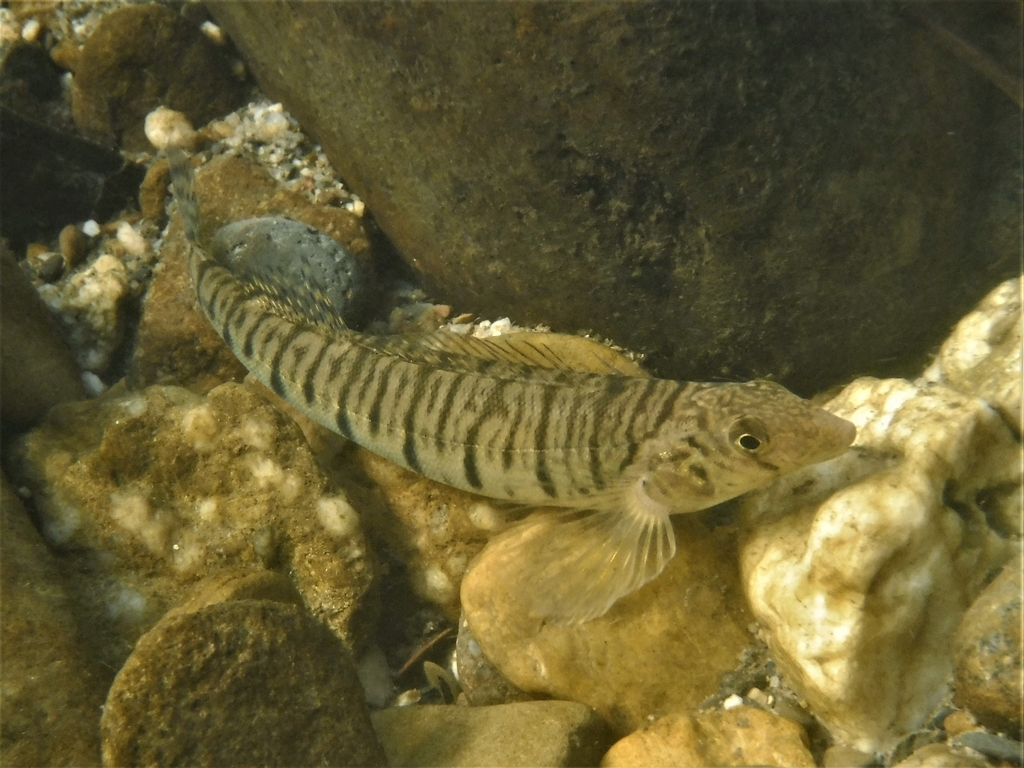
Conasauga Logperch
Percina jenkinsi
The Conasauga logperch (Percina jenkinsi) is a species of freshwater ray-finned fish, a darter from the subfamily Etheostomatinae, part of the family Percidae, which also contains the perches, ruffes and pikeperches. It is endemic to the United States. It is one of 184 species of darters in North America. It has been listed as endangered throughout its range with critical habitat under the U.S. Endangered Species Act since August 5, 1985.
From the article Conasauga logperch on Wikipedia (CC BY-SA), quoted section by section
Description
This is a slender fish with a maximum length of 4.6 inches (12 cm). They are characterized by the presence of a conical, "pig-like" snout and "tiger-stripe" pattern of numerous dark, vertical bars on a yellowish background. The curious snout development is an apparent adaptation to stone-flipping behavior, in which the snout is used to flip over rocks during feeding. Unlike many other darter species, logperches show little sexual dimorphism in coloration.
Wikipedia: “Anatomy and appearance”
Range & habitat
The Conasauga logperch is currently known only from an 11-mile reach of the Conasauga River, a Coosa River tributary in northern Georgia and south-central Tennessee. Thompson (1985) hypothesized jenkinsi to be derived from Percina caprodes, which entered the Conasauga system from the adjacent Hiwassee system of the Tennessee drainage. Specifically, it exists in the Conasauga River from the confluence of Half-way Branch with the Conasauga River in Polk County, Tennessee, downstream approximately 11 miles through Bradley County, Tennessee, to the Georgia State Highway 2 bridge in Murray County, Georgia.
Wikipedia: “Geographic distribution”
What it does
Logperch feed on a variety of invertebrates. This species feeds on aquatic invertebrates found under stones. It is known to flip over substrate and prey on disturbed invertebrates. The procedure of flipping substrate makes available to them a wide range of organisms including larvae of midges, mayflies, caddisflies, riffle beetles, stoneflies, limpets, and fish eggs. Young feed on microcrustaceans. It is most likely that introduced rainbow trout (Oncorhynchus mykiss) and brown trout (Salmo trutta) are the main predators for this species. Sexual maturity is reached after one year and spawning occurs in spring, in fast riffles over gravel substrate. The fish has a maximum life span of at least four years. Logperch are in a clade of darters that exhibit little ecological variation among species. Males are nonterritorial and several may follow a single female until breeding takes place. The parents bury the fertilized eggs in the substrate. Exposed eggs are usually eaten by other males. Eggs are adhesive and demersal (heavier than water) thus allowing them to remain in the substrate. Hatching requires 200 hours. Clutch size is not documented and varies greatly in the genus Percina; fecundity of Percina caprodes females is high, ranging from 1,000 to 3,000 ova per year, while Percina evides females have been observed with a fecundity of only about 130 to 400 ova per year.
Wikipedia: “Ecology”
In human culture
The Conasauga logperch was first formally described in 1985 by the American ichthyologist Dr. Bruce A. Thompson (1946–2007) and its specific name honors Thompson's fellow ichthyologist Robert E. Jenkins of Roanoke College.
Wikipedia: “Etymology”
Where it lives
Recorded sightings
—
geo-referenced records in GBIF, from museums, herbaria and field observers.
Drag the globe to turn it. Dots are where records exist, not a range map; darker means more records.
In the stacks
Searching the stacks…
Every page naming Percina jenkinsi in the Biodiversity Heritage Library →
This page is assembled live from iNaturalist, GBIF, Wikipedia, the Source Library and the Internet Archive. It is not yet part of the hand-edited codex. iNaturalist taxon 109083.