- Animals
- ›Chordates
- ›Vertebrates
- ›Ray-finned Fishes
- ›Spiny-rayed fishes
- ›Perches, Scorpionfishes, Sticklebacks, and Allies
- ›Perches, groupers and allies
- ›Perches, Darters, and allies
- ›Darters
- ›Percina
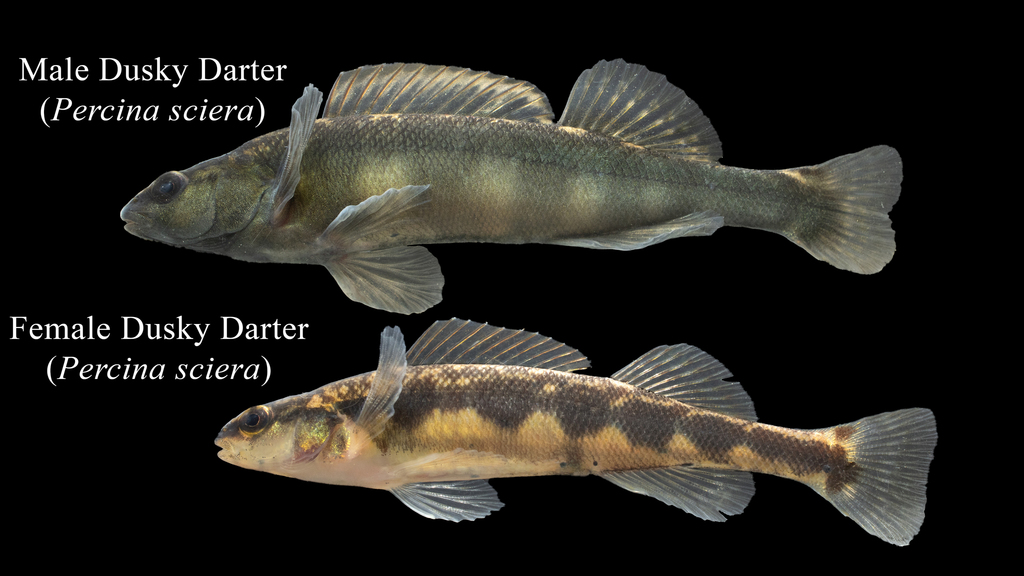
Dusky Darter
Percina sciera
The dusky darter (Percina sciera) is a species of freshwater ray-finned fish, a darter from the subfamily Etheostomatinae, part of the family Percidae, which also contains the perches, ruffes and pikeperches. It is found in, but not confined to, both large and small rivers, and shallow creeks (1–3rd order), in the eastern, southern, and southeastern United States, particularly the Mississippi River drainage system.
Percina are benthic and benthic-associated fishes. Percina sciera belongs to the family Percidae, which along with Etheostomatinae comprise approximately 20-percent of the recognized diversity in North American freshwater fish. Land development may threaten P. sciera habitat. Percina prefer low water velocity in riffle/pool transition areas primarily on top of woody debris in a sandy/boulder substrate.
From the article Dusky darter on Wikipedia (CC BY-SA), quoted section by section
Range & habitat
Percina sciera is considered both a wide-ranging and geographically restricted species that inhabits a variety of freshwater habitats including creeks, streams, rivers as well as lakes and reservoirs in the Mississippi River drainage. P. sciera is found in the eastern United States in areas ranging from the Tennessee Tombigbee waterway, to the unglaciated Allegheny Plateau section of Southern Ohio, to the second and fourth order streams within the Pine Hills of the Mississippi coastal plain. P. sciera has also been studied and monitored in lower Tallahala Creek near its confluence with the Leaf River, which is within the Pascagoula River drainage. Sympatric darter species, including P. sciera, segregate along several resource axes in the Appalachians such as the Elk River, West Virginia, one of several "islands" of fish diversity in the Eastern Highlands of the Mississippi River drainage system.
Wikipedia: “Geographic distribution”
What it does
All species of Percina are carnivorous, most species feeding on aquatic insect larvae such as chironomids (midges), black flies, ephemeropterans (mayflies), and hydropsychids (caddisflies). In the first few days of feeding, the larval form, referred to as the first-feeding stage, has slow growth due to poorly developed digestive systems, poor nutrient uptake, and lack of predator skills. Small (<.3mm) cladocerans such as Ceriodaphnia and Bosmina are a suitable food source for first-feeding dusky darters, although the quick, erratic movement of calanoid copepods and their long antennae limit the ingestion of first-feeding P. sciera. In laboratory settings, researchers found the dominant prey item for larval P. sciera was Ceriodaphnia; as many as 20 specimens were found in one larval darter. The maximum diameter of prey ingested by larvae was 0.27 to 0.37 mm, which is 70 to 90-percent of the P. sciera larval gape width. Gut contents of adult P. sciera indicate diets of small, benthic, macroinvertebrates, typically less than five millimeters in length. Compared with other competing species, P. sciera eats more but smaller prey to maintain its metabolism. In the Pascagoula River drainage, P. sciera consume more than three times the volume of small and medium-sized baetid nymphs and small simuliid larvae than similar species such as P. …
Wikipedia: “Diet”
In human culture
The spawning habits of P. sciera have been studied and propagated in a laboratory setting. P. sciera were reared from eggs to first spawn sexual maturity in a one-year period. At age one, P. sciera males averaged a total length of 94mm and weighed 7.5 grams, while females averaged 83mm and weighed 4.9g. Age one fish can spawn with the same success as two-year-old fish. P. sciera spawn over fine gravel (1–5mm in diameter) during a photothermal day length of 13-hours and water temperatures approaching 19 °C. Breeding females carry as many as 184 eggs ranging in diameter from 1.65-1.78mm. In one laboratory experiment, 6,372 eggs yielded only 720 Percina sciera larvae. Some darters in the family Percidae have been collected at ages up to four years.
Wikipedia: “Life history”
Where it lives
Recorded sightings
—
geo-referenced records in GBIF, from museums, herbaria and field observers.
Drag the globe to turn it. Dots are where records exist, not a range map; darker means more records.
In the stacks
Searching the stacks…
Every page naming Percina sciera in the Biodiversity Heritage Library →
This page is assembled live from iNaturalist, GBIF, Wikipedia, the Source Library and the Internet Archive. It is not yet part of the hand-edited codex. iNaturalist taxon 109101.