- Animals
- ›Chordates
- ›Vertebrates
- ›Birds
- ›Perching Birds
- ›Ovenbirds and Woodcreepers
- ›Typical Ovenbirds
- ›Synallaxis
On eBird ↗
Spix's Spinetail
Live sightings near you, the range map, bar charts of when it is seen, and Macaulay Library photos and recordings.
Spix's Spinetail
Synallaxis spixi
Spix's spinetail (Synallaxis spixi), also known as the Chicli spinetail, is a bird in the ovenbird family. It is found in Brazil, Argentina and Uruguay. The common name commemorates the German naturalist Johann Baptist von Spix (1782-1826).
From the article Spix's spinetail on Wikipedia (CC BY-SA), quoted section by section
Description
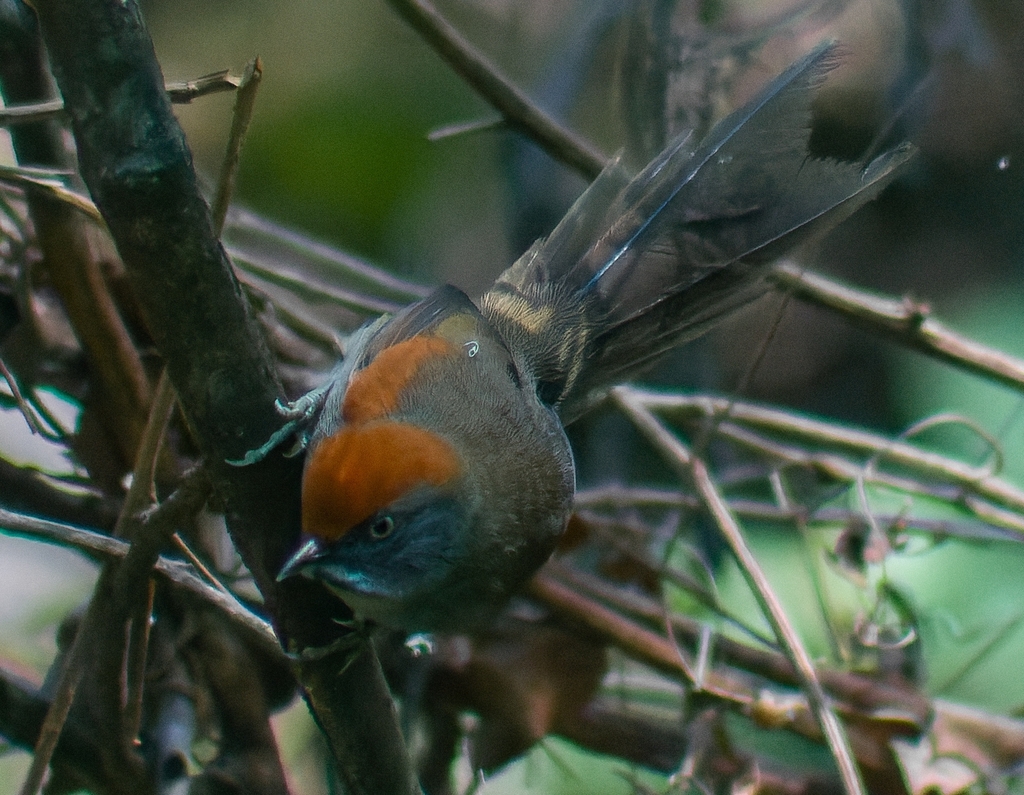
Spix's spinetail is 16 to 17 cm (6.3 to 6.7 in) long and weighs about 12 to 15 g (0.42 to 0.53 oz). The sexes have the same plumage. Adults have a pale gray supercilium on an otherwise grayish brown face. Their crown is rufous and their back, rump and uppertail coverts dark brown. Their lesser wing coverts are rufous, their median and greater wing coverts dark brown with wide rufous edges, and their flight feathers dark brown. Their tail is dark brown; it is graduated and the central feathers have pointed tips. Their throat is grayish white; the lower throat feathers are black with grayish edges. Their breast is brownish gray, their belly a paler brownish gray, and their flanks and undertail coverts browner. Their iris is reddish brown to pale orange, their maxilla black, their mandible gray, and their legs and feet gray to greenish gray. Juveniles have a grayish brown crown, ochraceous brown underparts, and a less distinct throat patch than the nominate.
Range & habitat
Spix's spinetail is found from Minas Gerais and Espírito Santo in southeastern Brazil south through eastern Paraguay and essentially all of Uruguay into Argentina as far as Buenos Aires Province. It inhabits a wide variety of landscapes in the Atlantic Forest biome, where it tends to stay low in dense undergrowth. Examples include fields and pastures, gallery forest, campo rupestres, restinga, savanna, and brushy second growth. In elevation it ranges from near sea level to 2,200 m (7,200 ft) though in Brazil its maximum is 2,050 m (6,700 ft).
Wikipedia: “Distribution and habitat”
What it does
The diet of Spix's spinetail is not known in detail but includes insects. It typically forages in pairs, usually in the understorey and sometimes on the ground. It usually stays within about 5 m (16 ft) of the ground but has been observed feeding significantly higher.
Wikipedia: “Feeding”
Listen
Looking for field recordings…
Where it lives
Recorded sightings
—
geo-referenced records in GBIF, from museums, herbaria and field observers.
Drag the globe to turn it. Dots are where records exist, not a range map; darker means more records.
In the stacks
Searching the stacks…
Every page naming Synallaxis spixi in the Biodiversity Heritage Library →
This page is assembled live from iNaturalist, GBIF, Wikipedia, the Source Library and the Internet Archive. It is not yet part of the hand-edited codex. iNaturalist taxon 10915.