- Animals
- ›Chordates
- ›Vertebrates
- ›Birds
- ›Perching Birds
- ›Ovenbirds and Woodcreepers
- ›Typical Ovenbirds
- ›Synallaxis
On eBird ↗
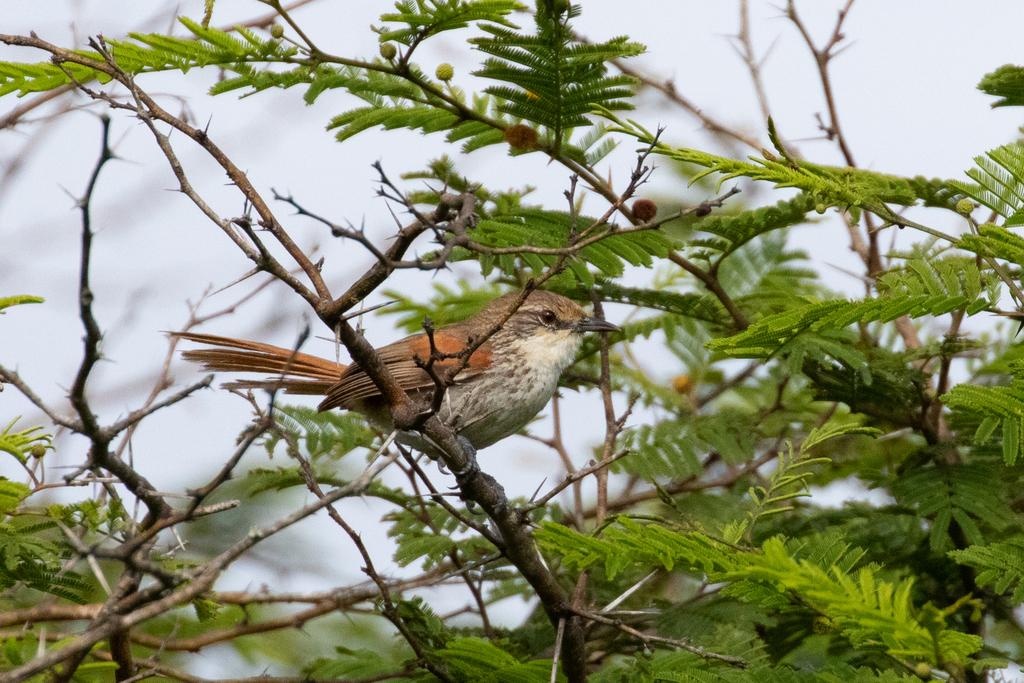
Necklaced Spinetail
Live sightings near you, the range map, bar charts of when it is seen, and Macaulay Library photos and recordings.
Necklaced Spinetail
Synallaxis stictothorax
The necklaced spinetail (Synallaxis stictothorax) is a species of ovenbird in the family Furnariidae. Found in Ecuador and Peru, its natural habitat is subtropical or tropical dry shrubland.
From the article Necklaced spinetail on Wikipedia (CC BY-SA), quoted section by section
Description
The necklaced spinetail is 11 to 13 cm (4.3 to 5.1 in) long and weighs 10 to 14 g (0.35 to 0.49 oz). It is one of the smallest members of genus Synallaxis. The sexes have the same plumage. Adults of the nominate subspecies have a white supercilium on an otherwise blackish face with faint whitish streaks. Their forecrown has black and white streaks. The rest of their crown is dull grayish brown, their back slightly browner, their rump rufescent-brown, and their uppertail coverts bright rufous. The wing has whitish at the bend; the coverts and secondaries are rufous and the primaries dusky. Their tail is bright rufous but for the dark brownish central pair of feathers. Their throat is white, their breast buffy white with fine black streaks, their belly whitish, and their flanks and undertail coverts tawny. Their iris is brown to reddish brown or brownish red, their bill black (sometimes with much gray on the mandible), and their legs and feet blue-gray to dark gray. The juvenile plumage has not been described. Subspecies S. s. maculata has a slightly more rufescent back and more rufous on the wing than the nominate. Its tail is rufous except for a small amount of dusky on the innermost pair of feathers.
Range & habitat
The necklaced spinetail has a disjunct distribution. The nominate subspecies is found in southwestern Ecuador from central Manabí Province south to western Guayas Province and Puná Island. Subspecies S. s. maculata is found from southern Loja Province in extreme southwestern Ecuador into northwestern Peru as far south as the Department of La Libertad. The species inhabits arid scrublands and the edges of deciduous forest. In elevation it occurs from near sea level to 300 m (1,000 ft) in Ecuador and 400 m (1,300 ft) in Peru.
Wikipedia: “Distribution and habitat”
What it does
The necklaced spinetail feeds on arthropods. It is more arboreal, rather bolder, more easily observed, and more acrobatic when feeding than most other members of genus Synallaxis. It typically forages in pairs, often as part of a mixed-species feeding flock. It gleans its prey from moss, live and dead leaves, and small branches, usually within about 1 or 2 m (3 or 7 ft) of the ground.
Wikipedia: “Feeding”
Listen
Looking for field recordings…
Where it lives
Recorded sightings
—
geo-referenced records in GBIF, from museums, herbaria and field observers.
Drag the globe to turn it. Dots are where records exist, not a range map; darker means more records.
In the stacks
Searching the stacks…
Every page naming Synallaxis stictothorax in the Biodiversity Heritage Library →
This page is assembled live from iNaturalist, GBIF, Wikipedia, the Source Library and the Internet Archive. It is not yet part of the hand-edited codex. iNaturalist taxon 10923.