- Animals
- ›Chordates
- ›Vertebrates
- ›Ray-finned Fishes
- ›Spiny-rayed fishes
- ›Perches, Scorpionfishes, Sticklebacks, and Allies
- ›Perches, groupers and allies
- ›Groupers
- ›Plectropomus
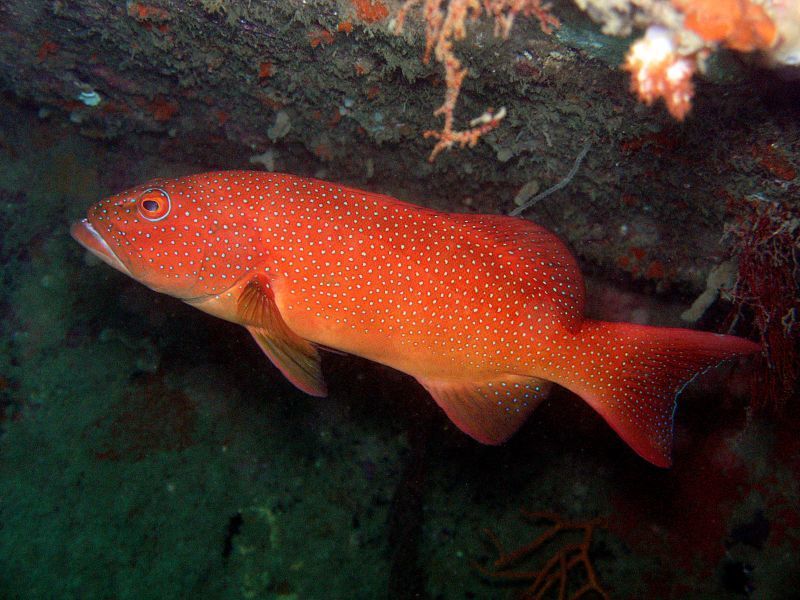
Leopard Coralgrouper
Plectropomus leopardus
The leopard coral grouper (Plectropomus leopardus), also known as the common coral trout, leopard coral trout, blue-dotted coral grouper or spotted coral grouper, is a species of marine ray-finned fish, a grouper from the family Epinephelidae. It is found in the Western Pacific Ocean.
Coral trout are the favourite target fish for all sectors of the fishery because they are a good food fish and command high market prices locally and overseas. The total commercial catch of coral trout was reported at over 1500 tonnes in 1998.
From the article Leopard coral grouper on Wikipedia (CC BY-SA), quoted section by section
Description
The leopard coral grouper has a body which is elongate and robust, with the standard length being 2.9 to 3.9 times the depth of the body. The preopercle is mostly rounded, with three large, downward pointing spines along the bottom half. The dorsal fin contains 7–8 spines and 10–12 soft rays while the anal fin contains 3 spines and 8 soft rays. The spiny part of the dorsal fin has a shorter base than the soft-rayed part. The caudal fin is a emarginate. The background colour is olive green to reddish brown or orange-red and its upper body is covered in regularly-spaced bright blue spots and there is a blue ring around the eye, this may be broken up. They are able to quickly change colour, and frequently take on a mottled pattern as they hunt. This species attains a total length of 120 centimetres (47 in), although they are commonly around 35 centimetres (14 in), and a maximum published weight of 23.6 kilograms (52 lb). although this is probably incorrect (and likely to be for P. leavis) as the Australian Spearfishing record for P. leopardus is 10.250 kilograms (22.60 lb).
Range & habitat
The leopard coral grouper is found in the western Pacific where it is distributed from southern Japan to Australia and from the east coast of Thailand and Malaysia east to the Solomon Islands, Caroline Islands and Fiji. In Australia it is found at Beacon Island in Western Australia, the Ashmore and Cartier Islands in the Timor Sea, around the tropical northcoast as far south as Sydney. This range includes reefs in the Coral Sea, Christmas Island, Cocos (Keeling) Islands and around Lord Howe Island in the Tasman Sea.
Wikipedia: “Distribution”
What it does
A project called the "Effects of Line Fishing" project studied populations to assess the size and age structures during reproduction of leopard coral grouper stocks to ascertain how fish stocks respond to various levels of fishing pressure. They are protogynous hermaphrodites, starting their lives as females, and change sex later in life. The trigger of this sex change is unknown. On average, sex change occurs when fish are between 23 and 62 cm (9.1 and 24.4 in) in length; the average length at sex change is 42 cm (17 in). This is believed to happen most frequently in the months immediately following spawning. The ELF research has determined that the sex ratio differs in different areas of the Great Barrier Reef, and may differ between reefs opened and protected from fishing. Sex ratios are an important consideration for management, as changes could seriously affect reproduction, thus the number of juveniles coming into the fishery in future years. All length classes of fish may have both male and female individuals. However, small fish are generally females, while most large fish are males. spawning corresponds to an increase in water temperature (from 25.0 to 26.5 °C or 77.0 to 79.7 °F) during late spring. …
Wikipedia: “Reproduction”
Where it lives
Recorded sightings
—
geo-referenced records in GBIF, from museums, herbaria and field observers.
Drag the globe to turn it. Dots are where records exist, not a range map; darker means more records.
In the stacks
Searching the stacks…
Every page naming Plectropomus leopardus in the Biodiversity Heritage Library →
This page is assembled live from iNaturalist, GBIF, Wikipedia, the Source Library and the Internet Archive. It is not yet part of the hand-edited codex. iNaturalist taxon 109743.