- Animals
- ›Chordates
- ›Vertebrates
- ›Cartilaginous Fishes
- ›Sharks and Rays
- ›Rays
- ›Stingrays
- ›Giant Stingarees
- ›Plesiobatis
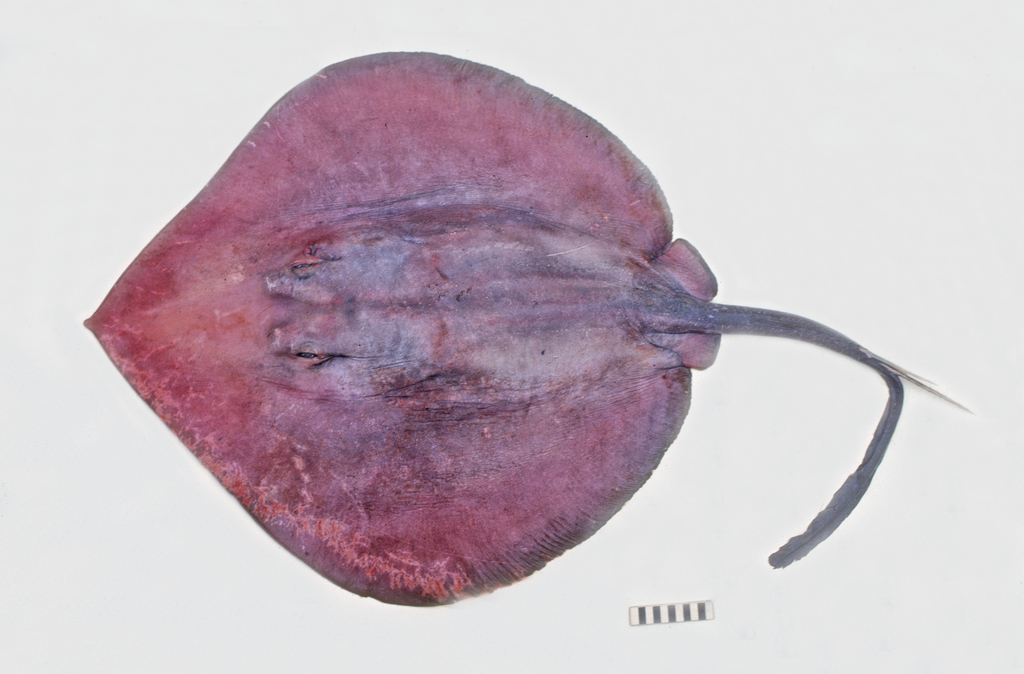
Giant Stingaree
Plesiobatis daviesi
The deepwater stingray or giant stingaree (Plesiobatis daviesi) is a species of stingray and the sole member of the family Plesiobatidae. It is widely distributed in the Indo-Pacific, typically over fine sediments on the upper continental slope at depths of 275–680 m (900–2,230 ft). This species reaches 2.7 m (8.9 ft) in length and 1.5 m (4.9 ft) in width. It has an oval pectoral fin disc with a long, flexible, broad-angled snout. Most of the entire latter half of its tail supports a distinctively long, slender, leaf-shaped caudal fin. Its coloration is dark above and white below, and its skin is almost completely covered by tiny dermal denticles.
Preying on crustaceans, cephalopods, and bony fishes, the deepwater stingray may hunt both on the sea floor and well above it in open water. It is likely aplacental viviparous, with the mother supplying her gestating young with histotroph ("uterine milk"). Captured rays merit caution due to their long, venomous stingers. This species is taken by deepwater commercial fisheries, but in numbers too small to significantly threaten its population. Therefore, the International Union for Conservation of Nature has assessed it as Least Concern.
From the article Deepwater stingray on Wikipedia (CC BY-SA), quoted section by section
Description
The deepwater stingray has a flabby body, with enlarged pectoral fins forming a disc usually longer than it is wide. The leading margins of the disc converge at a broad angle. The snout is thin and measures over six times as long as the diameter of the orbit; the snout tip protrudes slightly from the disc. The small eyes are positioned just ahead of the spiracles, which have angular posterior rims. The large, circular nostrils are placed close to the mouth, to which they are connected by a pair of broad grooves. Between the nostrils is a broad curtain of skin with a strongly fringed posterior margin. The wide, straight mouth contains 32–60 tooth rows in either jaw, increasing in number with age. Each tooth is small with a low, blunt cusp; in adult males the teeth at the center are sharp and backward-pointing. The five pairs of gill slits are small and placed beneath the disc. The pelvic fins are small and have blunt outer corners. The moderately thick tail measures 93–102% as long as the disc and lacks lateral skin folds and dorsal fins. One or two serrated stinging spines are present atop the tail, just ahead of the halfway point. The slender caudal fin originates a short distance behind the sting; it is symmetrical above and below, and terminates in a rounded leaf-like shape. …
Range & habitat
Records of the deepwater stingray come from a number of locations scattered widely in the Indo-Pacific: KwaZulu-Natal in South Africa and Mozambique, the Gulf of Mannar, the northern Andaman Islands, the South China Sea, the Ryukyu Islands and the Kyushu–Palau Ridge, along the southern coastline of Australia, northwestern Australia from the Rowley Shoals to Shark Bay, northeastern Australia from Townsville to Wooli, New Caledonia, and Hawaii. This bottom-dwelling species generally inhabits the upper continental slope at depths of 275–680 m (900–2,230 ft), over muddy or silty substrates. An anomalous record from only 44 m (144 ft) deep off Mozambique was made. It seems to be locally common in tropical Australian waters, but may be rarer elsewhere.
Wikipedia: “Distribution and habitat”
What it does
The diet of the deepwater stingray consists of cephalopods, crustaceans (including penaeid prawns, crabs, and lobsters), and bony fishes (including eels). Its long, flexible snout is well-suited for rooting through sediment, while the presence of mesopelagic species in its diet suggest that it may also hunt well above the sea floor. One recorded individual was found severely gouged by kitefin sharks (Dalatias licha), which are capable of excising plugs of flesh, cookiecutter-like, from larger animals. The deepwater stingray is presumed to be similar to other stingrays in being aplacental viviparous, and having the developing embryos nourished by maternally produced histotroph ("uterine milk"). Given its large size and deepwater habits, it is probably not highly prolific, with a small litter size and a long gestation period. The young are apparently born at close to 50 cm (20 in) long, as evidenced by the capture of a free-living specimen of that size that still bore a yolk sac scar. Males and females mature sexually at 1.3–1.7 m (4.3–5.6 ft) and 1.9–2.0 m (6.2–6.6 ft) long, respectively. The maximum size, and likely also the maturation size, varies between geographic regions.
Wikipedia: “Biology and ecology”
Where it lives
Recorded sightings
—
geo-referenced records in GBIF, from museums, herbaria and field observers.
Drag the globe to turn it. Dots are where records exist, not a range map; darker means more records.
In the stacks
Searching the stacks…
Every page naming Plesiobatis daviesi in the Biodiversity Heritage Library →
This page is assembled live from iNaturalist, GBIF, Wikipedia, the Source Library and the Internet Archive. It is not yet part of the hand-edited codex. iNaturalist taxon 109761.