- Animals
- ›Chordates
- ›Vertebrates
- ›Ray-finned Fishes
- ›Spiny-rayed fishes
- ›Freshwater Sunfishes, Grunters, and Allies
- ›Freshwater Sunfishes and relatives
- ›Freshwater Sunfishes
- ›Lepominae
- ›Lepomis
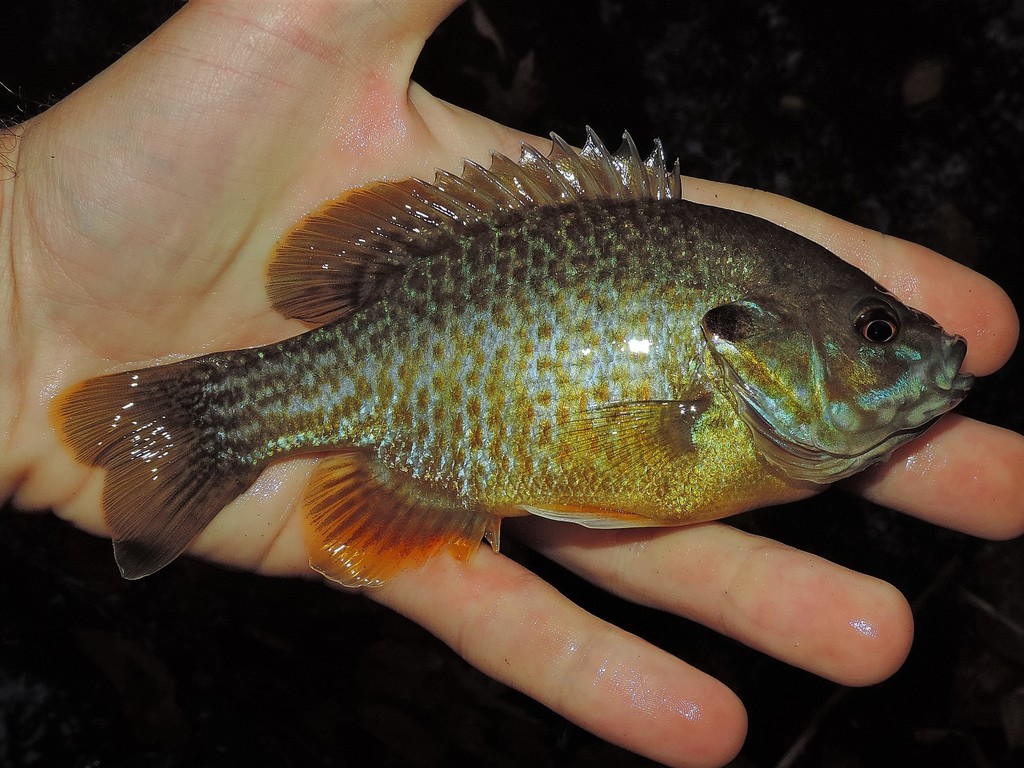
Greengill Sunfish
Lepomis macrochirus × cyanellus
The greengill sunfish (Lepomis macrochirus × cyanellus) is sometimes referred to as hybrid sunfish or bluegill x green sunfish hybrid. It is a hybrid between a bluegill (Lepomis macrochirus) and green sunfish (Lepomis cyanellus). They can sometimes be found in ponds, lakes, or streams where there is both bluegill and green sunfish. They are also stocked in some ponds as gamefish and as pets.
From the article Greengill sunfish on Wikipedia (CC BY-SA), quoted section by section
Description
While the greengill's appearance can vary from individual, they usually have certain morphological traits that are common throughout this hybrid.
Size. In aquaculture greengill can reach sizes up to 12 in (32 cm) and weigh around 2 pounds (965 grams). They can reach these sizes in captivity more regularly in part due a faster growth rate than both parent species. Though specimens found in the wild tend to be smaller, around 5 in (13 cm), though some can get to 6 in (16 cm).
Body shape. The body shape of greengill tend to be intermediate between both parent species. Though sometimes the body can be more elongate, like a green sunfish, or more deep, like a bluegill. The caudal fin, like most other lepomids, is emarginate in shape.
Coloration. Though the coloration and patterns on a greengill can vary due to its hybrid nature, they usually have a background color of blue that can resemble chain-like spots and stripes. The foreground coloration covering most of the body is usually dark green, brown, or black. The ventral side of the fish is often yellow or orange, though it can sometimes be darker. The coloration on the rim of the opercular flap is often orange or red with hints of white. There are usually thick iridescent blue streaks and blotches below the eye as well as on the jaw and operculum. The greengill will normally have a dark blotch on their soft dorsal fin. …
What it does
The greengill diet mostly consists of what the parent species ate. This includes creatures such as insects, arachnids, crayfish, and small fish. They can even be fed floating catfish pellets.
Wikipedia: “Diet”
Where it lives
Recorded sightings
—
geo-referenced records in GBIF, from museums, herbaria and field observers.
Drag the globe to turn it. Dots are where records exist, not a range map; darker means more records.
In the stacks
This page is assembled live from iNaturalist, GBIF, Wikipedia, the Source Library and the Internet Archive. It is not yet part of the hand-edited codex. iNaturalist taxon 1102243.