- Animals
- ›Chordates
- ›Vertebrates
- ›Birds
- ›Perching Birds
- ›Ovenbirds and Woodcreepers
- ›Woodcreepers
- ›Xiphorhynchus
On eBird ↗
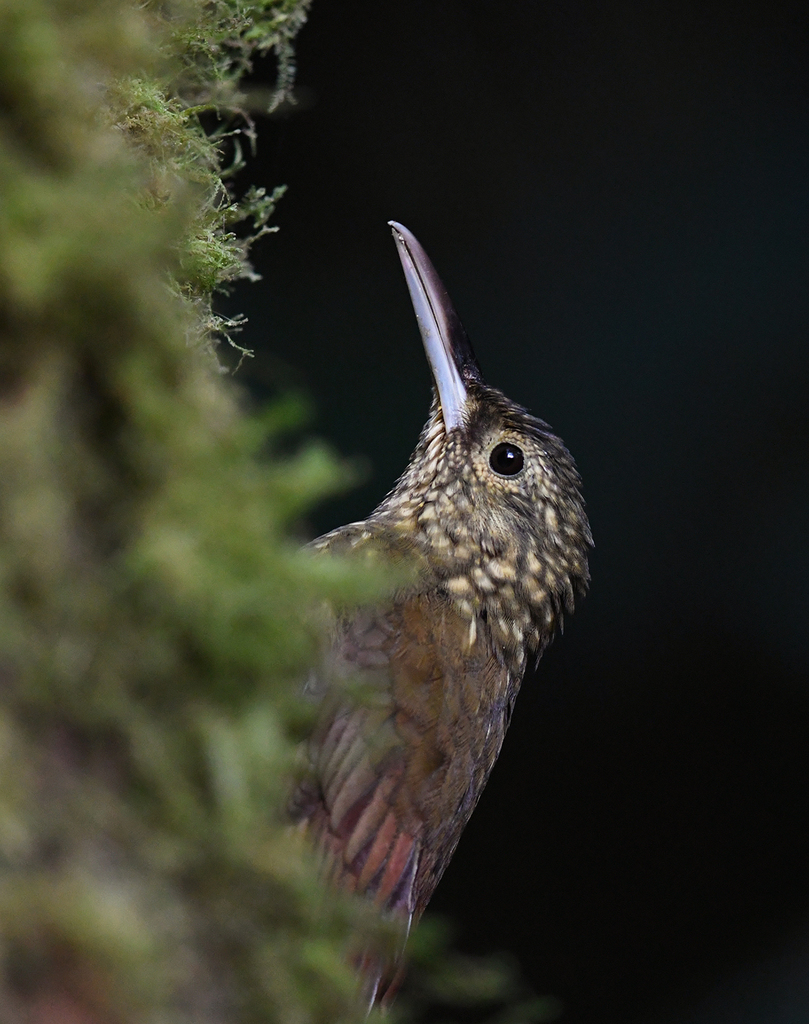
Spotted Woodcreeper
Live sightings near you, the range map, bar charts of when it is seen, and Macaulay Library photos and recordings.
Spotted Woodcreeper
Xiphorhynchus erythropygius
The spotted woodcreeper (Xiphorhynchus erythropygius) is a species of bird in the subfamily Dendrocolaptinae of the ovenbird family Furnariidae. It is found in Belize, Colombia, Costa Rica, Ecuador, El Salvador, Guatemala, Honduras, Mexico, Nicaragua, and Panama.
From the article Spotted woodcreeper on Wikipedia (CC BY-SA), quoted section by section
Description
The spotted woodcreeper is 19 to 24 cm (7.5 to 9.4 in) long. Males weigh 40 to 54 g (1.4 to 1.9 oz) and females 40 to 46 g (1.4 to 1.6 oz). It is a medium-sized member of genus Xiphorhynchus, with a longish, slightly decurved and gradually tapering bill. The sexes have the same plumage. Adults of the nominate subspecies X. e. erythropygius have dusky lores, a buff supercilium and eyering, and dusky olive ear coverts with buff streaks. Their crown and nape are dark olive to brownish olive with small buff spots and a narrow dusky edge. Their back and wing coverts are brownish olive to tawny brown with buff spots and wide buff streaks. Their rump is dark cinnamon-rufous and their flight feathers rufous-chestnut, with olive-brown edges and dusky tips on the primaries. Their tail is rufous-chestnut. Their throat is buffy with narrow dark olive barring. Their underparts are pale greenish olive with large buff teardrops that are lighter on the flanks and undertail coverts. Their underwing coverts are deep buff. Their iris is dark brown, their maxilla blackish to dark brown with sometimes a pale stripe on its cutting edge, their mandible whitish horn to pinkish gray, and their legs and feet blue- or greenish gray to slate gray. …
Range & habitat
The subspecies of the spotted woodcreeper are found thus; the ranges are discontinuous:
X. e. erythropygius, central and southern Mexico from San Luis Potosí and Hidalgo south to Oaxaca and Guerrero X. e. parvus, from southern Oaxaca and Chiapas in Mexico to and in Guatemala, northwestern El Salvador, Honduras, and north-central Nicaragua; locally in southern Belize X. e. punctigula, from southeastern Nicaragua through Costa Rica into central Panama X. e. insolitus, discontinuosly from central Panama into northwestern and north-central Colombia X. e. aequatorialis, the Pacific slope from western Colombia to southwestern Ecuador The spotted woodcreeper inhabits humid forest. In lower elevations it favors tropical evergreen forest and in higher ones evergreen montane forest, cloudforest, and especially in the north, pine and pine-oak woodlands. In all landscapes if favors forest with heavy covers of moss and epiphytes. In mature forest it tends to stay in the canopy of the interior, but is regular at the forest edge, in older secondary forest, and sometimes in tree plantations and at scattered trees near continuous forest. In elevation it mostly ranges between 600 and 1,800 m (2,000 and 5,900 ft) but reaches 2,900 m (9,500 ft) in northern Central America, 2,000 m (6,600 ft) in Ecuador, and locally 2,500 m (8,200 ft) elsewhere. …
Wikipedia: “Distribution and habitat”
What it does
The spotted woodcreeper's diet is mostly arthropods but also includes small vertebrates and small amounts of vegetable matter. It usually forages singly, though sometimes in pairs or more rarely in family groups. It regularly joins mixed-species feeding flocks at all levels of the forest. It hitches up trunks and along branches, usually in a spiral but also creeping along the underside of large limbs. Most prey is taken by gleaning bark and probing vine tangles, dead leaf clusters, bromeliads, and epiphytes. It sometimes flakes bark. It sometimes follows army ant swarms, staying fairly low and usually capturing prey like it does while with flocks.
Wikipedia: “Feeding”
Listen
Looking for field recordings…
Where it lives
Recorded sightings
—
geo-referenced records in GBIF, from museums, herbaria and field observers.
Drag the globe to turn it. Dots are where records exist, not a range map; darker means more records.
In the stacks
Searching the stacks…
Every page naming Xiphorhynchus erythropygius in the Biodiversity Heritage Library →
This page is assembled live from iNaturalist, GBIF, Wikipedia, the Source Library and the Internet Archive. It is not yet part of the hand-edited codex. iNaturalist taxon 11026.