- Animals
- ›Chordates
- ›Vertebrates
- ›Birds
- ›Perching Birds
- ›Ovenbirds and Woodcreepers
- ›Woodcreepers
- ›Xiphorhynchus
On eBird ↗
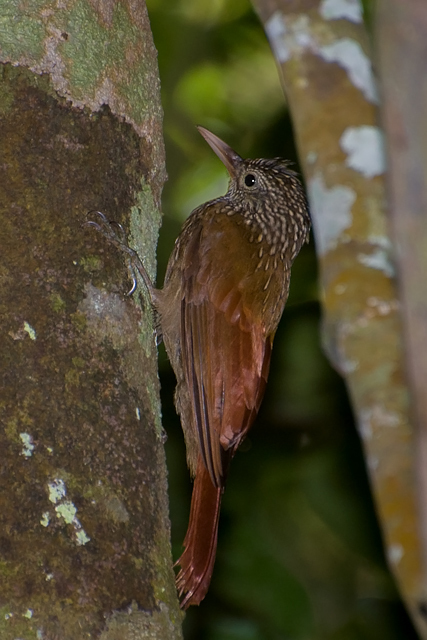
Striped Woodcreeper
Live sightings near you, the range map, bar charts of when it is seen, and Macaulay Library photos and recordings.
Striped Woodcreeper
Xiphorhynchus obsoletus
The striped woodcreeper (Xiphorhynchus obsoletus) is a species of bird in the woodcreeper subfamily (Dendrocolaptinae). It is found in Bolivia, Brazil, Colombia, Ecuador, French Guiana, Guyana, Peru, Suriname, and Venezuela. Its natural habitats are subtropical or tropical moist lowland forests, subtropical or tropical swamps, and subtropical or tropical dry shrubland.
From the article Striped woodcreeper on Wikipedia (CC BY-SA), quoted section by section
Description
The striped woodcreeper is medium-sized, with a slim, slightly decurved bill of moderate length. The species is 18 to 20.5 cm (7.1 to 8.1 in) long. Males weigh 27 to 37 g (0.95 to 1.3 oz) and females 24 to 36 g (0.85 to 1.3 oz). The sexes have the same plumage. Adults of the nominate subspecies X. o. obsoletus have a face with thin creamy buff and dark brown streaks that become bold scaling on the sides of the neck. They have a faint pale supercilium or none at all. Their crown and nape are blackish to dark olive-brown with pale spots that have dusky edges. Their back is olive-brown with dusky-edged whitish buff streaks. Their rump, wings, and tail are cinnamon-rufous to rufous-chestnut, with dusky to dark brown tips on the primaries. Their throat is buffy white, sometimes with a faint scaly appearance. Their underparts are grayish olive-brown and sometimes have a rufescent cast; they have buffy-white streaks with black edges that are bold on the breast and weaker on the lower belly and undertail coverts. Their iris is brown to dark brown, their maxilla pale brownish to grayish-horn with a darker base, their mandible pale bluish gray to light brown, and their legs and feet shades of gray or dark brown. Juveniles are similar to adults but with less well defined dark edges to their spots and streaks. Subspecies X. o. …
Range & habitat
The subspecies of the striped woodcreeper are found thus:
X. o. palliatus, the Amazon Basin in southeastern Colombia, eastern Ecuador, eastern Peru, northern Bolivia, and western Brazil east to the Rio Negro X. o. notatus, eastern Colombia's Arauca and Vichada departments, western and southern Venezuela, and northwestern Brazil X. o. obsoletus, the Amazon basin of northeastern and eastern Venezuela, the Guianas, northeastern Bolivia, and Brazil east of the Rio Negro and south to Mato Grosso X. o. caicarae, middle reaches of the Rio Orinoco in central Venezuela's Bolívar state The striped woodcreeper is primarily a bird of mature evergreen forest, and favors landscapes near water. These include várzea, igapó, and swamp forest, and river islands. It occurs less frequently in terra firme and secondary forest. In the southern part of its range it occurs in gallery forest within the cerrado. It is entirely a bird of the lowlands, being found only below 500 m (1,600 ft).
Wikipedia: “Distribution and habitat”
What it does
The striped woodcreeper's diet is mostly insects and other arthropods such as spiders. It usually forages singly but sometimes in pairs, and at all levels of the forest up to the subcanopy. It sometimes joins mixed-species feeding flocks and is not known to follow army ant swarms. It hitches up trunks and branches, sometimes on the underside of the latter, and gleans, probes, and pecks for prey. It also takes a significant part of its prey by mid-air capture during sallies from a perch.
Wikipedia: “Feeding”
Listen
Looking for field recordings…
Where it lives
Recorded sightings
—
geo-referenced records in GBIF, from museums, herbaria and field observers.
Drag the globe to turn it. Dots are where records exist, not a range map; darker means more records.
In the stacks
Searching the stacks…
Every page naming Xiphorhynchus obsoletus in the Biodiversity Heritage Library →
This page is assembled live from iNaturalist, GBIF, Wikipedia, the Source Library and the Internet Archive. It is not yet part of the hand-edited codex. iNaturalist taxon 11081.