- Animals
- ›Chordates
- ›Vertebrates
- ›Cartilaginous Fishes
- ›Sharks and Rays
- ›Sharks
- ›Galean Sharks
- ›Ground Sharks
- ›False Catsharks
- ›Pseudotriakis
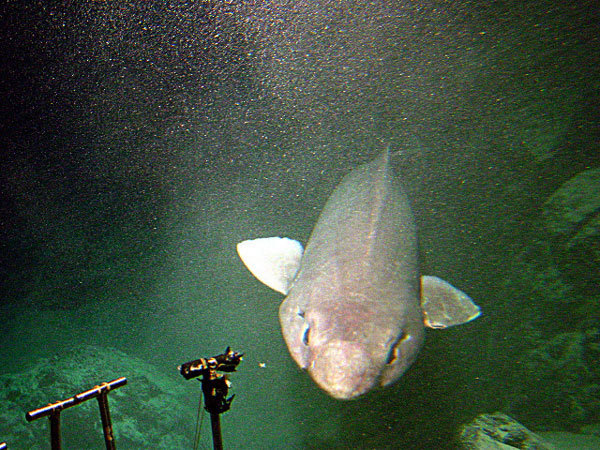
False Catshark
Pseudotriakis microdon
The false catshark or sofa shark (Pseudotriakis microdon) is a species of ground shark in the family Pseudotriakidae, and the sole member of its genus. It has a worldwide distribution, and has most commonly been recorded close to the bottom over continental and insular slopes, at depths of 500–1,400 m (1,600–4,600 ft). Reaching 3.0 m (9.8 ft) in length, this heavy-bodied shark can be readily identified by its elongated, keel-like first dorsal fin. It has long, narrow eyes and a large mouth filled with numerous tiny teeth. It is usually dark brown in color, though a few are light gray.
With flabby muscles and a large oily liver, the false catshark is a slow-moving predator and scavenger of a variety of fishes and invertebrates. It has a viviparous mode of reproduction, featuring an unusual form of oophagy in which the developing embryos consume ova or egg fragments released by the mother and use the yolk material to replenish their external yolk sacs for later use. This species typically gives birth to two pups at a time. The International Union for Conservation of Nature (IUCN) has assessed the conservation status of the false catshark as Least-concern. While neither targeted by fisheries nor commercially valuable, it is caught incidentally by longlines and bottom trawls, and its low reproductive rate may render it susceptible to population depletion.
From the article False catshark on Wikipedia (CC BY-SA), quoted section by section
Description
Bulky and soft-bodied, the false catshark has a broad head with a short, rounded snout. The nostrils have large flaps of skin on their anterior rims. The narrow eyes are over twice as long as high, and are equipped with rudimentary nictitating membranes; behind the eyes are large spiracles. The huge mouth is arched and bears short furrows at the corners. There are over two hundred rows of tiny teeth in each jaw, arranged in straight lines in the upper jaw and diagonal lines in the lower jaw; each tooth has a pointed central cusp flanked by one or two smaller cusplets on either side. The five pairs of gill slits are fairly small. The pectoral fins are small and rounded, with fin rays only near the base. The first dorsal fin is highly distinctive, being very long (roughly equal to the caudal fin) and low, resembling the keel of a ship; it originates over the pectoral fin rear tips and terminates over the pelvic fin origins. The second dorsal fin is larger than, and originates ahead of, the anal fin; both these fins are positioned very close to the caudal fin. The caudal fin has a long upper lobe with a ventral notch near the tip, and an indistinct lower lobe. The dermal denticles are shaped like arrowheads with a central ridge, and are sparsely distributed on the skin. This species is typically plain dark brown in color, darkening at the fin margins. …
Range & habitat
Though rarely encountered, the false catshark has been caught from locations scattered around the world, indicating a wide circumglobal distribution. In the western Atlantic, it has been reported from Canada, the United States, Cuba, and Brazil. In the eastern Atlantic, it is known from the waters of Iceland, France, Portugal, and Senegal, as well as the islands of Madeira, the Azores, the Canaries, and Cape Verde. Records from the Indian Ocean have come from off Madagascar, the Aldabra Group, Mauritius, Indonesia, and Australia. In the Pacific Ocean, it has been documented from Japan, Taiwan, Indonesia, the Coral Sea, New Zealand, and the Hawaiian Islands. Inhabiting continental and insular slopes, the false catshark mostly occurs between the depths of 500 and 1,400 m (1,600 and 4,600 ft), though it has been recorded as deep as 1,900 m (6,200 ft). Individuals occasionally wander into relatively shallower waters over the continental shelf, perhaps following submarine canyons or suffering from an abnormal condition. The false catshark generally swims close to the sea floor and has been found at seamounts, troughs, and deepwater reefs.
Wikipedia: “Distribution and habitat”
What it does
The soft fins, skin, and musculature of the false catshark suggest a sluggish lifestyle. An enormous oil-filled liver makes up 18–25% of its total weight, allowing it to maintain near-neutral buoyancy and hover off the bottom with little effort. This species likely captures prey via quick bursts of speed, with its large mouth allowing it to consume food of considerable size. It feeds mainly on bony fishes such as cutthroat eels, grenadiers, and snake mackerel, and also takes lanternsharks, squids, octopodes, and Heterocarpus shrimp. It likely also scavenges, as examination of stomach contents have found surface-dwelling fishes such as frigate mackerel, needlefishes, and pufferfishes. One specimen caught off the Canary Islands had swallowed human garbage, including potatoes, a pear, a plastic bag, and a soft drink can. There is a record of a false catshark found with bite marks from a great white shark (Carcharodon carcharias). Unusual among the ground sharks, the false catshark is viviparous with the developing embryos practicing intrauterine oophagy. Adult females have a single functional ovary, on the right, and two functional uteruses. A female 2.4 m (7.9 ft) long was found to contain an estimated 20,000 ova in her ovary, averaging 9 mm (0.35 in) across. …
Wikipedia: “Biology and ecology”
Where it lives
Recorded sightings
—
geo-referenced records in GBIF, from museums, herbaria and field observers.
Drag the globe to turn it. Dots are where records exist, not a range map; darker means more records.
In the stacks
Searching the stacks…
Every page naming Pseudotriakis microdon in the Biodiversity Heritage Library →
This page is assembled live from iNaturalist, GBIF, Wikipedia, the Source Library and the Internet Archive. It is not yet part of the hand-edited codex. iNaturalist taxon 111133.