- Animals
- ›Chordates
- ›Vertebrates
- ›Ray-finned Fishes
- ›Spiny-rayed fishes
- ›Gobies, cardinalfishes and allies
- ›Cardinalfishes and nurseryfishes
- ›Cardinalfishes
- ›Gobbleguts
- ›Pterapogon
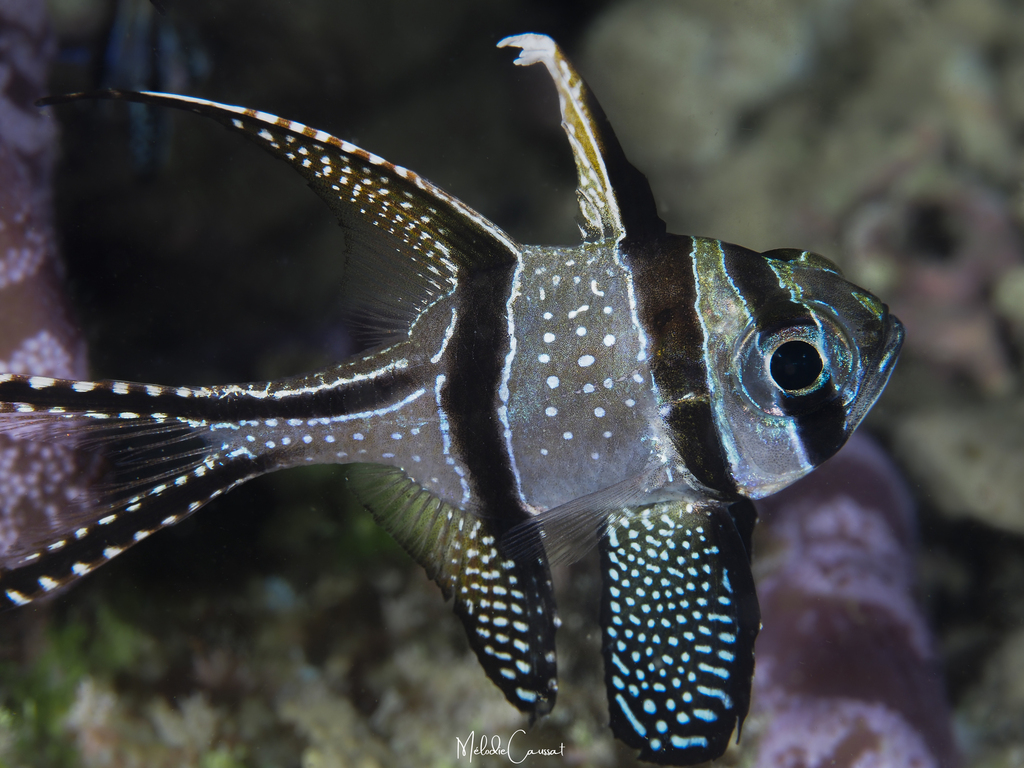
Banggai Cardinalfish
Pterapogon kauderni
The Banggai cardinalfish (Pterapogon kauderni) is a small tropical cardinalfish in the family Apogonidae. It is the only member of its genus, the sailfin cardinalfish which at first was included in Pterapogon now being separated in a distinct genus. This attractive fish is popular in the aquarium trade. It is among the relatively few marine fish to have been bred regularly in captivity, but significant numbers are still captured in the wild and it is now an endangered species. The detrimental impact of humans on its environment and certain fatal diseases threaten this species' numbers significantly. Iridovirus diseases are known to be a significant reason for fish mortality.
From the article Banggai cardinalfish on Wikipedia (CC BY-SA), quoted section by section
Description
This species grows up to 8 centimetres (3 in) total length. It is easily differentiated from all other cardinalfishes by its tasseled first dorsal fin, elongated anal and second dorsal fin rays, deeply forked caudal fin, and color pattern consisting of three black bars across the head and body and prominent black anterior edges on the anal and second dorsal fin. The male can be differentiated from the female by a conspicuous, enlarged oral cavity, which is apparent only when they are brooding.
Range & habitat
This species is restricted to the Banggai Islands of Indonesia. This species has an extremely limited geographic range (5,500 km2) and small total population size (estimated at 2.4 million). The Banggai cardinalfish is composed of isolated populations concentrated around the shallows of 17 large and 10 small islands within the Banggai Archipelago. A small population also occurs off Central Sulawesi, within Luwuk harbor. One additional population has become established in the Lembeh Strait (North Sulawesi), 400 km north of the natural area of the species distribution, following introduction by aquarium fish traders in 2000. Small populations seen (May 2014) in Secret Bay, northwest Bali (Banggai cardinal fish, Secret Bay, Bali).
Wikipedia: “Distribution”
What it does
The Banggai cardinalfish is the only member of its family that is diurnal. It is a demersal tropical marine fish that forms stable groups of about 9 individuals in shallow water, being most common at 1.5 to 2.5 m in depth. It inhabits a variety of shallow habitats, including coral reefs, seagrass beds, and open areas of sand and rubble. It is most common in calm habitats on the protected side of larger islands.
Symbiosis and mutualism. It is often found associated with the seagrass Enhalus acoroides and the long spined sea urchin Diadema setosum. It occurs among various living benthic substrates such as sea urchins, sea anemones, and branching corals; young fish are most commonly associated with sea anemones, while juveniles and adults occur most frequently among long-spined sea urchins and branching corals, as well as sea stars, hydrozoans, and mangrove prop roots. Individuals of 2 to 60 hover above the urchins, with the younger ones about 2 to 3 centimeters SL staying closest to them. The fish retreat among the spines when threatened. Individual fish exhibit well-defined homing behaviour and return to the original location of their group when disturbed. The Banggai cardinalfish often coexists with various anemonefish and anemone shrimp when sheltering in anemones and corals; when found among sea urchin spines, it associates with several other genera of cardinalfish. …
Wikipedia: “Ecology”
Where it lives
Recorded sightings
—
geo-referenced records in GBIF, from museums, herbaria and field observers.
Drag the globe to turn it. Dots are where records exist, not a range map; darker means more records.
In the stacks
Searching the stacks…
Every page naming Pterapogon kauderni in the Biodiversity Heritage Library →
This page is assembled live from iNaturalist, GBIF, Wikipedia, the Source Library and the Internet Archive. It is not yet part of the hand-edited codex. iNaturalist taxon 111185.