- Animals
- ›Chordates
- ›Vertebrates
- ›Birds
- ›Perching Birds
- ›Ovenbirds and Woodcreepers
- ›Woodcreepers
- ›Dendrocolaptes
On eBird ↗
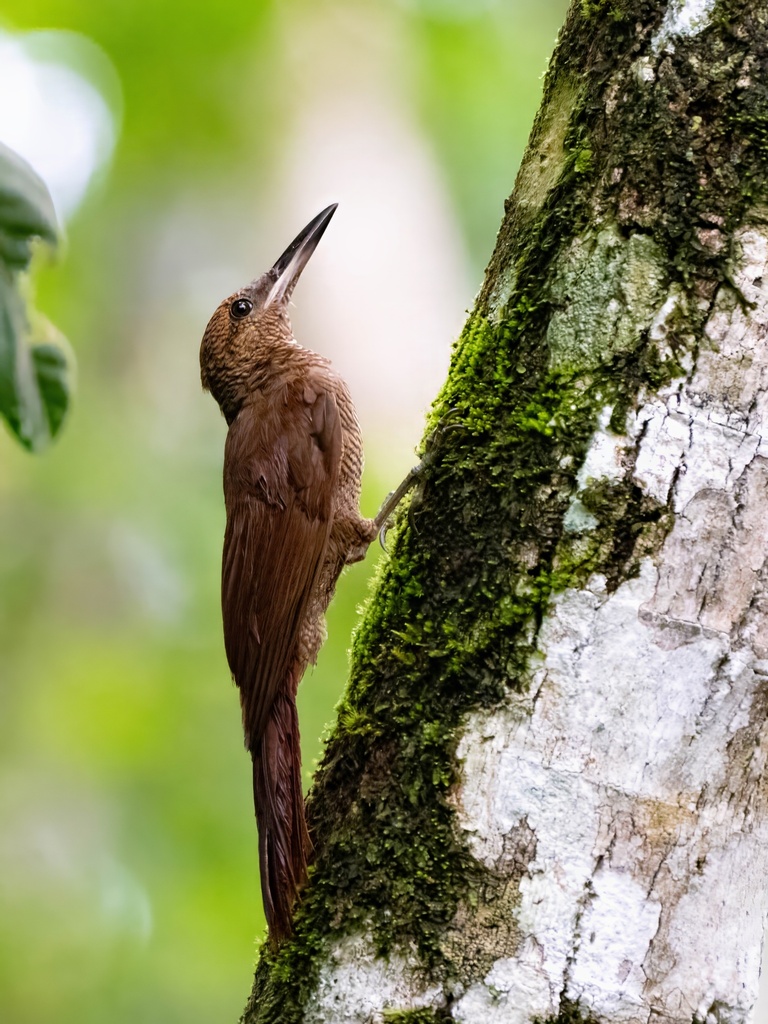
Northern Barred-Woodcreeper
Live sightings near you, the range map, bar charts of when it is seen, and Macaulay Library photos and recordings.
Northern Barred-Woodcreeper
Dendrocolaptes sanctithomae
The northern barred woodcreeper (Dendrocolaptes sanctithomae) is a sub-oscine passerine bird in subfamily Dendrocolaptinae of the ovenbird family Furnariidae. It is found from southern Mexico through Central America to Colombia, Venezuela and Ecuador.
From the article Northern barred woodcreeper on Wikipedia (CC BY-SA), quoted section by section
Description
The northern barred woodcreeper is one of the larger members of its subfamily. It is slim, with a long tail, a medium-length straight bill, and (in the male) a shaggy crest. It is 25 to 29 cm (9.8 to 11 in) long. Males weigh 53 to 72 g (1.9 to 2.5 oz) and females 54 to 83 g (1.9 to 2.9 oz). The sexes have the same plumage. Adults of the nominate subspecies D. s. sanctithomae have a mostly cinnamon-brown face with fine barring, a faint rufous supercilium, black lores, and a rich rufescent forehead, crown, and nape. Their back and wing coverts are olive-brown and their rump and tail are cinnamon-rufous to rufous-chestnut. Their crown and back have black barring. Their flight feathers are also cinnamon-rufous to rufous-chestnut, with dusky tips on the primaries. Their chin, throat, and underparts are golden to cinnamon-buff with narrow well-defined black barring. Their iris is light to dark brown, their bill mostly blackish with paler edges and base of the mandible, and their legs and feet variable among dark brown, black, grayish green, bluish, and horn. Juveniles are similar to adults but with more diffuse barring on their underparts, redder undertail coverts, and an entirely black bill. Subspecies D. s. …
Range & habitat
The subspecies of the northern barred woodcreeper are found thus:
D. s. sheffleri, the Pacific slope of southwestern Mexico's Sierra Madre del Sur D. s. sanctithomae, on the Caribbean slope from Veracruz and the Yucatán Peninsula in Mexico south through Belize, Guatemala, Honduras, Nicaragua, and Costa Rica into Panama; on the Pacific slope from Chiapas, Mexico, south intermittently through Guatemala, El Salvador, Honduras, Nicaragua, Costa Rica, Panama, and northern and western Colombia into northwestern Ecuador D. s. hesperius, the Pacific slope of southwestern Costa Rica and western Panama D. s. punctipectus, northern Colombia from the valley of the Magdalena River east into northwestern Venezuela (Note that the map excludes this subspecies' range.) The northern barred woodcreeper primarily inhabits humid tall evergreen forest. It also occurs in less tall forest, gallery forest, semi-deciduous forest, and mangroves, and even less frequently in cloudforest and pine-oak woodlands. It favors the forest interior but is regular at its edges, in mature secondary forest, and in plantations near natural forest. It is mostly a bird of the lowlands, most frequently found below 1,000 m (3,300 ft) of elevation. …
Wikipedia: “Distribution and habitat”
What it does
The northern barred woodcreeper forages mostly by following army ant swarms to feed on prey disturbed by the ants. It typical follows them singly or in pairs but up to four have been observed at a swarm. When attending a swarm it typically perches on a near-vertical trunk and makes short flights to pick prey from the ground, from trunks, vines, and foliage, and in mid-air. It also sometimes forages away from ant swarms, usually in the forest's low to mid-levels, but also to the sub-canopy. Its diet is mostly arthropods including insects, spiders, centipedes, and scorpions, and also includes small vertebrates like lizards.
Wikipedia: “Feeding”
Listen
Looking for field recordings…
Where it lives
Recorded sightings
—
geo-referenced records in GBIF, from museums, herbaria and field observers.
Drag the globe to turn it. Dots are where records exist, not a range map; darker means more records.
In the stacks
Searching the stacks…
Every page naming Dendrocolaptes sanctithomae in the Biodiversity Heritage Library →
This page is assembled live from iNaturalist, GBIF, Wikipedia, the Source Library and the Internet Archive. It is not yet part of the hand-edited codex. iNaturalist taxon 11126.