- Animals
- ›Chordates
- ›Vertebrates
- ›Birds
- ›Perching Birds
- ›Ovenbirds and Woodcreepers
- ›Woodcreepers
- ›Campylorhamphus
On eBird ↗
Red-billed Scythebill
Live sightings near you, the range map, bar charts of when it is seen, and Macaulay Library photos and recordings.
Red-billed Scythebill
Campylorhamphus trochilirostris
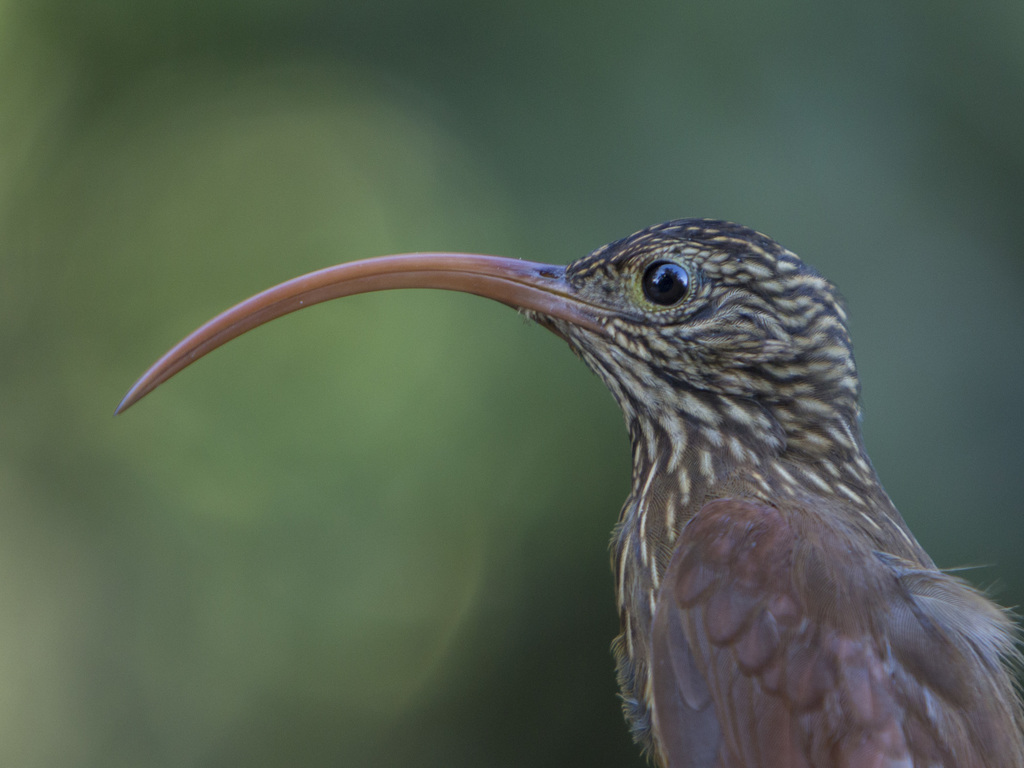
The red-billed scythebill (Campylorhamphus trochilirostris) is a species of bird in the subfamily Dendrocolaptinae of the ovenbird family Furnariidae. It is found in Argentina, Bolivia, Brazil, Colombia, Ecuador, Panama, Paraguay, Peru, and Venezuela.
From the article Red-billed scythebill on Wikipedia (CC BY-SA), quoted section by section
Description
The red-billed scythebill is 22 to 28 cm (8.7 to 11 in) long and weighs 30 to 55 g (1.1 to 1.9 oz). It is a slim, medium-sized woodcreeper with a very long, slim, dramatically decurved bill. The sexes have the same plumage. Adults of the nominate subspecies C. t. trochilirostris have a thinly streaked face and neck with a weak supercilium. Their crown, nape, and back are reddish olive-brown, with the back being somewhat lighter. Their crown has longish whitish to ochraceous spots with narrow blackish edges; the spots narrow on the nape and become thin streaks on the upper back. Their rump is cinnamon-rufous that contrasts little with the back, their flight feathers are rufous-chestnut, and their tail is a slightly darker rufous-chestnut. Their wing coverts have wide reddish olive-brown edges and the tips of the primaries are dusky. Their throat and chin are white, the latter with thin brownish streaks. Their underparts are a slightly lighter brown than the back; their breast has buff streaks that narrow on the belly but don't continue onto the undertail coverts. Their underwing coverts are light cinnamon to ochraceous. Their iris is dark brown to hazel, their bill bright red or reddish brown (often with a dusky tip and base), and their legs and feet grayish olive to dull pea-green. …
Range & habitat
The subspecies of the red-billed scythebill are found thus:
C. t. brevipennis, from central Panama's Coclé Province into Colombia along the Pacific coast to northern Chocó Department C. t. venezuelensis, locally across northern Colombia from Córdoba Department into northern and central Venezuela to the Rio Orinoco C. t. thoracicus, coastal from Colombia's Nariño Department south into western Ecuador C. t. zarumillanus, coastal far northwestern Peru's departments of Tumbes and Piura C. t. napensis, the Amazon Basin of eastern Ecuador and eastern Peru C. t. notabilis, southwestern and western Brazil south of the Amazon River between Acre state and the Rio Madeira C. t. snethlageae, Amazon Basin of central Brazil on both sides and islands of the Amazon between the Rio Madeira and Rio Tapajós C. t. major, interior eastern and southern Brazil from Piauí and Ceará south to extreme western Paraná C. t. trochilirostris, coastal eastern Brazil between Pernambuco and Bahia C. t. devius, southwestern Amazon Basin in northern Bolivia and possibly into immediately adjoining southeastern Peru and western Brazil C. t. lafresnayanus, eastern Bolivia, Mato Grosso and Mato Grosso do Sul in Brazil, and western Paraguay C. t. …
Wikipedia: “Distribution and habitat”
What it does
The red-billed scythebill's diet is chiefly arthropods, especially soft-bodied ones like spiders, and also includes small vertebrates. It usually forages singly, though sometimes in pairs, and often joins mixed-species feeding flocks. It hitches up and along trunks and branches, mostly from the upper level of the understory to the subcanopy but also sometimes higher and lower. It typically takes its prey by probing crevices and holes in bark, bamboo, rotting wood, moss clumps, bromeliads, and epiphytes.
Wikipedia: “Feeding”
Listen
Looking for field recordings…
Where it lives
Recorded sightings
—
geo-referenced records in GBIF, from museums, herbaria and field observers.
Drag the globe to turn it. Dots are where records exist, not a range map; darker means more records.
In the stacks
This page is assembled live from iNaturalist, GBIF, Wikipedia, the Source Library and the Internet Archive. It is not yet part of the hand-edited codex. iNaturalist taxon 11201.