- Animals
- ›Chordates
- ›Vertebrates
- ›Cartilaginous Fishes
- ›Sharks and Rays
- ›Sharks
- ›Galean Sharks
- ›Ground Sharks
- ›Catsharks
- ›Scyliorhinus
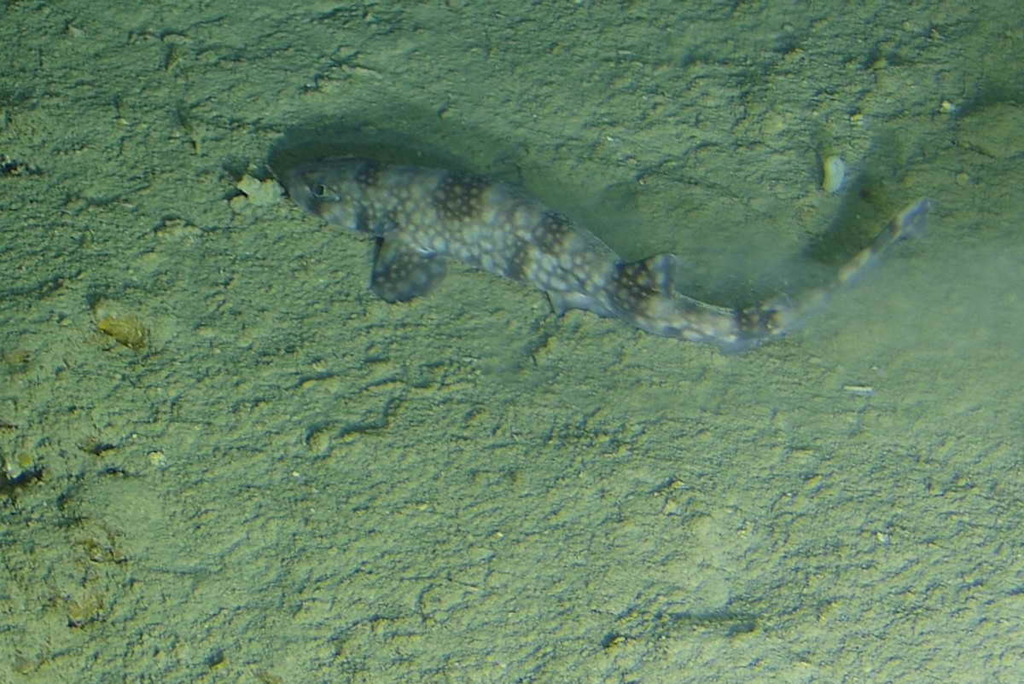
White-saddled catshark
Scyliorhinus hesperius
The whitesaddled catshark (Scyliorhinus hesperius) is a species of catshark, and part of the family Scyliorhinidae. It is found on the upper continental slope of the western central Atlantic Ocean, off the coasts of Honduras, Panama and Colombia, between latitudes 22° N and 9° N, at depths between 274 and 457 m (900 and 1,500 ft). It can grow to a length of 47 cm (19 in). The reproduction of this catshark is oviparous but otherwise, little is known about its biology.
From the article Whitesaddled catshark on Wikipedia (CC BY-SA), quoted section by section
Description
The whitesaddled catshark is a moderately small, slender catshark that reaches a maximum length of 47 cm (19 in). The front of the first dorsal fin is located above and just behind the base of the pelvic fin and the front of the second dorsal fin is located above the hind third of the base of the anal fin. The first dorsal fin is considerably larger than the second and the distance between the two is about the same as the length of the anal fin. The skin is fairly smooth and there are small, flat denticles. There are seven or eight dark saddles on the back and flanks, the whole surface being scattered with large white spots, but this catshark does not have any black spots.
Range & habitat
The whitesaddled catshark is found in the tropical western Atlantic and Caribbean Sea of Honduras, Panama and Colombia. It is a deep water, demersal fish and inhabits the continental slope at depths of between about 274 and 457 m (900 and 1,500 ft).
Wikipedia: “Distribution and habitat”
What it does
This fish is oviparous, producing two eggs at a time. The developing embryos feed on their egg yolks.
Wikipedia: “Ecology”
Where it lives
Recorded sightings
—
geo-referenced records in GBIF, from museums, herbaria and field observers.
Drag the globe to turn it. Dots are where records exist, not a range map; darker means more records.
In the stacks
Searching the stacks…
Every page naming Scyliorhinus hesperius in the Biodiversity Heritage Library →
This page is assembled live from iNaturalist, GBIF, Wikipedia, the Source Library and the Internet Archive. It is not yet part of the hand-edited codex. iNaturalist taxon 112378.