- Animals
- ›Chordates
- ›Vertebrates
- ›Cartilaginous Fishes
- ›Sharks and Rays
- ›Sharks
- ›Galean Sharks
- ›Ground Sharks
- ›Catsharks
- ›Scyliorhinus
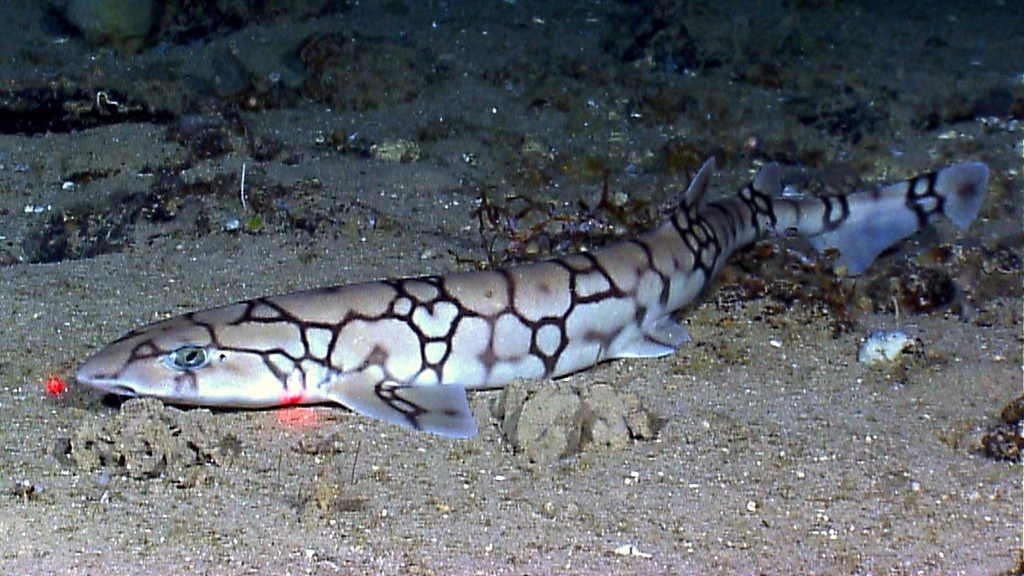
Chain Catshark
Scyliorhinus retifer
The chain catshark or chain dogfish (Scyliorhinus retifer) is a small, reticulated catshark that is biofluorescent. The species is common in the Northwest Atlantic, Gulf of Mexico, and Caribbean. It is harmless and rarely encountered by humans. It has very similar reproductive traits to the small-spotted catshark (S. canicula).
From the article Chain catshark on Wikipedia (CC BY-SA), quoted section by section
Range & habitat
The chain catshark is found in the Northwest Atlantic, Gulf of Mexico and Caribbean, ranging from George's Bank in Massachusetts, to Nicaragua and Barbados. In the Mid-Atlantic Bight, the chain catshark is found along the outer continental shelf and upper slope. The shark occupies depths of 36 to 750 meters (118–2,461 ft); in the northern part of its range it is mainly found between 36 and 230 meters (118–755 ft) and in the southern areas generally deeper than 460 meters (1,510 ft). Due to the shark's depth distribution, it has been suggested that the shark does not perform large-scale migrations. Temperature is thought to limit the shark's distribution in northern areas, particularly during the winter. Although bands of warm water at the edge of the shelf have been observed, the temperature varies seasonally, thus limiting this non-migratory species. In general, the chain catshark is found in waters with a temperature between 8.5 °C (47 °F) and 14 °C (57 °F).
Wikipedia: “Distribution”
What it does
The catshark spends the daytime resting at the bottom, usually in contact with certain structures. It has been observed with large burrowing cerianthid anemone tubes and boulders. The bottom rubble is thought to be used as a camouflage with the shark's spotted surface. Adult sharks tend to prefer rough bottoms, creating a difficulty for trawl sampling, while the immature forms are found near smoother regions. The chain catshark has been known to feed on squid, bony fish, polychaetes and crustaceans. In aquaria, they are relatively motionless, spending the day resting on the bottom, but during the night and when fed they are very active.
Wikipedia: “Habitat and behavior”
Where it lives
Recorded sightings
—
geo-referenced records in GBIF, from museums, herbaria and field observers.
Drag the globe to turn it. Dots are where records exist, not a range map; darker means more records.
In the stacks
Searching the stacks…
Every page naming Scyliorhinus retifer in the Biodiversity Heritage Library →
This page is assembled live from iNaturalist, GBIF, Wikipedia, the Source Library and the Internet Archive. It is not yet part of the hand-edited codex. iNaturalist taxon 112380.