- Animals
- ›Chordates
- ›Vertebrates
- ›Cartilaginous Fishes
- ›Sharks and Rays
- ›Sharks
- ›Galean Sharks
- ›Ground Sharks
- ›Catsharks
- ›Scyliorhinus
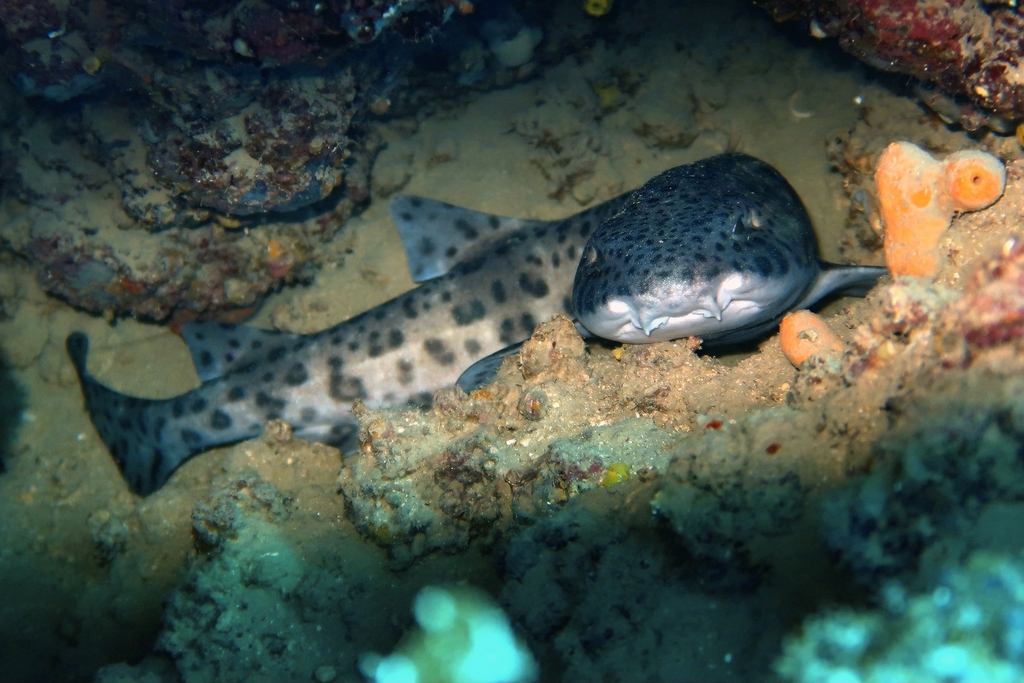
Nursehound
Scyliorhinus stellaris
The nursehound (Scyliorhinus stellaris), also known as the large-spotted dogfish, greater spotted dogfish or bull huss, is a species of catshark, belonging to the family Scyliorhinidae, found in the northeastern Atlantic Ocean. It is generally found among rocks or algae at a depth of 20–60 m (70–200 ft). Growing up to 1.6 m (5.2 ft) long, the nursehound has a robust body with a broad, rounded head and two dorsal fins placed far back. It shares its range with the more common and closely related small-spotted catshark (S. canicula), which it resembles in appearance but can be distinguished from, in having larger spots and nasal skin flaps that do not extend to the mouth.
Nursehounds have nocturnal habits and generally hide inside small holes during the day, often associating with other members of its species. A benthic predator, it feeds on a range of bony fishes, smaller sharks, crustaceans, and cephalopods. Like other catsharks, the nursehound is oviparous in reproduction. Females deposit large, thick-walled egg cases, two at a time, from March to October, securing them to bunches of seaweed. The eggs take 7–12 months to hatch. Nursehounds are marketed as food in several European countries under various names, including "flake", "catfish", "rock eel", and "rock salmon". It was once also valued for its rough skin (called "rubskin"), which was used as an abrasive. The International Union for Conservation of Nature (IUCN) has assessed the nursehound as Vulnerable, as its population in the Mediterranean Sea seems to have declined substantially from overfishing.
From the article Nursehound on Wikipedia (CC BY-SA), quoted section by section
Description
The nursehound attains a length of 1.6 m (5.2 ft), though most measure less than 1.3 m (4.3 ft). This shark has a broad, rounded head and a stout body that tapers towards the tail. The eyes are oval in shape, with a thick fold of skin on the lower rim but no nictitating membrane. Unlike in the small-spotted catshark, the large flaps of skin beside the nares do not reach the mouth. In the upper jaw, there are 22–27 tooth rows on either side and 0–2 teeth at the symphysis (center); in the lower jaw, there are 18–21 tooth rows on either side and 2–4 teeth at the symphysis. The teeth are Y-shaped and smooth-edged; the anterior teeth have a single central cusp, while the posterior teeth have an additional pair of lateral cusplets. Towards the rear of the jaws, the teeth become progressively smaller and more angled, with proportionately larger lateral cusplets. The five pairs of gill slits are small, with the last two over the pectoral fin bases. The two dorsal fins are placed far back on the body; the first is larger than the second and originates over the bases of the pelvic fins. The pectoral fins are large. In males, the inner margins of the pelvic fins are merged into an "apron" over the claspers. The caudal fin is broad and nearly horizontal, with an indistinct lower lobe. The skin is very rough, due to a covering of large, upright dermal denticles. …
Range & habitat
The nursehound is found in the northeastern Atlantic from southern Norway and Sweden to Senegal, including off the British Isles, throughout the Mediterranean Sea, and the Canary Islands. It may occur as far south as the mouth of the Congo River, though these West African records may represent misidentifications of the West African catshark (S. cervigoni). Its range seems to be rather patchy, particularly around offshore islands, where there are small local populations with limited exchange between them. The nursehound can be found from the intertidal zone to a depth of 400 m (1,300 ft), though it is most common between 20 m (66 ft) and 60–125 m (197–410 ft). This bottom-dwelling species prefers quiet water over rough or rocky terrain, including sites with algal cover. In the Mediterranean, it favors algae-covered coral.
Wikipedia: “Distribution and habitat”
What it does
Primarily nocturnal, nursehounds spend the day inside small holes in rocks and swim into deeper water at night to hunt. Sometimes two sharks will squeeze into the same hole, and several individuals will seek out refuges within the same local area. In one tracking study, a single immature nursehound was observed to use five different refuges in succession over a period of 168 days, consistently returning to each one over a number of days before moving on. Nursehounds may occupy refuges to hide from predators, avoid harassment by mature conspecifics, and/or to facilitate thermoregulation. In captivity, these sharks are gregarious and tend to rest in groups, though the individuals comprising any particular group changes frequently. This species is less common than the small-spotted catshark. The nursehound feeds on a variety of benthic organisms, including bony fishes such as mackerel, deepwater cardinalfishes, dragonets, gurnards, flatfishes, and herring, and smaller sharks such as the small-spotted catshark. It also consumes crustaceans, in particular crabs but also hermit crabs and large shrimp, and cephalopods. Given the opportunity, this shark will scavenge. Adults consume relatively more bony fish and cephalopods, and fewer crustaceans, than juveniles. …
Wikipedia: “Biology and ecology”
Where it lives
Recorded sightings
—
geo-referenced records in GBIF, from museums, herbaria and field observers.
Drag the globe to turn it. Dots are where records exist, not a range map; darker means more records.
In the stacks
Searching the stacks…
Every page naming Scyliorhinus stellaris in the Biodiversity Heritage Library →
This page is assembled live from iNaturalist, GBIF, Wikipedia, the Source Library and the Internet Archive. It is not yet part of the hand-edited codex. iNaturalist taxon 112381.