- Animals
- ›Chordates
- ›Vertebrates
- ›Cartilaginous Fishes
- ›Sharks and Rays
- ›Sharks
- ›Galean Sharks
- ›Ground Sharks
- ›Catsharks
- ›Scyliorhinus
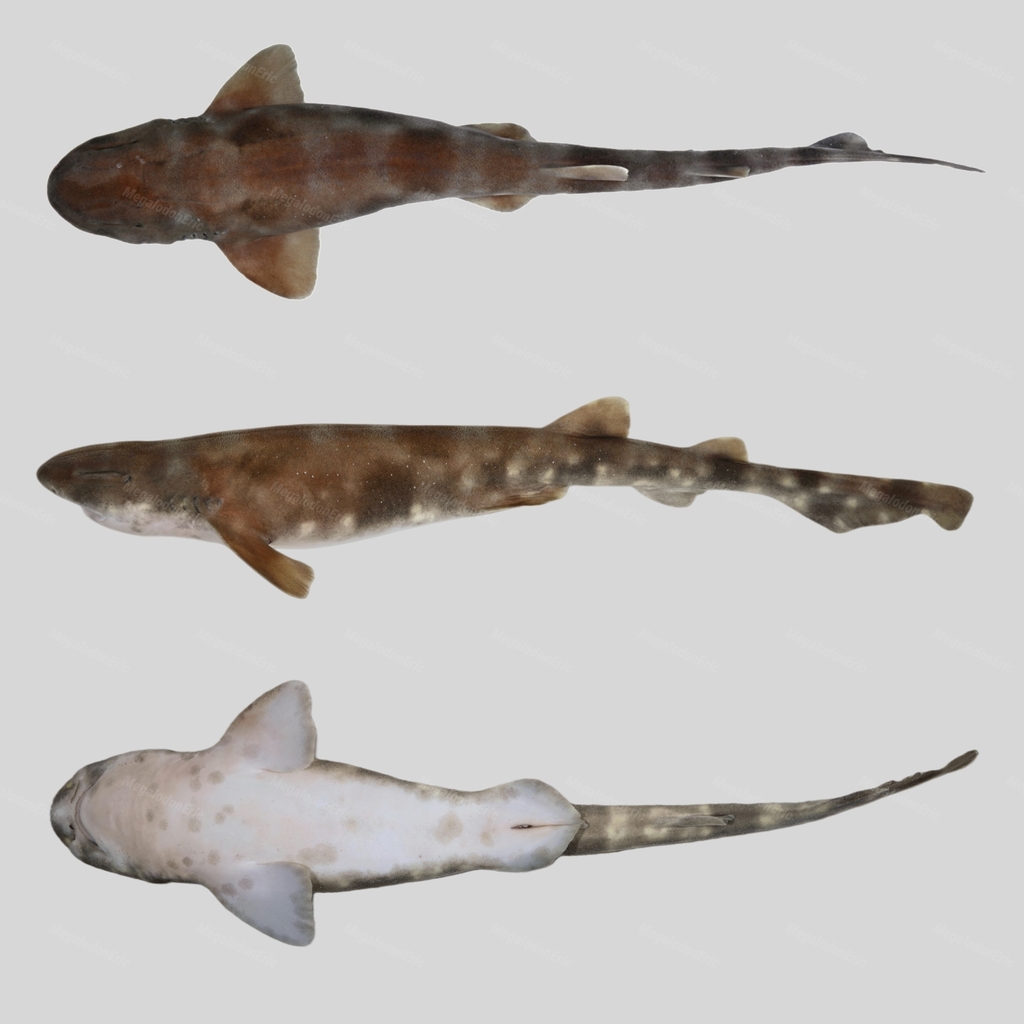
Cloudy catshark
Scyliorhinus torazame
The cloudy catshark (Scyliorhinus torazame) is a common species of catshark, belonging to the family Scyliorhinidae. It is a bottom-dweller that inhabits rocky reefs in the northwestern Pacific Ocean, from the shore to a depth of 320 m (1,050 ft). Growing up to 50 cm (20 in) long, this small, slim shark has a narrow head with a short blunt snout, no grooves between the nostrils and mouth, and furrows on the lower but not the upper jaw. It is also characterized by extremely rough skin and coloration consisting of a series of dark brown saddles along its back and tail, along with various darker and lighter spots in larger individuals.
The diet of the cloudy catshark consists of molluscs, crustaceans, and bony fishes. It is oviparous, with females laying encapsulated eggs two at a time in nursery areas. The claspers of the male bear numerous hooks that likely serve to facilitate copulation. This harmless shark can be readily maintained in captivity and is used as a model organism for biological research. It is caught incidentally, and generally discarded, by commercial fisheries. These activities do not appear to have negatively affected its population, leading it to be listed under Least Concern by the International Union for Conservation of Nature (IUCN).
From the article Cloudy catshark on Wikipedia (CC BY-SA), quoted section by section
Description
The cloudy catshark reaches 50 cm (20 in) long and has a thin, deep, and firm body. The narrow head makes up slightly under one-sixth of the total length, and is two-thirds as wide as it is long. The snout is short and rounded. The large nostrils are preceded by small, triangular flaps of skin that do not reach the wide mouth. The medium-sized eyes are horizontally oval, equipped with rudimentary nictitating membranes (protective third eyelids), and followed by moderate spiracles. There are no grooves between the nostrils and the mouth. There are furrows extending from the corners of the mouth over the lower jaw only. The small teeth have a long central cusp typically flanked by two pairs of cusplets. The five pairs of gill slits are short, with the fourth pair over the pectoral fin origins. The two dorsal fins are placed towards the back of the body, with the first originating over the rear of the pelvic fin bases. The first dorsal fin has a rounded apex and is larger than the second dorsal fin, which has a more angular shape. The pectoral and pelvic fins are moderate in size. In males, the inner margins of the pelvic fins are merged to form an "apron" over the long, cylindrical claspers. The origin of the anal fin lies approximately between the dorsal fins. …
Range & habitat
The cloudy catshark is common in the northwestern Pacific off Japan, Korea, China, and possibly the Philippines. Bottom-dwelling in nature, this species can be found from the shore out to a depth of 320 m (1,050 ft) on the continental shelf and upper continental slope. It favors rocky reefs and does not appear to be migratory.
Wikipedia: “Distribution and habitat”
What it does
The cloudy catshark feeds primarily on molluscs, followed by crustaceans and bony fishes. A predator of both this shark and its egg cases is the blotchy swell shark (Cephaloscyllium umbratile). A known parasite of this species is the myxosporidian Chloromyxum scyliorhinum. Reproduction is oviparous; adult females have a single functional ovary and two functional oviducts. As a prelude to mating, the male bites at the female's pectoral fin, side, and gill region. Once he has a grip, he wraps his body around hers and inserts one of his claspers into her cloaca. Copulation may last between 15 seconds and 4 minutes. The claspers of the male are unusual in that each has a row of around a hundred hooks running along the inner margin. These hooks likely serve to anchor the male to the female during copulation. The female is capable of storing sperm within her nidamental gland (an organ that secretes egg cases) for many months. Females produce two mature eggs at a time, one per oviduct. The eggs are enclosed in smooth, translucent yellow, vase-shaped capsules measuring 1.9 cm (0.75 in) across and 5.5 cm (2.2 in) long. There are long tendrils at the four corners of the capsule. The eggs are laid in defined nursery areas: One such area is located at a depth of 100 m (330 ft) off Hakodate. …
Wikipedia: “Biology and ecology”
Where it lives
Recorded sightings
—
geo-referenced records in GBIF, from museums, herbaria and field observers.
Drag the globe to turn it. Dots are where records exist, not a range map; darker means more records.
In the stacks
Searching the stacks…
Every page naming Scyliorhinus torazame in the Biodiversity Heritage Library →
This page is assembled live from iNaturalist, GBIF, Wikipedia, the Source Library and the Internet Archive. It is not yet part of the hand-edited codex. iNaturalist taxon 112383.