- Animals
- ›Chordates
- ›Vertebrates
- ›Ray-finned Fishes
- ›Carps, Characins, Catfishes and Allies
- ›Minnows, Suckers, Carps, and Loaches
- ›Carps and Minnows
- ›True Minnows
- ›Plagopterines
- ›Semotilus
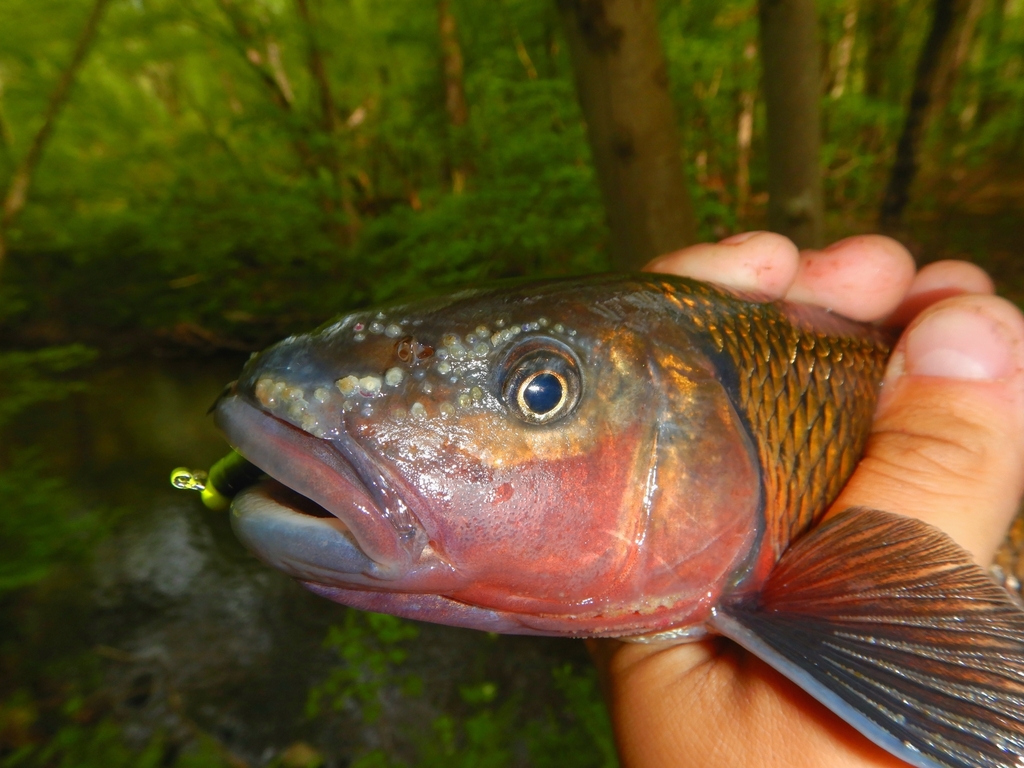
Fallfish
Semotilus corporalis
The fallfish (Semotilus corporalis) is a species of freshwater ray-finned fish in the family Leuciscidae. The fallfish is the largest minnow species native to Eastern North America.
From the article Fallfish on Wikipedia (CC BY-SA), quoted section by section
Description
Average specimens generally measure about 7 in (18 cm) in length, but individuals occasionally grow to 15 in (38 cm) with exceptional specimens of more than 19 in (48 cm) having been recorded. Juvenile fallfish have a dark stripe that runs down the center of their body. They are a silvery shade on the top and sides of the body, but have a white shading on the belly. Breeding males develop a pinkish tone on the opercular region, although the species does not develop bright breeding colors. Spawning males build stone nests, known as a redd, which form a prominent part of the bottom on many streams throughout the northeast. Spawning is communal with both males and females joining the nest builder.
Range & habitat
Fallfish are found in the northeastern United States and eastern Canada, where they inhabit clear streams, lakes, and ponds. They predominantly prefer swift currents, however, they can also be found in well oxygenated pools. As their name suggests they are often found at the base of waterfalls. Before the introduction of fish such as smallmouth bass, largemouth bass, and brown trout, the fallfish was the apex predator in many streams.
Wikipedia: “Distribution and habitat”
What it does
Juvenile and young fallfish primarily consume chironomids and zooplankton. Once they reach 100mm their diet transitions to small fish (including their own young) and prey of opportunity such as fish eggs and terrestrial insects. There is little overlap between the diets of juvenile and adult fallfish.
Wikipedia: “Diet and predation”
Where it lives
Recorded sightings
—
geo-referenced records in GBIF, from museums, herbaria and field observers.
Drag the globe to turn it. Dots are where records exist, not a range map; darker means more records.
In the stacks
Searching the stacks…
Every page naming Semotilus corporalis in the Biodiversity Heritage Library →
This page is assembled live from iNaturalist, GBIF, Wikipedia, the Source Library and the Internet Archive. It is not yet part of the hand-edited codex. iNaturalist taxon 112459.