- Animals
- ›Chordates
- ›Vertebrates
- ›Birds
- ›Perching Birds
- ›Ovenbirds and Woodcreepers
- ›Typical Ovenbirds
- ›Cranioleuca
On eBird ↗
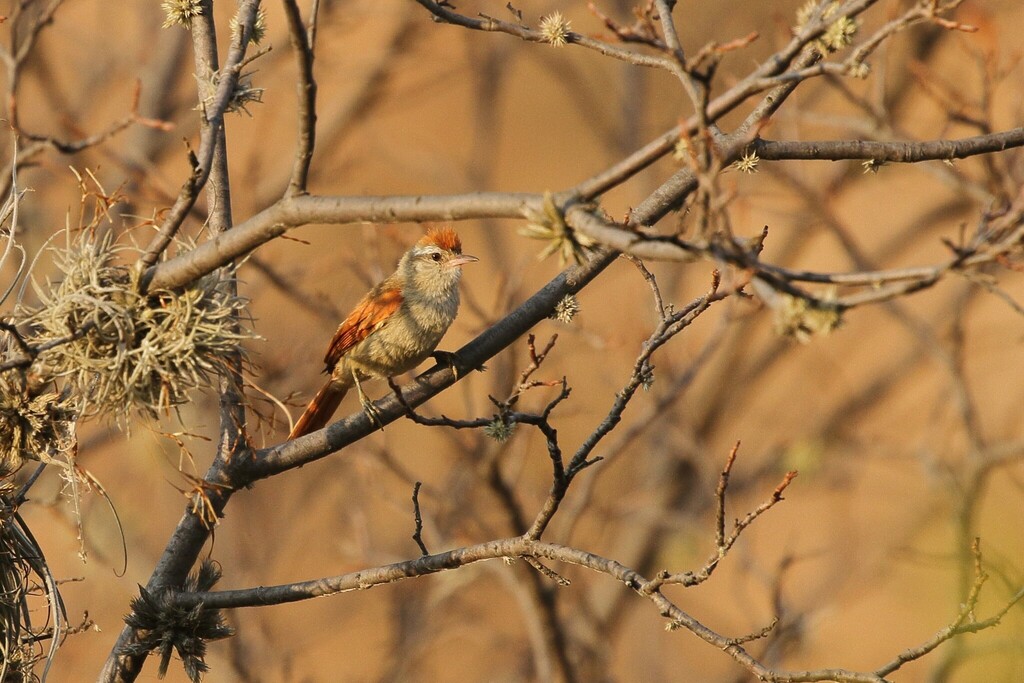
Bolivian Spinetail
Live sightings near you, the range map, bar charts of when it is seen, and Macaulay Library photos and recordings.
Bolivian Spinetail
Cranioleuca henricae
The Bolivian spinetail or Inquisivi spinetail (Cranioleuca henricae) is a species of bird in the Furnariidae family, which was discovered in 1993 near Inquisivi, in the department of La Paz.
From the article Bolivian spinetail on Wikipedia (CC BY-SA), quoted section by section
Description
The Bolivian spinetail is 14.5 to 15 cm (5.7 to 5.9 in) long. The sexes have the same plumage. Adults have a white supercilium and dirty white lores with black tips on an otherwise gray face. Their crown is rufous with buff and gray speckles on the forecrown. Their nape and back are light brownish olive, their rump tawny olive, and their uppertail coverts cinnamon brown. Their tail is rufous with a faint dusky wash on the innermost pair of feathers. Their wings are rufous with grayish brown inner webs on the primary coverts and fuscous tips to the flight feathers. Their chin and upper throat are dirty white and the rest of their underparts are light grayish olive with a faint buff tinge. Their iris is warm brown, their bill pink with a sooty tip to the mandible, and their legs and feet olive yellow or olivaceous. What is thought to be a juvenile had a crown the same color as the adult's back and a less distinct supercilium.
Range & habitat
The Bolivian spinetail is found only in a few valleys in Bolivia's northern and central Andes. Documented and sight records have come from a few locations in the departments of La Paz and Cochabamba. It inhabits deciduous forest, sometimes with columnar cacti and low bushes, and sometimes epiphytic lichens and Tillandsia on the trees. In elevation it is known to range between 1,600 and 2,300 m (5,200 and 7,500 ft) and might occur as high as 3,300 m (10,800 ft).
Wikipedia: “Distribution and habitat”
What it does
The Bolivian spinetail feeds on arthropods but details are lacking. During the breeding season it apparently forages in pairs and joins mixed-species feeding flocks in other seasons. It typically forages in the forest's lower levels, between 1 and 4 m (3 and 13 ft) above the ground, gleaning prey from bark and foliage.
Wikipedia: “Feeding”
Listen
Looking for field recordings…
Where it lives
Recorded sightings
—
geo-referenced records in GBIF, from museums, herbaria and field observers.
Drag the globe to turn it. Dots are where records exist, not a range map; darker means more records.
In the stacks
Searching the stacks…
Every page naming Cranioleuca henricae in the Biodiversity Heritage Library →
This page is assembled live from iNaturalist, GBIF, Wikipedia, the Source Library and the Internet Archive. It is not yet part of the hand-edited codex. iNaturalist taxon 11262.