- Animals
- ›Chordates
- ›Vertebrates
- ›Birds
- ›Perching Birds
- ›Ovenbirds and Woodcreepers
- ›Typical Ovenbirds
- ›Cranioleuca
On eBird ↗
Stripe-crowned Spinetail
Live sightings near you, the range map, bar charts of when it is seen, and Macaulay Library photos and recordings.
Stripe-crowned Spinetail
Cranioleuca pyrrhophia
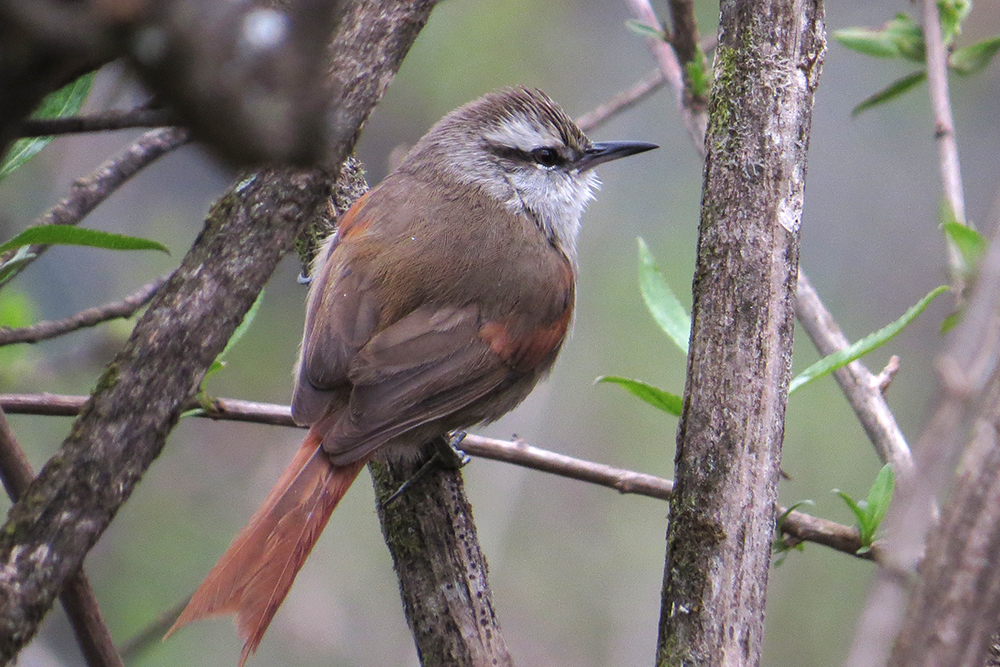
The stripe-crowned spinetail (Cranioleuca pyrrhophia) is a species of bird in the family Furnariidae. It is found in Argentina, Bolivia, Brazil, Paraguay, and Uruguay. Its natural habitats are subtropical or tropical dry forest and subtropical or tropical moist lowland forest. The species shows considerable plumage variation following Gloger's rule. It is known to hybridize with Cranioleuca obsoleta in Southern Rio Grande do Sul, Brazil.
From the article Stripe-crowned spinetail on Wikipedia (CC BY-SA), quoted section by section
Description
The stripe-crowned spinetail is 13 to 16 cm (5.1 to 6.3 in) long and weighs 10 to 16 g (0.35 to 0.56 oz). It is a smallish member of genus Cranioleuca and has unique crown and tail patterns. The species shows considerable plumage variation following Gloger's rule. The sexes have the same plumage. Adults of the nominate subspecies have a wide white supercilium, dark brown lores, dark brown behind the eye, and mixed whitish and brown ear coverts. Their crown is dramatically striped with blackish and buffy brown; the stripes are fainter in southern Brazil and Paraguay. Their hindcrown and back are grayish brown that is browner in southern Bolivia. Their rump and uppertail coverts are browner than the back. Their tail feathers are graduated and very pointed, giving a forked appearance. The central pair of feathers are dark brown or rufous with dark brown inner webs, the next two pairs rufous with dark brown along the shafts and on the tip, and the outer pair rufous. Their wing coverts are rufous, their primary coverts dark brown, and their flight feathers dull brownish. Their throat is whitish, their breast brownish gray or buffish gray, and their belly a darker gray. The breast and belly are paler in southern Bolivia. …
Range & habitat
The nominate subspecies of the stripe-crowned spinetail is by far the most widespread, and the southernmost representative of genus Cranioleuca. It is found in lowland southern Bolivia, in western Paraguay, in northeastern and central Argentina as far south as Río Negro Province, in essentially all of Uruguay, and in Brazil's southernmost state of Rio Grande do Sul. C. p. rufipennis is found in the Andes of Bolivia's La Paz and Cochabamba departments. C. p. striaticeps is found in Bolivia's central and southern Andes, in the departments of Cochabamba, Santa Cruz, and Tarija. The stripe-crowned spinetail inhabits a variety of landscapes including tropical deciduous forest, gallery forest, arid montane scrublands, dry savanna, semi-humid woodlands, and in the Andes Alnus and Podocarpus woodlands. In elevation it ranges from near sea level to 3,100 m (10,200 ft).
Wikipedia: “Distribution and habitat”
What it does
The stripe-crowned spinetail feeds on arthropods. It typically forages singly or in pairs and often joins mixed-species feeding flocks. It acrobatically gleans prey from bark, lichens, mosses, and epiphytes as it hitches and climbs along small branches from the forest's understorey to its canopy.
Wikipedia: “Feeding”
Listen
Looking for field recordings…
Where it lives
Recorded sightings
—
geo-referenced records in GBIF, from museums, herbaria and field observers.
Drag the globe to turn it. Dots are where records exist, not a range map; darker means more records.
In the stacks
Searching the stacks…
Every page naming Cranioleuca pyrrhophia in the Biodiversity Heritage Library →
This page is assembled live from iNaturalist, GBIF, Wikipedia, the Source Library and the Internet Archive. It is not yet part of the hand-edited codex. iNaturalist taxon 11266.