- Animals
- ›Chordates
- ›Vertebrates
- ›Ray-finned Fishes
- ›Spiny-rayed fishes
- ›Trout-perches, Pirate Perches, and Cavefishes
- ›Cavefishes
- ›Speoplatyrhinus
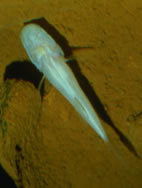
Alabama Cavefish
Speoplatyrhinus poulsoni
The Alabama cavefish (Speoplatyrhinus poulsoni) is a critically endangered species of amblyopsid cavefish found only in underground pools in Key Cave, located in northwestern Alabama, United States in the Key Cave National Wildlife Refuge. It was discovered underneath a colony of gray bats in 1967 by researchers Robert A. Kuehne and John E. Cooper and scientifically described in 1974.
On any single visit to the cave, no more than 10 individuals of this fish have been observed, and scientists estimate fewer than 100 are left. This species of fish is believed to be the rarest species of cavefish in the United States and one of the rarest of all freshwater fish, as researchers have failed to find the fish in any other location. The Alabama cavefish exists in a fragile ecosystem based on nutrient-rich guano of the gray bat.
From the article Alabama cavefish on Wikipedia (CC BY-SA), quoted section by section
Range & habitat
The Alabama cavefish is one of the rarest cavefish species in North America. While the specific habitat requirements of the fish are unknown, it is known that the Alabama cavefish is a cave obligate, restricted to Key Cave in Lauderdale County, Alabama. Key Cave is the critical habitat of the Alabama cavefish. Cave habitats tend to be stable, with drastic changes mainly being associated with the inflow of water. Annual rainfall and flooding in the cave produce changes in water level, temperature, and food availability for the fish. Researchers speculate that the flooding may trigger a hormonal change in the cavefish for growth and reproduction. Since the discovery of the cavefish, only nine specimens have been collected (all before 1983). Because very few individuals have been collected and observed, and the population is confined to Key Cave, the Alabama cavefish is believed to be the rarest of the American cavefish and the rarest of all freshwater fish. Since the underground water system in the area is so widespread, researchers had hoped that the cavefish had dispersed to other sites. However, studies of the 120 other caves in the area, conducted since 1977, have failed to locate any other Alabama cavefish populations. …
Wikipedia: “Habitat and distribution”
What it does
The diet of the Alabama cavefish, which consists of copepods, isopods, amphipods, and smaller cavefish, is supported by the nutrient-filled bat guano. It also can survive on other small organisms such as mites, spiders, millipedes, beetles, and other insects.
Wikipedia: “Diet”
Toxicity
The Alabama cavefish was first listed as a threatened species under the Endangered Species Act in 1977. Following further assessment of the species' range and changing environmental conditions, the cavefish was considered an endangered species in 1988. By 1990, a recovery plan was created for the fish, which stipulates that the species would be down-listed when the following three criteria are met: (1) three other viable populations are found in discontinuous aquatic systems outside the Key Cave area, (2) the aquifer recharge areas for all four populations are protected, and (3) all four populations are demonstrated to be stable or increasing over at least a 20-year period. In 2019, amendments to the recovery plan were made that changed the criteria for down-listing and created a criterion for delisting. For the cavefish to be down-listed, the criteria now stipulate that: (1) the species must demonstrate a stable or increasing trend in the existing Key Cave population, (2) two more cavefish populations must be created, and (3) the aquifer recharge areas must be delineated, mapped, and protected. In order for the cavefish to be delisted entirely, however, the aquifer recharge area must be protected by a conservation mechanism for at least one of the new populations and all other threats to the cavefish must be addressed or managed, allowing viability for the foreseeable future.
Wikipedia: “Endangered Species Act”
In human culture
There is little information available on both the life history and reproductive cycle of the Alabama cavefish. It is hypothesized that, because of the jugular position of the vent and the size of the branchial chamber, the Alabama cavefish practices branchial incubation, or mouth-brooding. The Alabama cavefish, like most fish, utilizes seasonal cues to trigger hormonal changes that lead to its growth and reproduction. While most fish rely on a large change in water temperature or photoperiod, the Alabama cavefish mainly relies on the flooding of the cave in the winter and spring. This flooding results in an increased inflow of water into the cave and a small temperature change, signaling to the cavefish to begin reproduction. Even with these cues, reproduction does not occur every year for the Alabama cavefish. In years when reproduction does occur, only a few eggs are produced per female. Assumptions about the life history of the Alabama cavefish are largely based on information from the Northern cavefish, which sees only about 20% of the females spawn in a given year. It is hypothesized that the population growth for the Alabama cavefish is less than half of that of the Northern cavefish. Furthermore, the maximum longevity of the Alabama cavefish is estimated to be around 5–10 years; however, this estimate could be off by a factor of 3 or 4.
Wikipedia: “Life history and reproduction”
Where it lives
Recorded sightings
—
geo-referenced records in GBIF, from museums, herbaria and field observers.
Drag the globe to turn it. Dots are where records exist, not a range map; darker means more records.
In the stacks
Searching the stacks…
Every page naming Speoplatyrhinus poulsoni in the Biodiversity Heritage Library →
This page is assembled live from iNaturalist, GBIF, Wikipedia, the Source Library and the Internet Archive. It is not yet part of the hand-edited codex. iNaturalist taxon 112886.