- Animals
- ›Chordates
- ›Vertebrates
- ›Cartilaginous Fishes
- ›Sharks and Rays
- ›Sharks
- ›Galean Sharks
- ›Ground Sharks
- ›Hammerhead and Winghead Sharks
- ›Sphyrna
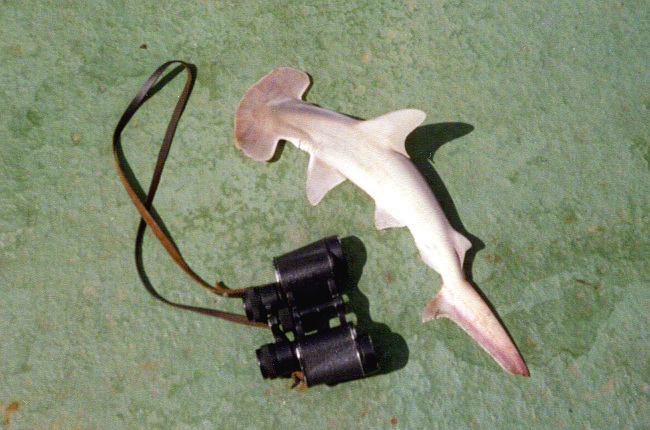
Scoophead
Sphyrna media
The scoophead (Sphyrna media) is a little-known species of hammerhead shark, part of the family Sphyrnidae. It inhabits the tropical waters of the western Atlantic Ocean, from Panama to southern Brazil, and in the eastern Pacific Ocean from the Gulf of California to Ecuador, and probably northern Peru, as well. It is found in shallow, inshore habitats.
One of the smaller hammerheads, the scoophead measures 150 cm long; adult males measure 90 cm long and adult females 100–133 cm. It is distinguished by its moderately broad, mallet-shaped head (22–33% as wide as the body is long). The forward margin of the head is arched, with weak medial and lateral indentations and no prenarial grooves, traits that this species shares with the scalloped bonnethead (Sphyrna corona). It is distinguished from the scalloped bonnethead by its shorter snout, broadly arched mouth, and deeply concave anal fin. The first dorsal fin is moderately falchate, and the second dorsal fin is as tall as the anal fin. The pelvic fins are not falchate, with a straight to moderately concave rear margin. Its coloration is grey-brown above, light below, with no fin markings.
Where it lives
Recorded sightings
—
geo-referenced records in GBIF, from museums, herbaria and field observers.
Drag the globe to turn it. Dots are where records exist, not a range map; darker means more records.
In the stacks
Searching the stacks…
Every page naming Sphyrna media in the Biodiversity Heritage Library →
This page is assembled live from iNaturalist, GBIF, Wikipedia, the Source Library and the Internet Archive. It is not yet part of the hand-edited codex. iNaturalist taxon 112959.