- Animals
- ›Chordates
- ›Vertebrates
- ›Cartilaginous Fishes
- ›Sharks and Rays
- ›Sharks
- ›Galean Sharks
- ›Ground Sharks
- ›Hammerhead and Winghead Sharks
- ›Sphyrna
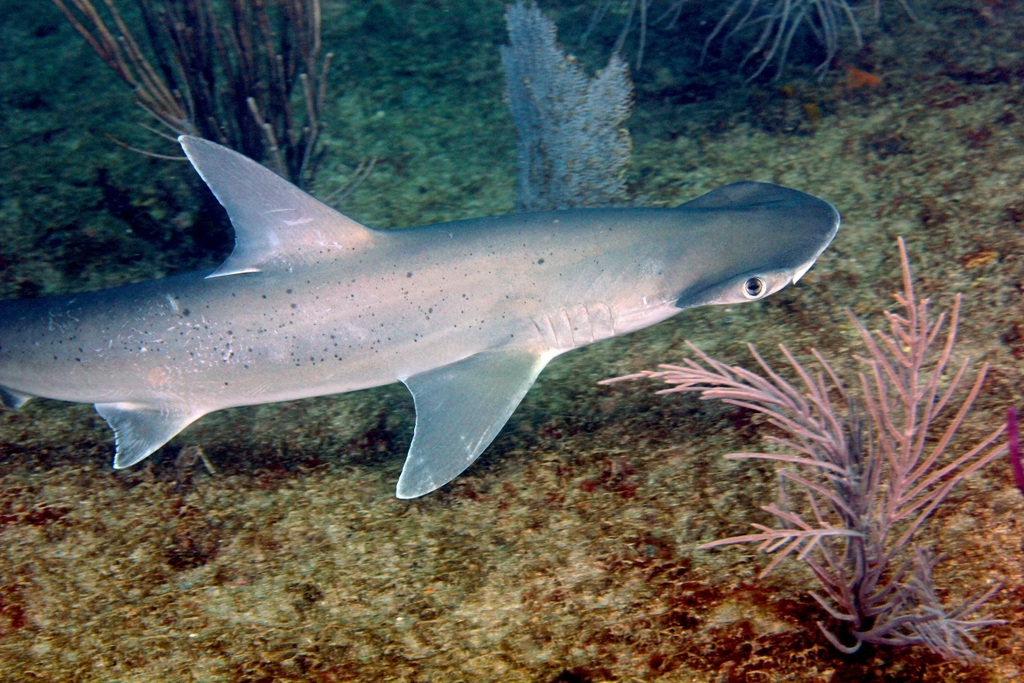
Bonnethead
Sphyrna tiburo
The bonnethead (Sphyrna tiburo), also called a bonnet shark or shovelhead, is the smallest member of the hammerhead shark genus Sphyrna, and part of the family Sphyrnidae. It is an abundant species in the littoral zone of the North Atlantic and the Gulf of Mexico, is the only shark species known to display sexual dimorphism in the morphology of the head, and is one of two shark species known to be omnivorous.
From the article Bonnethead on Wikipedia (CC BY-SA), quoted section by section
Description
The shark is characterized by a broad, smooth, spade-like head: it has the smallest cephalofoil (hammerhead) of all Sphyrna species. The body is grey-brown above and lighter on the underside. Typically, bonnethead sharks are about 80–90 cm (2.6–3.0 ft) long, with a maximum size of about 150 cm (4.9 ft). The generic name Sphyrna probably derives from a misspelling of sphyra, the Greek word for "hammer"; the specific name tiburo derives from the Spanish word tiburón, meaning "shark".
Range & habitat
This species occurs on both sides of the American coast, in regions where the water is usually warmer than 70 °F (21 °C). In the Atlantic, it ranges from New England, where it is rare, to the Gulf of Mexico and Brazil, and in the Pacific it ranges from southern California to northern Peru. During the summer, it is common in the inshore waters of the Carolinas and Georgia; in spring, summer, and fall, it is found off Florida and in the Gulf of Mexico. In the winter, the bonnethead shark is found closer to the equator, where the water is warmer. While it is still abundant in the North Atlantic Ocean and Gulf of Mexico, it has become significantly less common in the Caribbean Sea, and has been nearly extirpated from most of its South Atlantic and Pacific range. It frequents shallow estuaries and bays over seagrass, mud, and sandy bottoms.
Wikipedia: “Distribution and habitat”
What it does
The bonnethead shark is an active tropical shark that swims in small groups of five to 15 individuals, although schools of hundreds or even thousands have been reported. They move constantly following changes in water temperature and to maintain respiration. The bonnethead shark sinks if it does not keep moving, since hammerhead sharks are among the most negatively buoyant of marine vertebrates.
Wikipedia: “Behavior”
Where it lives
Recorded sightings
—
geo-referenced records in GBIF, from museums, herbaria and field observers.
Drag the globe to turn it. Dots are where records exist, not a range map; darker means more records.
In the stacks
Searching the stacks…
Every page naming Sphyrna tiburo in the Biodiversity Heritage Library →
This page is assembled live from iNaturalist, GBIF, Wikipedia, the Source Library and the Internet Archive. It is not yet part of the hand-edited codex. iNaturalist taxon 112960.