- Animals
- ›Chordates
- ›Vertebrates
- ›Birds
- ›Perching Birds
- ›Ovenbirds and Woodcreepers
- ›Typical Ovenbirds
- ›Asthenes
On eBird ↗
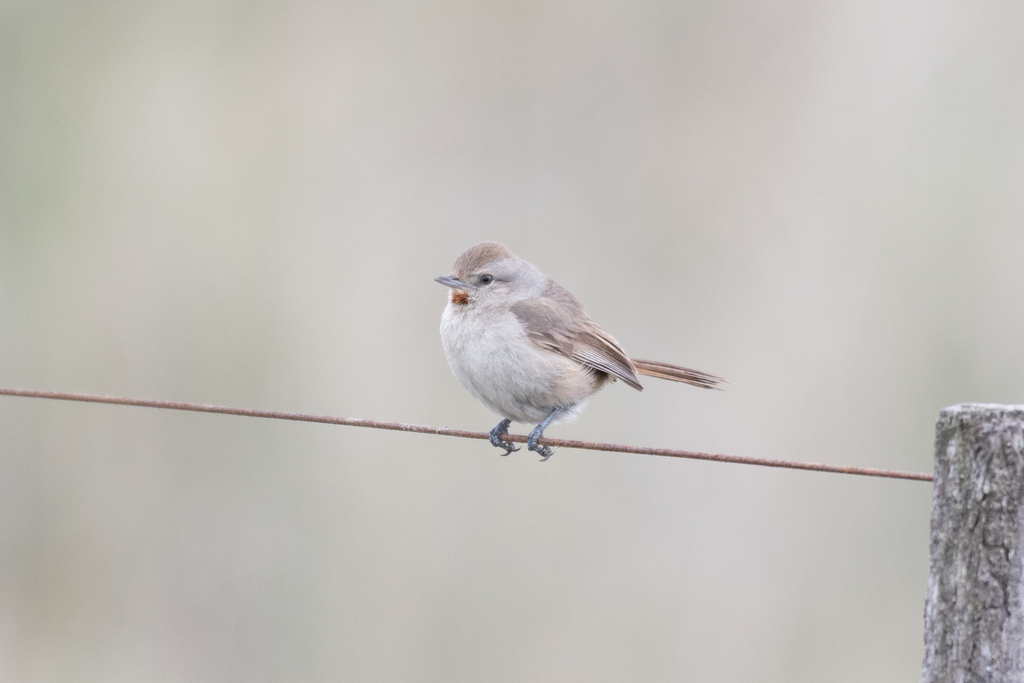
Short-billed Canastero
Live sightings near you, the range map, bar charts of when it is seen, and Macaulay Library photos and recordings.
Short-billed Canastero
Asthenes baeri
The short-billed canastero (Asthenes baeri) is a species of bird in the family Furnariidae. It is found in Argentina, Bolivia, Brazil, Paraguay, and Uruguay. Its natural habitat is subtropical or tropical dry shrubland. Three subspecies are recognized:
From the article Short-billed canastero on Wikipedia (CC BY-SA), quoted section by section
Description
The short-billed canastero is 14 to 15 cm (5.5 to 5.9 in) long and weighs 10 to 18 g (0.35 to 0.63 oz). It has a short and thick bill, and is more similar to the wholly unrelated little thornbird (Phacellodomus sibilatrix) than to other canasteros. The sexes have the same plumage. Adults of the nominate subspecies have an indistinct wide grayish supercilium on an otherwise dull grayish brown face. Their crown is dull gray-brown, their back a slightly grayer brown, and their rump and uppertail coverts gray with a brown tinge. Their wings are mostly dull grayish brown with paler gray edges on the coverts and flight feathers. Their tail's innermost two pairs of feathers are mostly dark brownish fuscous and the rest mostly dull rufous. Their chin is pale grayish, their upper throat orange-tawny with a darker lower margin, and their lower throat, breast, and belly pale dull grayish. Their flanks and undertail coverts are pale rufescent. Their iris is brown to grayish brown, their maxilla black to dark gray or dark brown, their mandible gray to pinkish gray, and their legs and feet gray to brownish gray. Juveniles have little or no orange-tawny on the throat and a mottled upper breast. Subspecies A. b. chacoensis is very slightly paler than the nominate and has a whiter supercilium and more rufous on the tail. A. b. …
Range & habitat
The nominate subspecies of the short-billed canastero is found in southern Bolivia, western Paraguay, central Argentina, extreme southeastern Brazil, and western Uruguay. Subspecies A. b. chacoensis is found in extreme south-central Bolivia and northwestern Paraguay. A. b. neiffi is found in western Argentina. The species inhabits arid lowland scrublands, Gran Chaco scrub and woodlands, and woodlands of the Monte Desert. In elevation it ranges from sea level to 1,300 m (4,300 ft).
Wikipedia: “Distribution and habitat”
What it does
The short-billed canastero feeds on a wide variety of arthropods. It forages singly or in pairs, apparently capturing prey by gleaning low vegetation and to a lesser extent on the ground.
Wikipedia: “Feeding”
Listen
Looking for field recordings…
Where it lives
Recorded sightings
—
geo-referenced records in GBIF, from museums, herbaria and field observers.
Drag the globe to turn it. Dots are where records exist, not a range map; darker means more records.
In the stacks
Searching the stacks…
Every page naming Asthenes baeri in the Biodiversity Heritage Library →
This page is assembled live from iNaturalist, GBIF, Wikipedia, the Source Library and the Internet Archive. It is not yet part of the hand-edited codex. iNaturalist taxon 11320.