- Animals
- ›Chordates
- ›Vertebrates
- ›Birds
- ›Perching Birds
- ›Ovenbirds and Woodcreepers
- ›Typical Ovenbirds
- ›Cinclodes
On eBird ↗
Dark-bellied Cinclodes
Live sightings near you, the range map, bar charts of when it is seen, and Macaulay Library photos and recordings.
Dark-bellied Cinclodes
Cinclodes patagonicus
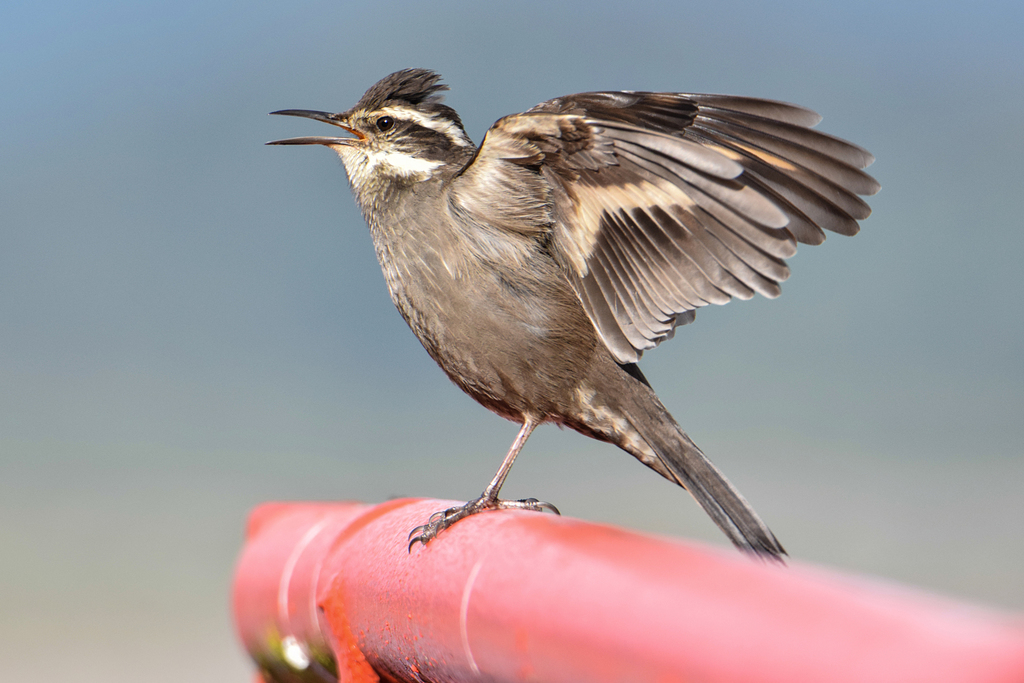
The dark-bellied cinclodes (Cinclodes patagonicus) is a species of bird in the family Furnariidae. It is found in Argentina and Chile. Its natural habitats are rivers and rocky shores. The dark-bellied cinclodes is distributed in Chile from about Santiago southwards to Tierra del Fuego and in adjacent areas of extreme western Argentina. It is found near streams, lakes and marshlands from sea level up to 2,500 m. It has a bold white supercilium and throat.
From the article Dark-bellied cinclodes on Wikipedia (CC BY-SA), quoted section by section
Description
The dark-bellied cinclodes is 18 to 20 cm (7.1 to 7.9 in) long and weighs about 36 to 50 g (1.3 to 1.8 oz). It is a largish cinclodes with a long decurved bill. The sexes have the same plumages, and the two subspecies differ very little. Adults of the nominate subspecies have a white supercilium that begins at the forehead, dark brown lores and ear coverts, and a white malar area with some faint darker flecks. Their crown and nape are dark brown and their upperparts a slightly lighter brown. Their wings are dark brown with blackish brown primary coverts. Their primary coverts and flight feathers each have a thin pale rufous-tinged white band. Their tail is dark brown; the outer three pairs of feathers have progressively more tawny-whitish on their tips. Their throat is whitish with faint darker specks and their underparts mostly dull dark brown. Their upper breast has pale spots that become streaks through the lower breast onto the upper belly. Their undertail coverts are dark brown with whitish tips. Their iris is dark brown, their bill brown to blackish, and their legs and feet brown to blackish. Juveniles are like adults with pale edges on the feathers of their back and less distinct breast markings. Subspecies C. p. chilensis is slightly smaller than the nominate, with buffier tips on the outer tail feathers and slightly browner underparts with less streaking on the belly.
Range & habitat
The dark-bellied cinclodes is native to the southern cone of South America. Subspecies C. p. chilensis is the more northerly. It is found in south-central Chile between the Atacama and Aysén regions and in adjacent western Argentina between Mendoza Province and Santa Cruz Province. The nominate subspecies is found south to Tierra del Fuego from Aysén in Chile and Santa Cruz in Argentina. The species inhabits a variety of landscapes, all of which are associated with water. These include rocky coastal beaches, lakesides, river and stream banks, and the edges of wet forest. Even in semi-arid areas it stays near water. In the northern part of its range it mostly occurs inland but in the south it is found at sea level. In the Andes it reaches elevations of about 3,500 m (11,500 ft).
Wikipedia: “Distribution and habitat”
What it does
The dark-bellied cinclodes feeds on marine and terrestrial invertebrates, and always near water. It usually forages singly or in pairs, gleaning prey from the ground, rocks, debris on beaches, and the water's edge.
Wikipedia: “Feeding”
Listen
Looking for field recordings…
Where it lives
Recorded sightings
—
geo-referenced records in GBIF, from museums, herbaria and field observers.
Drag the globe to turn it. Dots are where records exist, not a range map; darker means more records.
In the stacks
Searching the stacks…
Every page naming Cinclodes patagonicus in the Biodiversity Heritage Library →
This page is assembled live from iNaturalist, GBIF, Wikipedia, the Source Library and the Internet Archive. It is not yet part of the hand-edited codex. iNaturalist taxon 11379.