- Animals
- ›Chordates
- ›Vertebrates
- ›Cartilaginous Fishes
- ›Sharks and Rays
- ›Rays
- ›Electric Rays
- ›Sleeper Rays
- ›Temera
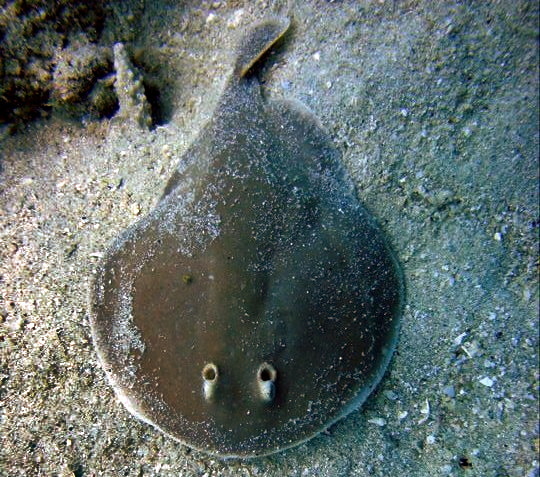
Finless Sleeper Ray
Temera hardwickii
The finless sleeper ray (Temera hardwickii) is a species of electric ray in the family Narkidae, and the sole member of its genus. It is found over the continental shelf of Southeast Asia from the eastern Andaman Sea to Vietnam and Borneo. Typically growing no more than 15 cm (5.9 in) long, it may be the smallest cartilaginous fish. The finless sleeper ray is the only electric ray that lacks dorsal fins. It has an oval pectoral fin disc that varies from longer than wide to wider than long, depending on age, and a short, robust tail that terminates in a short, deep caudal fin. The trailing margins of its pelvic fins are sexually dimorphic, being more concave in males.
Like other members of its family, the finless sleeper ray can generate a defensive electric shock from paired electric organs in its disc. It gives birth to live young, with the developing embryos nourished by yolk. A litter size of four has been recorded from one individual. The International Union for Conservation of Nature (IUCN) has assessed the finless sleeper ray as Vulnerable. This slow-reproducing species is caught by intensive bottom trawl and possibly other fisheries throughout its range, which likely cause high mortality regardless of whether it is discarded or utilised.
From the article Finless sleeper ray on Wikipedia (CC BY-SA), quoted section by section
Description
The pectoral fin disc of the finless sleeper ray is oval in shape; it is slightly wider than long in adults, and circular or longer than wide in juveniles. The small and bulging eyes are immediately followed by smooth-rimmed spiracles of roughly equal size. A pair of kidney-shaped electric organs are visible beneath the skin on either side of the head. A curtain of skin, reaching the mouth, is present between the small, circular nostrils. The nostrils are connected to the corners of the mouth by a pair of grooves. The small mouth is gently arched and protrusible. The flattened teeth have hexagonal bases and are arranged into narrow bands. There are five pairs of short gill slits. The pelvic fins are only slightly overlapped by the disc; each is long, wide, and roughly triangular, with trailing margins that are more concave in males than in females. The tail is stout and much shorter than the disc. Unique amongst electric rays, there are no dorsal fins. The tail terminates in a fairly large, triangular caudal fin about as long as wide, with rounded corners. The skin entirely lacks dermal denticles. This species is plain light brown dorsally, sometimes with darker markings and whitish spots, and pale ventrally, with broad darker margins on the pectoral and pelvic fins. …
Range & habitat
The range of the finless sleeper ray extends from the eastern Andaman Sea, near southern border between Thailand and Myanmar, through the Strait of Malacca to Singapore, and northward to Vietnam. Its exact distribution off Thailand is uncertain. There is a single record of this species from Sarawak in Borneo. This bottom-dwelling species inhabits fine sediment habitat over the continental shelf in both inshore and offshore waters. In the 19th century, it was reportedly abundant year-round in the Straits of Malacca. It is locally common in some areas.
Wikipedia: “Distribution and habitat”
What it does
The finless sleeper ray can produce a moderate electric shock for defence against predators. The shock originates from the two electric organs, each about one-third as long as the ray. The organs consist of numerous fluid-filled pentagonal or hexagonal columns, which essentially act as batteries connected in parallel. This species probably feeds on small invertebrates. The robust structure of its jaws suggest that it may prefer hard-shelled prey. Theodore Edward Cantor wrote in an 1850 account that this species was often infested by minute worms under the skin, which he termed "Cysteocercus temerae" and classified as "entozoa" (an obsolete grouping that included acanthocephalans, trematodes, cestodes, and nematodes). Reproduction in the finless sleeper ray is viviparous, with the embryos sustained through gestation by a yolk sac. A single account exists of a pregnant female 10.5 cm (4.1 in) long that contained four late-term foetuses each 2.9 cm (1.1 in) long; the young were similar in form and colouration to the adult, but had thicker discs. Males reach sexual maturity at around 8.2–10.9 cm (3.2–4.3 in) in length, and females at around 10.5–14.8 cm (4.1–5.8 in) in length.
Wikipedia: “Biology and ecology”
Where it lives
Recorded sightings
—
geo-referenced records in GBIF, from museums, herbaria and field observers.
Drag the globe to turn it. Dots are where records exist, not a range map; darker means more records.
In the stacks
Searching the stacks…
Every page naming Temera hardwickii in the Biodiversity Heritage Library →
This page is assembled live from iNaturalist, GBIF, Wikipedia, the Source Library and the Internet Archive. It is not yet part of the hand-edited codex. iNaturalist taxon 113885.