- Animals
- ›Chordates
- ›Vertebrates
- ›Reptiles
- ›Snakes and Lizards
- ›Lizards
- ›Geckos
- ›Sphaeros and Allies
- ›Teratoscincus
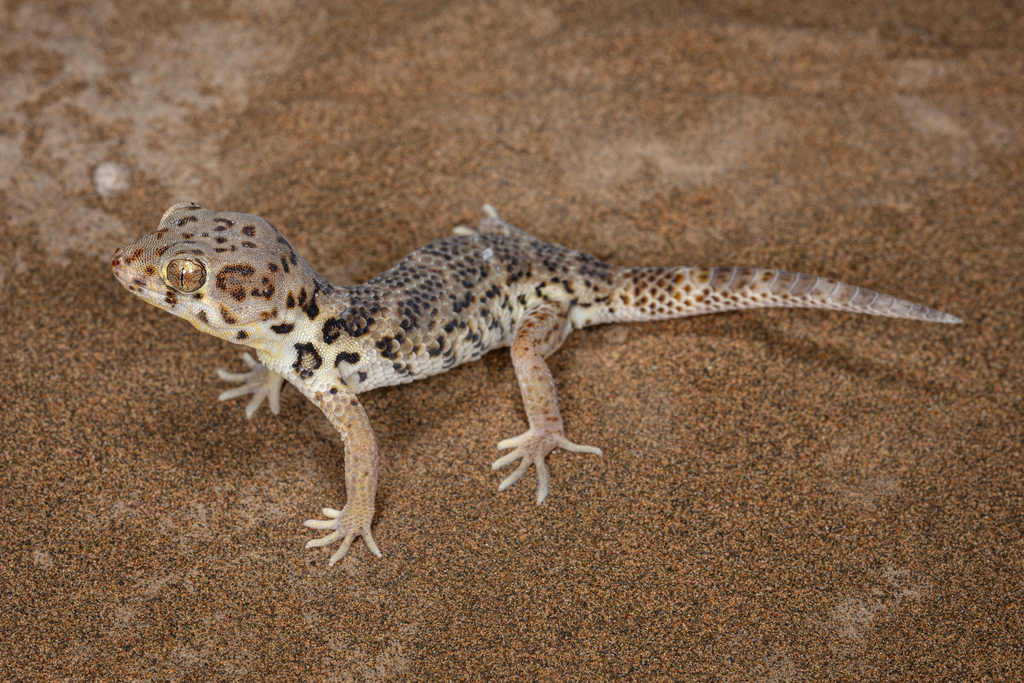
Tibetan Wonder Gecko
Teratoscincus roborowskii
Teratoscincus roborowskii, commonly known as the Tibetan wonder gecko or Turpan wonder gecko, is a species of gecko in the family Sphaerodactylidae. The species is endemic to the Turpan Depression in Xinjiang, northwestern China, where it occurs in arid shrubland and desert habitats. It reaches a snout-vent length of 75.5–93.6 mm (3.0–3.7 in), and adult males tend to have wider heads than adult females.
This lizard is a nocturnal and ground-dwelling species, emerging from its burrow to forage at night. Its diet shifts seasonally, feeding mainly on insects in spring and fruit in summer and autumn. The fruit of the caper bush is an important food item in certain months, and the gecko is also a seed disperser for this plant. During the winter, this reptile hibernates in its burrow.
From the article Teratoscincus roborowskii on Wikipedia (CC BY-SA), quoted section by section
Description
A moderately sized lizard, the adults of this species reach a snout-vent length of 75.52–93.62 mm (2.973–3.686 in) and exhibit sexual dimorphism, with males having wider heads than females. On average, adult head width is 20.31 mm (0.800 in) in males and 19.77 mm (0.778 in) in females, though juveniles show no significant differences between sexes. This species has large eyes, while the snout and tail are short. The scales on the head are small, while those on the torso and tail are large and overlapping. The large cycloid scales on the back of the neck are arranged tapering from the forelimb level to the ear level, a feature distinguishing this species from the related common wonder gecko and Przewalski's wonder gecko. Adults have a largely orange background color with irregular dark spots on the upper surface, while the underside and flanks are lighter. Juveniles have thin dark crossbands on the upper surface that are lost with age. Five to eight of these bands may be present on the body and four to six may be on the tail, but most commonly there are seven and five bands on the body and tail respectively. This patterning may be mimicry of Mesobuthus scorpions, which have seven body plates and five tail segments.
Range & habitat
The Turpan wonder gecko is endemic to the Turpan Depression in Xinjiang, China, where it occurs in sandy areas such as shrubland and deserts. Older records of it being found in Gansu are now believed to be erroneous. Its habitat is arid, with an average annual precipitation of 16.4 mm (0.65 in), and an annual evaporation of 3,000 mm (9.8 ft). It occurs at a wide range of elevations, being recorded from 100 m (330 ft) below to 470 m (1,540 ft) above sea level, and has an estimated extent of occurrence of 6811 km². Dead wood is an important microhabitat for the species, providing shelter, foraging and thermoregulation.
Wikipedia: “Distribution and habitat”
What it does
This reptile is a nocturnal species, retreating to burrows during the day and emerging to feed at night. It is active in temperatures from 17–41 °C (63–106 °F) and hibernates in its burrow from October to late March. Though mostly solitary, male-female pairs have been seen emerging from the same burrows. It is a ground-dwelling species that forages mostly near or under vegetation, and may flee towards shrubs if disturbed on bare ground. The species is oviparous, and the females lay clutches of one or two eggs among shrubs.
Diet. This lizard is an omnivorous species with a varied diet. It is primarily carnivorous, with animal matter making up approximately 80% of its food intake, and feeds mostly on insects. Seasonal shifts have been recorded in its diet: from April to May it consumes mainly ants, darkling beetles and ground beetles, whereas from June to September plant fruits become a significant food item and darkling beetles are consumed less. This shift in diet seasonally alters the gut flora of the lizard, with lower microbiota diversity but more different phyla and families present in autumn than in spring. The fruit of the caper bush, which begins ripening in July, is reported to be its main plant food item and can comprise 85% of its diet in summer and autumn. …
Wikipedia: “Behavior and ecology”
Where it lives
Recorded sightings
—
geo-referenced records in GBIF, from museums, herbaria and field observers.
Drag the globe to turn it. Dots are where records exist, not a range map; darker means more records.
In the stacks
Searching the stacks…
Every page naming Teratoscincus roborowskii in the Biodiversity Heritage Library →
This page is assembled live from iNaturalist, GBIF, Wikipedia, the Source Library and the Internet Archive. It is not yet part of the hand-edited codex. iNaturalist taxon 113904.