On eBird ↗
Indian Yellow-nosed Albatross
Live sightings near you, the range map, bar charts of when it is seen, and Macaulay Library photos and recordings.
Indian Yellow-nosed Albatross
Thalassarche carteri
The Indian yellow-nosed albatross (Thalassarche carteri) is a member of the albatross family, and is the smallest of the mollymawks. In 2004, BirdLife International split this species from the Atlantic yellow-nosed albatross; however Clements has not split it yet, and the SACC has not either, but recognises the need for a proposal.
From the article Indian yellow-nosed albatross on Wikipedia (CC BY-SA), quoted section by section
Description
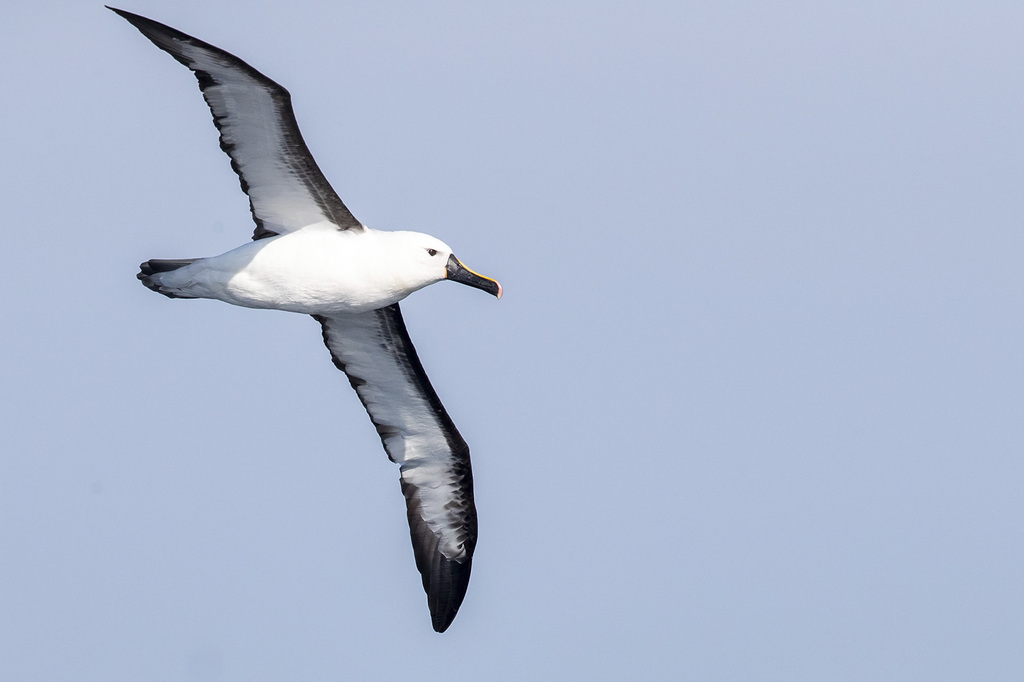
The Indian yellow-nosed albatross weighs 2.55 kg (5.6 lb), is 76 cm (30 in) long and is 2 m (6.6 ft) across the wings. The adult has a pale grey or white head and nape, with a dark grey mantle, upperwing, and tail. Its rump and underparts are white, and its underwing is white with a black tip with a narrow black margin at the leading edge. Its bill is black with a yellow upper ridge and a red tip. The juvenile has a white head and all black bill. It is difficult to distinguish from the closely related grey-headed albatross and Atlantic yellow-nosed albatross, the latter with which it was long considered conspecific and is still considered by some a subspecies of. It can be distinguished from the Atlantic yellow-nosed by its head, the grey plumage of which is lighter on the Indian yellow-nosed.
Range & habitat
It breeds on Prince Edward Islands, the Crozet Islands, Kerguelen Island, Amsterdam Island (on the Falaises d'Entrecasteaux) and St Paul Islands in the Indian Ocean. When feeding during incubation, birds will forage up to 1,500 km (930 mi) from the colony. At sea it ranges from South Africa to the Pacific Ocean just beyond New Zealand, ranging from 30° S to 50° S.
Wikipedia: “Range and habitat”
What it does
Like all albatrosses, the Indian yellow-nosed albatross is a colonial breeder. It breeds annually, and the adults begin breeding at the age of eight years. A mud nest is built in bare rocky areas or in tussock grass or ferns, and a single egg is laid. The nesting season begins in August, with laying occurring around September/October. Incubation lasts around 70 days. After hatching the chick takes around 115 days to fledge.
Wikipedia: “Reproduction”
Listen
Looking for field recordings…
Where it lives
Recorded sightings
—
geo-referenced records in GBIF, from museums, herbaria and field observers.
Drag the globe to turn it. Dots are where records exist, not a range map; darker means more records.
In the stacks
Searching the stacks…
Every page naming Thalassarche carteri in the Biodiversity Heritage Library →
This page is assembled live from iNaturalist, GBIF, Wikipedia, the Source Library and the Internet Archive. It is not yet part of the hand-edited codex. iNaturalist taxon 113965.