- Animals
- ›Chordates
- ›Vertebrates
- ›Reptiles
- ›Snakes and Lizards
- ›Snakes
- ›Colubrid Snakes
- ›Colubrine Snakes
- ›Thelotornis
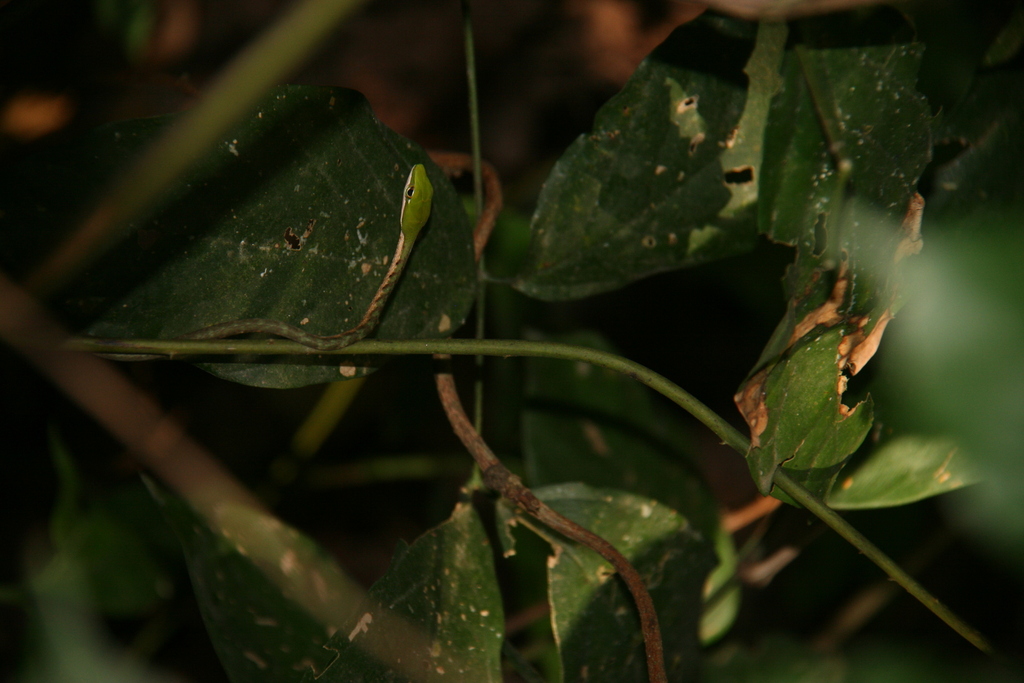
Bird Snake
Thelotornis kirtlandii
The forest vine snake (Thelotornis kirtlandii), also known commonly as the forest twig snake or simply the twig snake, and as the bird snake (as are other members of the genus Thelotornis), is a species of venomous snake in the subfamily Colubrinae of the family Colubridae. The species is endemic to Africa.
From the article Forest vine snake on Wikipedia (CC BY-SA), quoted section by section
Description
As an adult, T. kirtlandii usually has a total length (including tail) of 0.9–1.4 m (3.0–4.6 ft). The maximum recorded total length is 1.6 m (5.2 ft). The body and tail are very thin and are cylindrical in cross section. The tail is very long, 33% to 42% of the total length. The dorsal scales are arranged in 19 rows at midbody, and are feebly keeled. The top of the head is green, and the upper labials and chin are white. Dorsally, the body and tail are grayish brown. Ventrally, the snake is light gray, speckled with black.
Range & habitat
T. kirtlandii is found in Sub-Saharan Africa, south to a latitude of about 17° S. It has been recorded from Angola, Benin, Cameroon, Central African Republic, Congo, DR Congo, Equatorial Guinea, Gabon, Ghana, Guinea, Guinea-Bissau, Ivory Coast, Kenya, Liberia, Nigeria, Sierra Leone, Somalia, Tanzania, Togo, Uganda, and Zambia.
Wikipedia: “Geographic range”
Toxicity
T. kirtlandii produces a venom which is slow acting but potentially lethal. It causes non-clotting of blood and renal failure. There is no antivenom.
Wikipedia: “Venom”
In human culture
The specific name, kirtlandii, is in honor of American naturalist Jared Potter Kirtland.
Wikipedia: “Etymology”
Where it lives
Recorded sightings
—
geo-referenced records in GBIF, from museums, herbaria and field observers.
Drag the globe to turn it. Dots are where records exist, not a range map; darker means more records.
In the stacks
Searching the stacks…
Every page naming Thelotornis kirtlandii in the Biodiversity Heritage Library →
This page is assembled live from iNaturalist, GBIF, Wikipedia, the Source Library and the Internet Archive. It is not yet part of the hand-edited codex. iNaturalist taxon 114036.