- Animals
- ›Chordates
- ›Vertebrates
- ›Birds
- ›Perching Birds
- ›Ovenbirds and Woodcreepers
- ›Woodcreepers
- ›Glyphorynchus
On eBird ↗
Wedge-billed Woodcreeper
Live sightings near you, the range map, bar charts of when it is seen, and Macaulay Library photos and recordings.
Wedge-billed Woodcreeper
Glyphorynchus spirurus
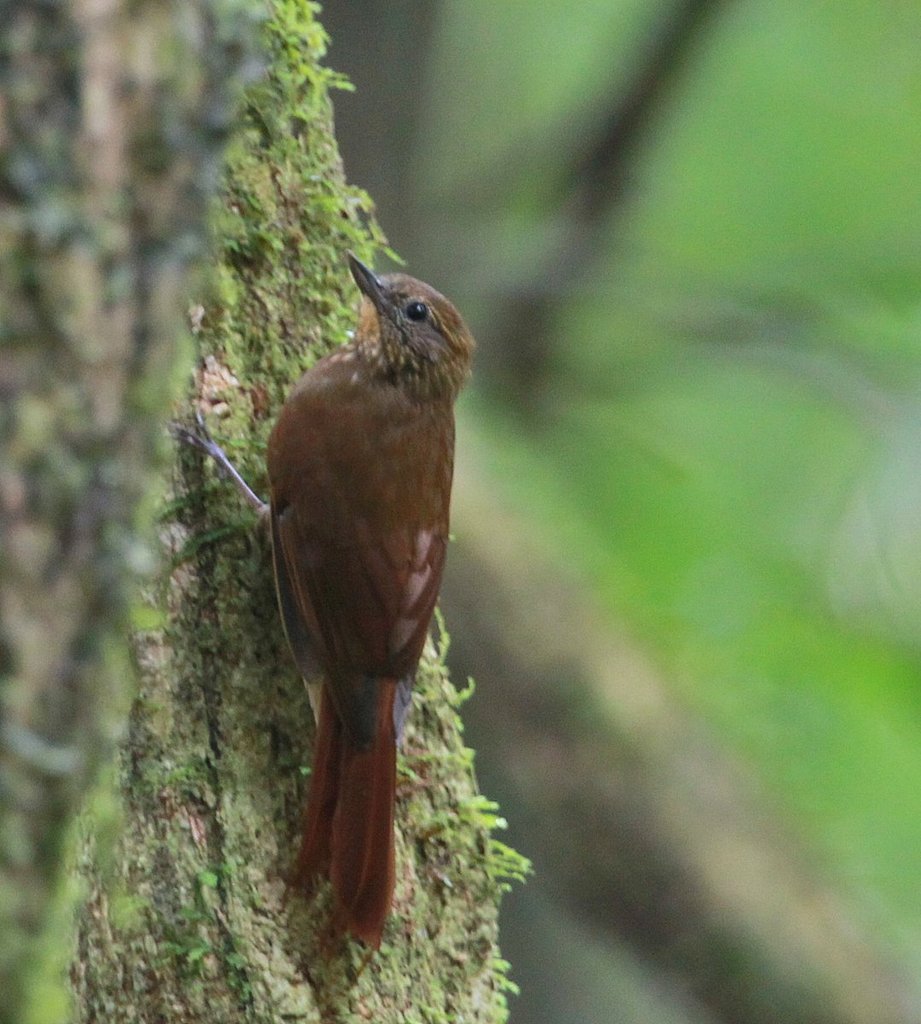
The wedge-billed woodcreeper (Glyphorynchus spirurus), is a passerine bird which breeds in the tropical New World from southern Mexico to northern Bolivia, central Brazil and the Guianas; it is absent from the Pacific coastal areas except between Costa Rica and Ecuador. It is the only member of the genus Glyphorynchus.
From the article Wedge-billed woodcreeper on Wikipedia (CC BY-SA), quoted section by section
Description
The wedge-billed woodcreeper is the smallest woodcreeper, with a short, upturned, wedge-shaped bill resembling those of the three members of genus Xenops. It is 13 to 16 cm (5.1 to 6.3 in) long and weighs 10.5 to 21 g (0.37 to 0.74 oz). The sexes are alike. The nominate subspecies G. s. spirurus has a grayish forehead, a rich brown to russet-brown crown and nape, light buff lores, a thin buff to buff-white supercilium, a buff eyering, sooty-brown auriculars, and a brown malar stripe. Its upper back and scapulars are rich brown to russet-brown, and its lower back, uppertail coverts, and tail are cinnamon-rufous to rufous-chestnut. Its wing coverts are russet, its inner secondaries rufous, and its other secondaries and its primaries dark brown with blackish tips. The underside of most wing feathers have a stripe of buff to buff-white that shows as a band in flight. The sides of its neck are brown with small buff spots and its throat is whitish buff to buff with some dusky spots. Its underparts are olive-brown to russet-brown, its undertail coverts have a rufous-chestnut wash, and its underwing coverts and axillaries are white. Its upper breast has large round fulvous spots and its lower breast has narrow streaks of the same color. …
Range & habitat
The subspecies of the wedge-billed woodcreeper are found thus:
G. s. pectoralis, from Veracruz in southern Mexico south on the Caribbean slope through Belize, Guatemala, Honduras, and Nicaragua onto the Caribbean and Pacific slopes through Costa Rica into central and western Panama. At least one record from El Salvador. G. s. subrufescens, Pacific slope of southeastern Panama south through western Colombia into western Ecuador as far as El Oro Province G. s. pallidulus, both slopes of eastern Panama into Colombia's Chocó Department G. s. integratus, northern Colombia and east of its Andes into western Venezuela G. s. rufigularis, the Amazon Basin north of the Amazon River from central Colombia and southern Venezuela south into northeastern Ecuador and northwestern Brazil east to the Rio Negro G. s. amacurensis, northeastern Venezuela's Sucre and Delta Amacuro states G. s. spirurus, the Amazon Basin north of the Amazon River from eastern Venezuela east through the Guianas and Brazil from the Rio Negro to the Atlantic Ocean G. s. coronobscurus, Cerro de la Neblina in southern Venezuela G. s. castelnaudii, the Amazon Basin south of the Rio Napo and Amazon River from eastern and northeastern Peru into Brazil east to the Rio Madeira G. s. albigularis, the Amazon Basin in southeastern Peru and northern Bolivia G. s. …
Wikipedia: “Distribution and habitat”
What it does
The wedge-billed woodcreeper usually forages in pairs or as a member of mixed-species feeding flocks, especially those led by Thamnomanes antshrikes. It seldom follows army ant swarms but will feed at the edges of them when a feeding flock encounters a swarm. It mostly feeds in the lower to middle levels of the forest though it will go higher. Its diet is almost entirely very small arthropods, which it captures while hitching up a trunk or less often along a branch. It picks prey from crevices and clumps of moss, flakes bark, and hammers on wood.
Wikipedia: “Feeding”
Listen
Looking for field recordings…
Where it lives
Recorded sightings
—
geo-referenced records in GBIF, from museums, herbaria and field observers.
Drag the globe to turn it. Dots are where records exist, not a range map; darker means more records.
In the stacks
Searching the stacks…
Every page naming Glyphorynchus spirurus in the Biodiversity Heritage Library →
This page is assembled live from iNaturalist, GBIF, Wikipedia, the Source Library and the Internet Archive. It is not yet part of the hand-edited codex. iNaturalist taxon 11410.