- Animals
- ›Chordates
- ›Vertebrates
- ›Ray-finned Fishes
- ›Spiny-rayed fishes
- ›Mackerels, Tunas, Butterfishes, and Allies
- ›Scombroidei
- ›Mackerels, Tunas, and Bonitos
- ›Scombrinae
- ›Thunnus
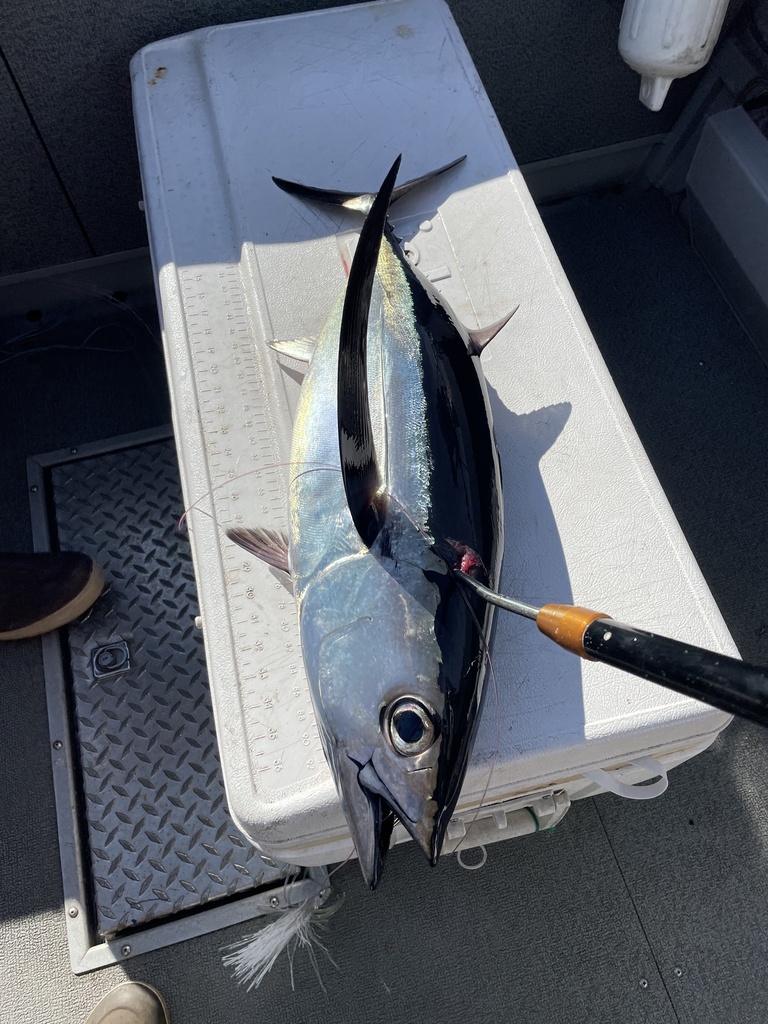
Albacore
Thunnus alalunga
The albacore (Thunnus alalunga), known also as the albicore or longfin tuna, is a species of tuna of the order Scombriformes. It lives in temperate and tropical waters across the globe in the epipelagic and mesopelagic zones. There are six distinct stocks known globally in the Atlantic, Pacific, and Indian oceans, as well as in the Mediterranean Sea. The albacore has an elongate, fusiform body with a conical snout, large eyes, and remarkably long pectoral fins. Its body is a deep blue dorsally and shades of silvery white ventrally. Individuals can reach up to 1.4 m (4 ft 7 in) in length.
Albacore are pelagic predators, eating a wide variety of foods, including fish, crustaceans, and cephalopods. They are unique among tuna in that their primary food-source is cephalopods, with fish making up a much smaller portion of their diet. Reproduction usually occurs from November to February and is oviparous. An adult female can release over two million eggs in a single cycle. Fry (juvenile fish) generally stay near where they were spawned for about a year before moving on. Albacore form schools based on their stage in the life cycle, but also combine with other tuna like the skipjack tuna, yellowfin tuna, and bluefin tuna. Schools of grown albacore are highly migratory.
From the article Albacore on Wikipedia (CC BY-SA), quoted section by section
Description
The albacore has a streamlined, fusiform body with a conical snout, large mouth, and big eyes. Its body is dark blue dorsally, shades of silvery white ventrally, and covered by small scales. The pectoral fins begin slightly before the first dorsal fin and extend well beyond the front of the anal fin, usually as far as the second dorsal finlet, often as long as 30% of the fish's total length. Like the fish's body, the fins are dark blue on top, but change to a medium yellow color on the underside. They are markedly shorter in fish under 0.5 m (1 ft 8 in) in length, often resulting in confusion with T. obesus juveniles, which also have long pectoral fins, though these are rounded at the tips where the albacore's taper to a point. The first dorsal fin is a deep yellow and the second, which is smaller than the first, is a light yellow, as is the anal fin. It has 7–9 dorsal finlets and 7–8 anal finlets, dark blue and silvery white in color respectively, matching the part of the fish's body they are on. The caudal fin is also silvery white. At 1.4 m (4 ft 7 in) maximum length, the albacore is the smallest of the bluefin tuna. It reaches sexual maturity at 0.9 m (2 ft 11 in) and its common length is only slightly larger at 1.0 m (3 ft 3 in). Males and females exhibit no sexual dimorphism.
Range & habitat
The albacore has a cosmopolitan distribution in tropical and temperate waters across the globe and in every ocean as well as the Mediterranean Sea. Its latitudinal range extends from 59°N to 46°S. Its temperature range is 10–25 °C (50–77 °F). Its depth range is 0–600 m (0–1,969 ft; 0–328 fathoms) in the epipelagic and mesopelagic zones. It is most often found in surface waters 15.6–19.4 °C (60.1–66.9 °F) in temperature, though larger individuals can be found in deeper waters 13.5–25.2 °C (56.3–77.4 °F). It can survive at temperatures as low as 9.5 °C (49.1 °F) for short periods of time. It favors areas where warm and cool water mix.
Wikipedia: “Distribution and habitat”
What it does
The albacore is a powerful, hard-hitting predator that forms mixed schools with skipjack tuna, yellowfin tuna, and bluefin tuna, sometimes around floating objects like sargassum weeds. Schools of albacore are highly migratory within bodies of water and segregated by maturity, with older fish tending to form more compact groups. Of those caught by humans, immature albacore have a 1:1 sex ratio while older albacore are mostly male. In the Atlantic Ocean, older fish are found in cooler waters. The opposite is true for the Pacific Ocean, where fish are found more abundantly along thermal discontinuities. Depth range also varies by location: Atlantic fish dive as deep as 600 m (2,000 ft) where Pacific fish reach only 380 m (1,250 ft) in depth. In the northeast Atlantic, feeding migrations to productive areas occur during the summer. Due to climate changes over the last 40 years, the timing and spatial distribution of the albacore have also changed. Albacore show a broad range of behavioral differences by region. In Baja California, albacore make frequent dives to depths exceeding 200 m (660 ft) during the day and stay near the surface at night, while off the coast of Washington and Oregon they stay near the surface the entire day. Albacore never really rest; their need for oxygen means they must always be on the move.
Feeding. Albacore tuna are pelagic (open-sea) predators. …
Wikipedia: “Biology and ecology”
At the table
As with other tunas, albacore meat is a versatile ingredient that is used a wide variety of dishes.
Wikipedia: “Cuisine”
Where it lives
Recorded sightings
—
geo-referenced records in GBIF, from museums, herbaria and field observers.
Drag the globe to turn it. Dots are where records exist, not a range map; darker means more records.
In the stacks
Searching the stacks…
Every page naming Thunnus alalunga in the Biodiversity Heritage Library →
This page is assembled live from iNaturalist, GBIF, Wikipedia, the Source Library and the Internet Archive. It is not yet part of the hand-edited codex. iNaturalist taxon 114122.