- Animals
- ›Chordates
- ›Vertebrates
- ›Reptiles
- ›Snakes and Lizards
- ›Lizards
- ›Skinks and allies
- ›Skinks
- ›Mabuyas
- ›Trachylepis
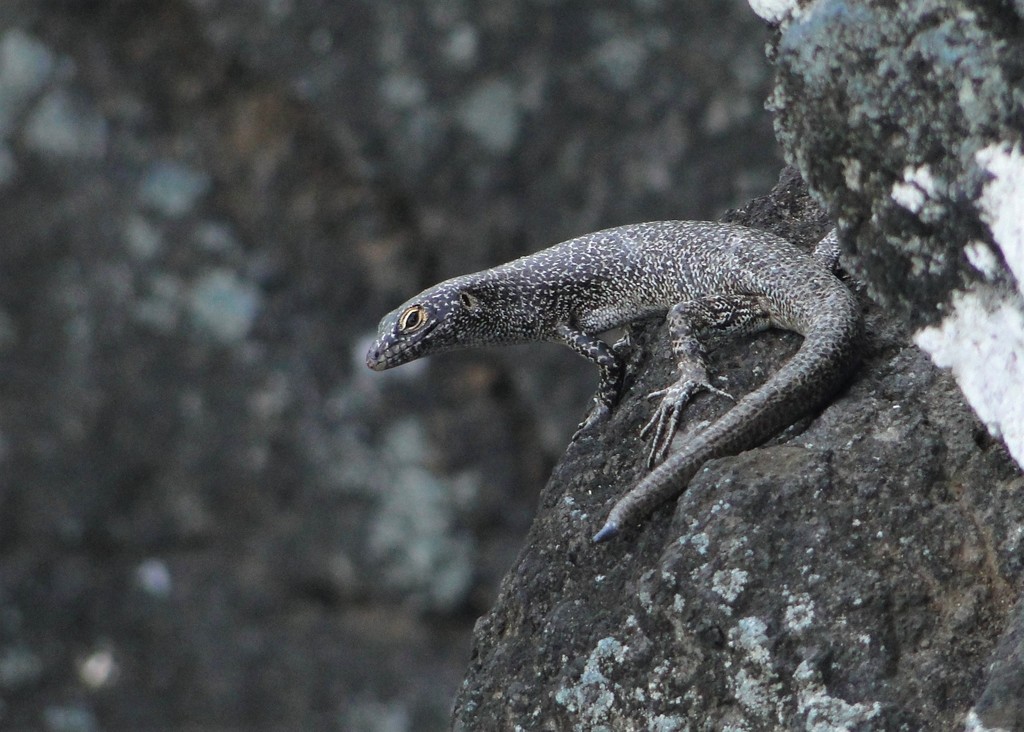
Noronha Skink
Trachylepis atlantica
The Noronha skink (Trachylepis atlantica) is a species of skink from the island of Fernando de Noronha off northeastern Brazil. It is covered with dark and light spots on the upperparts and is usually about 7 to 10 cm (3 to 4 in) in length. The tail is long and muscular, but breaks off easily. Very common throughout Fernando de Noronha, it is an opportunistic feeder, eating both insects and plant material, including nectar from the Erythrina velutina tree, as well as other material ranging from cookie crumbs to eggs of its own species. Introduced predators such as feral cats prey on it and several parasitic worms infect it.
Perhaps seen by Amerigo Vespucci in 1503, it was first formally described in 1839. Its subsequent taxonomic history has been complex, riddled with confusion with Trachylepis maculata and other species, homonyms, and other problems. The species is classified in the otherwise mostly African genus Trachylepis and is thought to have reached its island from Africa by rafting. The enigmatic Trachylepis tschudii, supposedly from Peru, may well be the same species.
From the article Noronha skink on Wikipedia (CC BY-SA), quoted section by section
Description
The Noronha skink is covered with light and dark spots above, but there is substantial variation in the precise colors. There are no longitudinal stripes. The scales on the underparts are yellowish or grayish. The eyelids are white to yellow. It has a small head with small nostrils, which are placed far to the front at the sides of the head. The mouth contains small and conical teeth and a thin but well-developed tongue. The eyes are small and placed laterally and contain dark, rounded irises. There are three to five well-developed auricular lobules (small projections) in front of the ears; these lobules are absent in true Mabuya. The hindlimbs are longer and stronger than the forelimbs, which are small. The tail is longer than the body and is muscular but very brittle. It is nearly cylindrical in form and tapers towards the end. In reptiles, features of the scales are important in distinguishing among species and groups of species. In the Noronha skink, the supranasal scales (located above the nose) are in contact, as are the prefrontal scales (behind the nose) in most individuals. The two frontoparietal scales (above and slightly behind the eyes) are not fused. Unlike in T. maculata, the parietal scales (behind the frontoparietals) are in contact with each other. …
What it does
The Noronha skink is very abundant throughout Fernando de Noronha, even occurring commonly in houses, and also occurs on the smaller islands that surround the main island of the archipelago. Its abundance may be a result of the absence of ecologically similar competitors. Apart from T. atlantica, the reptile fauna of Fernando de Noronha consists of the indigenous amphisbaenian Amphisbaena ridleyi and two introduced lizards, the gecko Hemidactylus mabouia and the tegu Tupinambis merianae. The species is found in several microhabitats, but most often on rocks. Although predominantly ground-dwelling, it is a good climber. Nothing is known about its reproduction except that skinks studied in late October and early November, during the dry season, showed little evidence of reproductive activity. The Noronha skink is oviparous (egg-laying), like many Trachylepis, but unlike Mabuya, which are all viviparous (giving live birth). Trachylepis atlantica is active during the day. Its body temperature averages 32 °C (90 °F), a few degrees higher than the environment temperature. During the day, body temperature peaks at up to 38 °C (100 °F) around midday and is lower earlier and later. In the early morning, the lizard may bask in the sun. …
Wikipedia: “Ecology and behavior”
Where it lives
Recorded sightings
—
geo-referenced records in GBIF, from museums, herbaria and field observers.
Drag the globe to turn it. Dots are where records exist, not a range map; darker means more records.
In the stacks
Searching the stacks…
Every page naming Trachylepis atlantica in the Biodiversity Heritage Library →
This page is assembled live from iNaturalist, GBIF, Wikipedia, the Source Library and the Internet Archive. It is not yet part of the hand-edited codex. iNaturalist taxon 114283.