On eBird ↗
Taita Thrush
Live sightings near you, the range map, bar charts of when it is seen, and Macaulay Library photos and recordings.
Taita Thrush
Turdus helleri
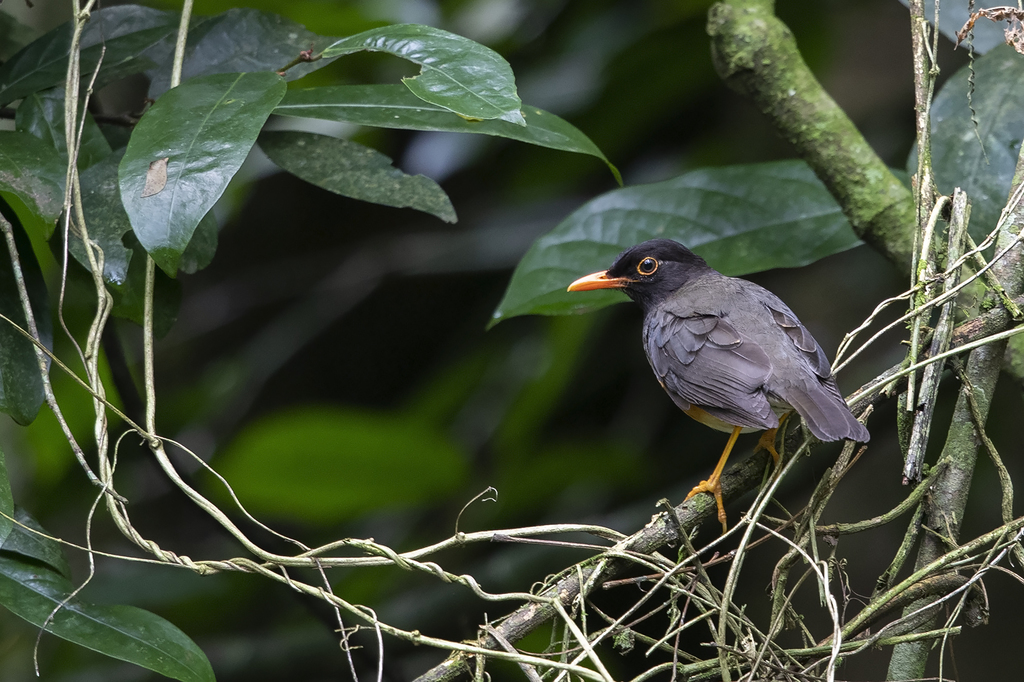
The Taita thrush (Turdus helleri), also known as Taita olive thrush or Heller's ground thrush, is a critically endangered bird from the family of thrushes (Turdidae), endemic to the Taita Hills in Kenya.
From the article Taita thrush on Wikipedia (CC BY-SA), quoted section by section
Description
The Taita thrush was previously classified as subspecies of the olive thrush (Turdus olivaceus), but it is now treated as distinct species. It reaches a length between 20 and 22 centimetres. The head and upperparts are dark grey-brown to black, the breast is grey, the underparts are white, and the flanks are rufous-red. The eye is dark with a narrow yellow or orange eye-ring, and the bill and legs are bright orange. It was named after the zoologist Edmund Heller (1875–1939), a workmate of the American ornithologist Edgar Alexander Mearns (1856–1916) who first described this species in 1913.
Range & habitat
The Taita thrush is a forest-dependent endemic bird confined to four forests in the Taita Hills in the south east of Kenya: Mbololo, Chawia, Yale and Ngangao. The forests cover a tiny 342 ha. Conservationists are using birds, with the thrush as the flagship species, to champion the conservation of the Taita Hills forests.
Wikipedia: “Distribution”
What it does
It is restricted to montane moist forests. Despite its natural native habitat having been severely logged in the past, it has avoided forests with secondary growth, shrub vegetation, and cultivated areas. Extensive research has shown only minimal migration between the fragmented populations.
Wikipedia: “Ecology”
Listen
Looking for field recordings…
Where it lives
Recorded sightings
—
geo-referenced records in GBIF, from museums, herbaria and field observers.
Drag the globe to turn it. Dots are where records exist, not a range map; darker means more records.
In the stacks
Searching the stacks…
Every page naming Turdus helleri in the Biodiversity Heritage Library →
This page is assembled live from iNaturalist, GBIF, Wikipedia, the Source Library and the Internet Archive. It is not yet part of the hand-edited codex. iNaturalist taxon 114663.