- Animals
- ›Chordates
- ›Vertebrates
- ›Reptiles
- ›Snakes and Lizards
- ›Lizards
- ›Iguanas and Allies
- ›Dragons and Chameleons
- ›Dragons
- ›Bearded Dragons, Water Dragons, and Allies
- ›Tympanocryptis
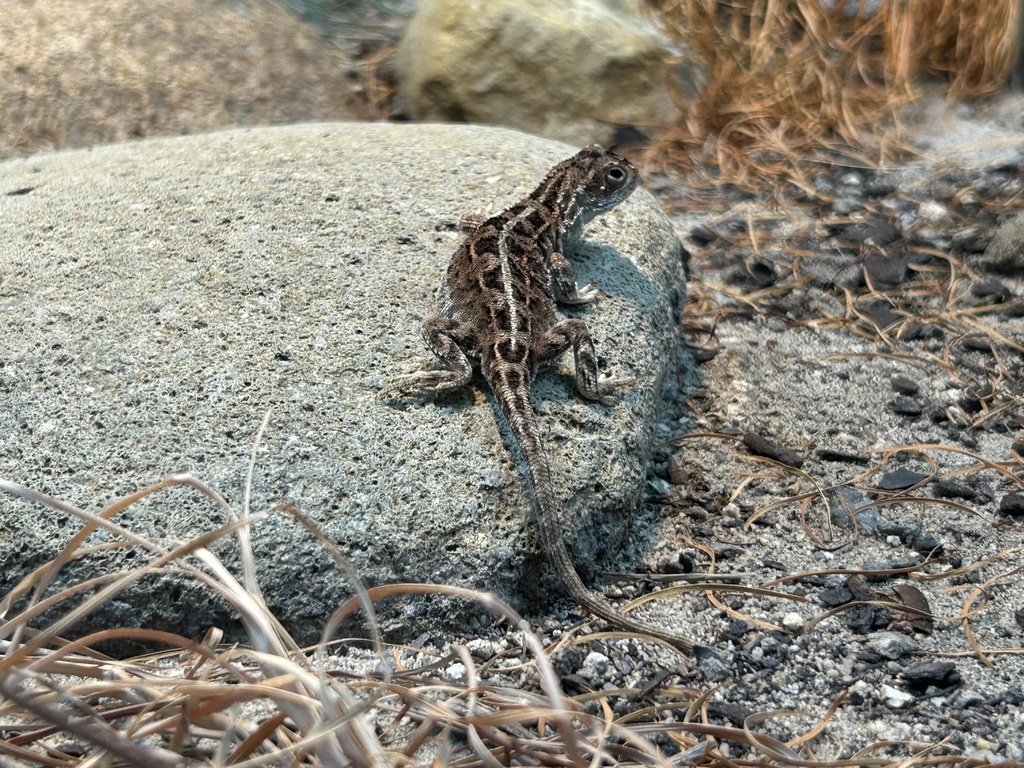
Canberra Grassland Earless Dragon
Tympanocryptis lineata
Tympanocryptis lineata, the Canberra grassland earless dragon or lined earless dragon, is a species of agama found in Australia.
From the article Tympanocryptis lineata on Wikipedia (CC BY-SA), quoted section by section
Description
The Canberra grassland earless dragon is a small, light brown to grey brown lizard usually less than 150 millimetres long and weighing 5–9 grams. The species has a tapering snout, six or seven dark brown bands on its back, dark speckling on its front (especially the throat), and eleven or fewer dark blotches on its tail. Some variation in the appearance of individuals in this species is known. For example, spiny scales on the back, and pigmentation of speckles on the front may vary between individuals. Individuals may exhibit orange-pink colouration on their throat, flanks and sides of head, particularly during the breeding season.
Range & habitat
The Canberra grassland earless dragon has a very narrow distribution, being found only in a small area of the Australian Capital Territory and New South Wales. Populations have been detected at locations within 13 kilometres of Canberra Airport. Its geographical distribution does not overlap with any other earless dragon species, and as such the Canberra grassland earless dragon is considered to be geographically isolated.
Wikipedia: “Distribution”
What it does
Canberra grassland earless dragons inhabit temperate grasslands characterised by tussocks with open space, few or no trees and shrubs and minimal pasture. They prefer well-drained sites dominated by tall speargrass (genus Austrostipa) and shorter wallaby grass (genus Austrodanthonia). They eat a range of invertebrates including ants, beetles, spiders, moths and moth larvae. The species is thought to utilise existing arthropod burrows for shelter in order to endure extreme temperatures experienced in its habitat.
Wikipedia: “Ecology and habitat”
Where it lives
Recorded sightings
—
geo-referenced records in GBIF, from museums, herbaria and field observers.
Drag the globe to turn it. Dots are where records exist, not a range map; darker means more records.
In the stacks
Searching the stacks…
Every page naming Tympanocryptis lineata in the Biodiversity Heritage Library →
This page is assembled live from iNaturalist, GBIF, Wikipedia, the Source Library and the Internet Archive. It is not yet part of the hand-edited codex. iNaturalist taxon 114697.