- Animals
- ›Chordates
- ›Vertebrates
- ›Ray-finned Fishes
- ›Salmons, Pikes and Mudminnows
- ›Pikes and Mudminnows
- ›Mudminnows
- ›Umbra
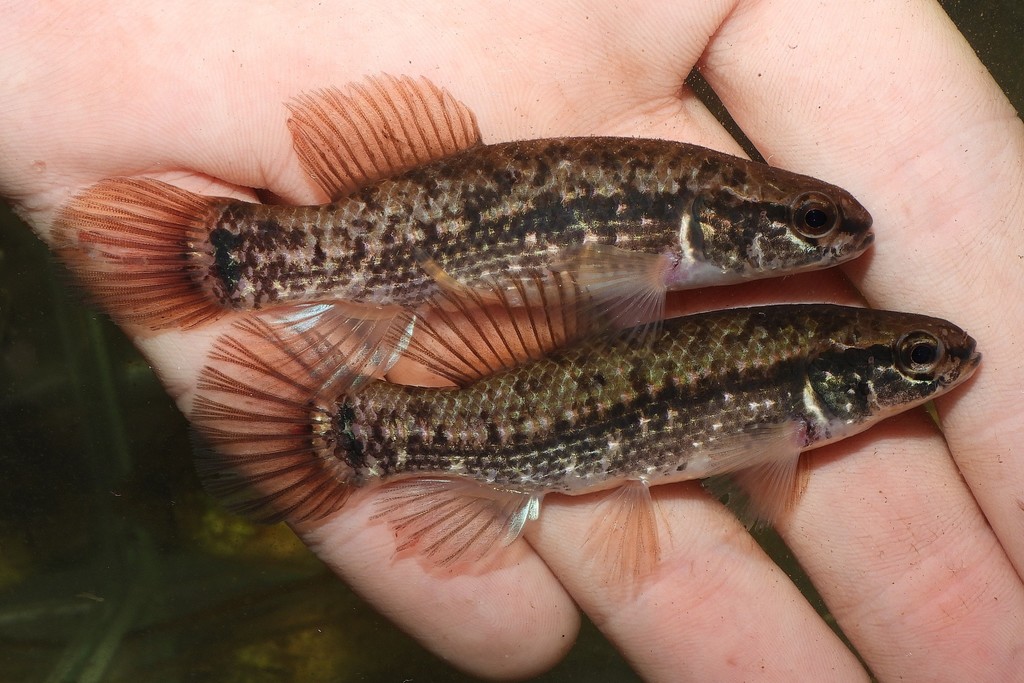
Eastern Mudminnow
Umbra pygmaea
The eastern mudminnow (Umbra pygmaea) is a species of freshwater fish belonging to the family Umbridae. It is native to eastern North America, but has been introduced to Europe. It feeds primarily on insect larvae and other small aquatic invertebrates.
From the article Eastern mudminnow on Wikipedia (CC BY-SA), quoted section by section
Description
It is an elongated, stout-bodied fish, brown or yellow-green in color, with about 10 or more dark, narrow, lateral stripes separated by pale spaces, although there is no lateral line on the fish. The pelvic fin lies somewhat farther back on the body, such that it rests below the dorsal fin. The body is elongated, and the maximum size of the fish is 15 cm (5.9 in).
Range & habitat
The native range of the eastern mudminnow is from New York to Florida, and found as west as Georgia. It has also been introduced to Europe, where it can be found in France, Belgium, Germany, the Netherlands, Denmark, and Poland. It is generally found in still or slow-moving waters, often in dense vegetation, often over heavily vegetated streams, swamps, and ponds. The eastern mudminnow has shown great adaptability to poor habitats with low pH, temperature, and presence of oxygen. At least one incident has been documented where an eastern mudminnow has survived an entire night out of water. The fish can be found in waters with a pH ranging from 3.5 to 8.1 in natural environments. The optimal pH for growth is 4.5, which is often detrimental or even fatal for most fish.
Wikipedia: “Distribution and habitat”
What it does
The eastern mudminnow are bottom-feeders and feed on insect larvae, worms, molluscs, and crustaceans.
Wikipedia: “Diet”
Where it lives
Recorded sightings
—
geo-referenced records in GBIF, from museums, herbaria and field observers.
Drag the globe to turn it. Dots are where records exist, not a range map; darker means more records.
In the stacks
Searching the stacks…
Every page naming Umbra pygmaea in the Biodiversity Heritage Library →
This page is assembled live from iNaturalist, GBIF, Wikipedia, the Source Library and the Internet Archive. It is not yet part of the hand-edited codex. iNaturalist taxon 114748.