On eBird ↗
St. Helena Hoopoe
Live sightings near you, the range map, bar charts of when it is seen, and Macaulay Library photos and recordings.
Saint Helena Giant Hoopoe
Upupa antaios
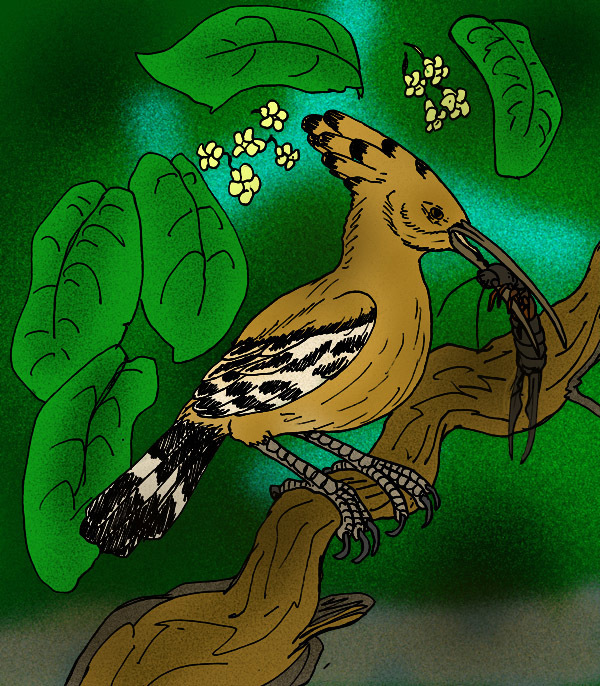
The Saint Helena hoopoe (Upupa antaios), also known as the Saint Helena giant hoopoe or giant hoopoe, is an extinct species of hoopoe (family Upupidae) known exclusively from an incomplete subfossil skeleton. Once endemic to the island of Saint Helena, it was last seen around 1550, likely driven to extinction by various aspects of human activity.
From the article Saint Helena hoopoe on Wikipedia (CC BY-SA), quoted section by section
Description
The Saint Helena hoopoe was a large bird, with heavier and more robust skull and leg elements than the Eurasian or common hoopoe (Upupa epops), of which it is a likely descendant. In opposition, the distal wing bones were much smaller than those of modern hoopoes. This and other clues indicate that it was almost certainly flightless. A height cannot be estimated based upon the incomplete skeleton; however, a likely weight range of 101–145 grams has been posited, using several skeletal aspects from the chest region comparable to the common hoopoe (which weighs 46–89 grams). Coloration and markings are unknown, but anatomical similarities to modern hoopoe species make visual similarities plausible.
What it does
Before its extinction, the Saint Helena hoopoe was endemic to the island of Saint Helena in the southern Atlantic Ocean, hence its name. When it was still extant, the areas in which it lived were likely scrubwoods, consisting of a desert environment with shrub-adjacent plant life; in fact, the presence of its remains in the region serves as evidence for such an environment in the past, given that hoopoes in general occupy grasslands and open woodlands. In such an environment, the Saint Helena hoopoe could have been a predator of the Saint Helena earwig (Labidura herculeana), which is also extinct. Otherwise, assumptions can be made that the Saint Helena hoopoe was similar to extant species, but little else is known. Other extinct endemic birds of Saint Helena include the Saint Helena rail, the Saint Helena crake, the Saint Helena dove, and the Saint Helena cuckoo. (Of these, the dove was also likely flightless.) The extinct seabirds of Saint Helena include the Saint Helena bulweria, the Saint Helena petrel, and the Saint Helena shearwater. No extant species of hoopoe is present on Saint Helena.
Extinction. The extinction of the Saint Helena hoopoe is directly attributable to the effects of colonization, including the introduction of predators like rats and cats, as well as being hunted by humans. …
Wikipedia: “Ecology”
In human culture
The Saint Helena hoopoe has only ever gone by the scientific name Upupa antaios, and has no known synonyms. The name "antaios" is a reference to Greek mythology; the wrestler Antaios was a son of Gaia, and could only maintain his strength when in contact with the ground. Storrs L. Olson, who described the Saint Helena hoopoe, drew parallels between the new species and the wrestler – "likewise a giant of its kind and as necessarily committed to the earth". Common names for the Saint Helena hoopoe in various languages remark upon either its size or its origin. "Abubilla gigante" (Cebuano) and Kæmpehærfugl (Danish) both mean "giant hoopoe"; "huppe de Sainte-hélène" (French) and "sankthelenahärfågel" (Swedish) both mean "Saint Helena hoopoe".
Wikipedia: “Etymology and nomenclature”
Listen
Looking for field recordings…
Where it lives
Recorded sightings
—
geo-referenced records in GBIF, from museums, herbaria and field observers.
Drag the globe to turn it. Dots are where records exist, not a range map; darker means more records.
In the stacks
Searching the stacks…
Every page naming Upupa antaios in the Biodiversity Heritage Library →
This page is assembled live from iNaturalist, GBIF, Wikipedia, the Source Library and the Internet Archive. It is not yet part of the hand-edited codex. iNaturalist taxon 114775.