- Animals
- ›Chordates
- ›Vertebrates
- ›Cartilaginous Fishes
- ›Sharks and Rays
- ›Rays
- ›Stingrays
- ›Round Rays
- ›Urolophus
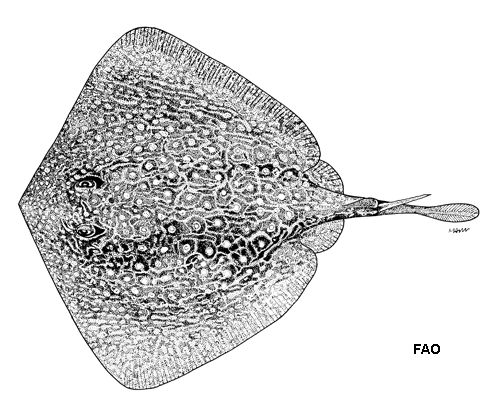
Patchwork Stingaree
Urolophus flavomosaicus
The patchwork stingaree (Urolophus flavomosaicus) is a little-known species of stingray in the family Urolophidae, with a disjunct distribution off northwestern and northeastern Australia. It typically inhabits the outer continental shelf, at a depth of 60–320 m (200–1,050 ft). This species has a diamond-shaped pectoral fin disc much wider than it is long, and a short, flattened tail with a prominent dorsal fin and leaf-like caudal fin. There is a skirt-shaped curtain of skin between its nostrils. Its dorsal colour pattern resembles a mosaic of dark brown rings with light-coloured centers, separated by fine reticulated lines. The International Union for Conservation of Nature (IUCN) has listed the patchwork stingaree under Least Concern, as it is subject to minimal fishing pressure.
From the article Patchwork stingaree on Wikipedia (CC BY-SA), quoted section by section
Description
Among the largest members of its family, the patchwork stingaree can grow to at least 59 cm (23 in) long. It has a diamond-shaped pectoral fin disc much wider than long, with broadly rounded outer corners and nearly straight anterior margins that converge at an obtuse angle. The tip of the snout protrudes slightly past the disc. The small eyes are followed by comma-shaped spiracles with angular posterior rims. The outer rim of each nostril may be enlarged into a small knob; between the nostrils is a skirt-shaped curtain of skin with a finely fringed trailing margin. There are 8–14 stubby papillae (nipple-like structures) on the floor of the large mouth, as well as a narrow patch of large papillae on the lower jaw. The teeth are small with roughly oval bases, and the five pairs of gill slits are short. The pelvic fins are small with curved margins. The short, very flattened tail measures 67–79% as long as the disc and terminates in a short, deep, leaf-shaped caudal fin. A lateral skin fold runs along the each side of the tail, which is most obvious in juveniles. The upper surface of the tail bears a rather large dorsal fin followed by a serrated stinging spine. The skin entirely lacks dermal denticles. …
Range & habitat
The patchwork stingaree is a northern Australian endemic with a discontinuous range: the western population is found from the Houtman Abrolhos to Cape Leveque in Western Australia, and the eastern population from Caloundra to Townsville in Queensland. It seems to be rather patchily distributed, with only small numbers of individuals present at any particular location. This benthic species is mostly found over fine substrates on the outer continental shelf, and has been reported from 60 to 320 m (200 to 1,050 ft) deep.
Wikipedia: “Distribution and habitat”
What it does
Virtually nothing is known of the natural history of the patchwork stingaree. Ecologically, it is apparently the tropical equivalent of the temperate sandyback stingaree. Reproduction is presumably aplacental viviparous like in other stingrays, with the developing embryos sustained by maternally produced histotroph ("uterine milk"). The litter size is probably small, judging by related species. Males mature sexually at under 38 cm (15 in) long.
Wikipedia: “Biology and ecology”
Where it lives
Recorded sightings
—
geo-referenced records in GBIF, from museums, herbaria and field observers.
Drag the globe to turn it. Dots are where records exist, not a range map; darker means more records.
In the stacks
Searching the stacks…
Every page naming Urolophus flavomosaicus in the Biodiversity Heritage Library →
This page is assembled live from iNaturalist, GBIF, Wikipedia, the Source Library and the Internet Archive. It is not yet part of the hand-edited codex. iNaturalist taxon 114793.