- Animals
- ›Chordates
- ›Vertebrates
- ›Birds
- ›Perching Birds
- ›Ovenbirds and Woodcreepers
- ›Woodcreepers
- ›Lepidocolaptes
On eBird ↗
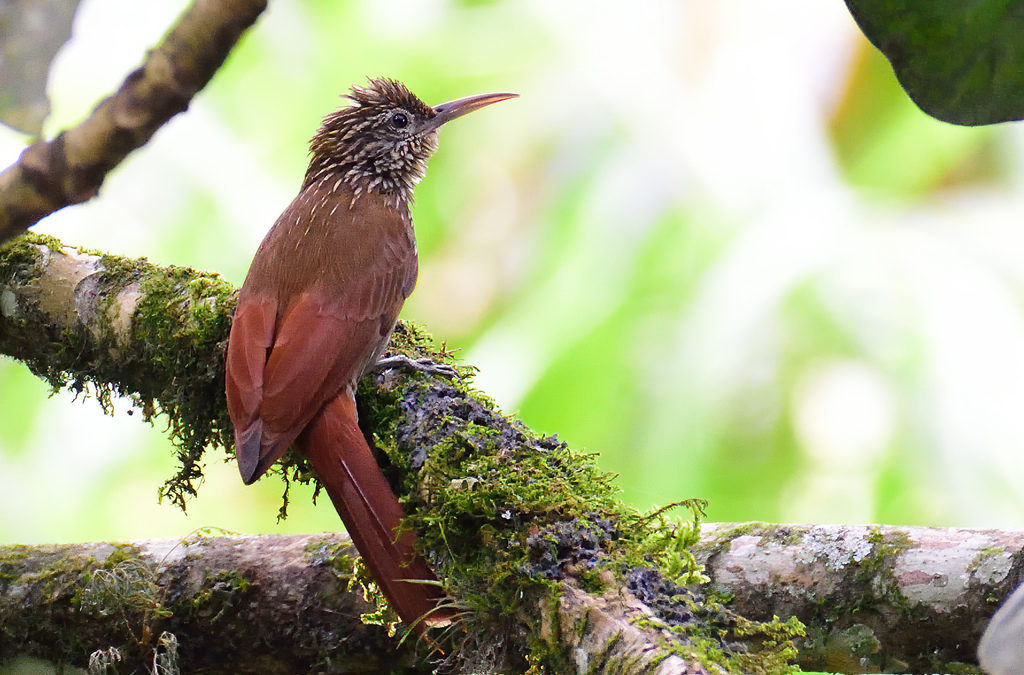
Streak-headed Woodcreeper
Live sightings near you, the range map, bar charts of when it is seen, and Macaulay Library photos and recordings.
Streak-headed Woodcreeper
Lepidocolaptes souleyetii
The streak-headed woodcreeper (Lepidocolaptes souleyetii) is a passerine bird in the subfamily Dendrocolaptinae of the ovenbird family Furnariidae. It is found in Mexico, Central America, Brazil, Colombia, Ecuador, Guyana, Peru, Venezuela, and on Trinidad.
From the article Streak-headed woodcreeper on Wikipedia (CC BY-SA), quoted section by section
Description
The streak-headed woodcreeper is 19 to 21 cm (7.5 to 8.3 in) long and weighs 23 to 31 g (0.81 to 1.1 oz). It is a slim, medium-sized woodcreeper with a longish, slender, decurved bill. The sexes have the same plumage. Adults of the nominate subspecies L. s. souleyetii have a face with thin whitish buff and dark brown streaks; the sides of the neck are more heavily streaked. They have a whitish buff supercilium and eyering. Their crown and nape are dark brown with bold whitish buff streaks that often extend onto the upper back. Their back and wing coverts are rufous-olive to cinnamon-brown. Their flight feathers, rump, and tail are cinnamon-rufous to rufous-chestnut. Their primaries have brownish edges and dusky tips. Their throat is whitish buff to pale cinnamon. Their underparts are grayish olive to buffy brown with black-edged whitish buff streaks. The streaks are wide on the breast and sides, those on the belly and flanks narrower, and those on the undertail coverts minimal. Their underwing coverts are ochraceous to pale cinnamon-buff. Their iris is pale brown or brown, their bill pale brown or horn with most of the mandible bluish-pink, and their legs and feet grayish olive-green. …
Range & habitat
The subspecies of the streak-headed woodcreeper are found thus:
L. s. guerrerensis, Mexico's Sierra Madre del Sur in Guerrero and Oaxaca L. s. compressus, from Veracruz, Campeche, and Chiapas in southern Mexico through Central America into western Panama L. s. lineaticeps, from Panama's Canal Zone into northern and eastern Colombia and western Venezuela L. s. littoralis, Trinidad, northeastern Colombia's Atlántico Department and Santa Marta region, central Venezuela, Guyana, and extreme northern Brazil L. s. uaireni, southeastern Venezuela's Bolívar state L. s. esmeraldae, from southwestern Colombia's Nariño Department south in Ecuador into El Oro Province L. s. souleyetii, from southwestern Ecuador's El Oro and Loja provinces into northwestern Peru as far as the Department of Lambayeque The streak-headed woodcreeper inhabits a variety of wooded landscapes, most of them semi-open to open. These include deciduous and somewhat humid forest, gallery forest, secondary forest, plantations, the edges of humid forest, and open areas with scattered trees. It also locally occurs in mangrove and in arid scrublands. In elevation it reaches 1,500 m (4,900 ft) in Mexico, 1,850 m (6,100 ft) in northern Central America, 1,500 m (4,900 ft) in Costa Rica (though uncommon above 900 m (3,000 ft)), 1,500 m (4,900 ft) in Colombia, and 1,600 m (5,200 ft) in Venezuela. …
Wikipedia: “Distribution and habitat”
What it does
The streak-headed woodcreeper's diet is mostly non-flying arthropods, and other invertebrates such as crabs and small fruits are minor components. It forages mostly singly or in pairs, at all levels of the forest, hitching up trunks and branches. It is not known to join mixed-species feeding flocks. It captures prey by flaking bark and probing into crevices and moss clumps.
Wikipedia: “Feeding”
Listen
Looking for field recordings…
Where it lives
Recorded sightings
—
geo-referenced records in GBIF, from museums, herbaria and field observers.
Drag the globe to turn it. Dots are where records exist, not a range map; darker means more records.
In the stacks
Searching the stacks…
Every page naming Lepidocolaptes souleyetii in the Biodiversity Heritage Library →
This page is assembled live from iNaturalist, GBIF, Wikipedia, the Source Library and the Internet Archive. It is not yet part of the hand-edited codex. iNaturalist taxon 11553.