On eBird ↗
Copper Pheasant
Live sightings near you, the range map, bar charts of when it is seen, and Macaulay Library photos and recordings.
Copper Pheasant
Syrmaticus soemmerringii
The copper pheasant (Syrmaticus soemmerringii), also known as Soemmerring's pheasant or yamadori (ヤマドリ), is a pheasant endemic to the Japanese archipelago. The scientific name commemorates the German scientist Samuel Thomas von Sömmerring. It is the official bird of multiple Japanese prefectures, cities, and towns. It was commonly hunted for sport throughout the 20th century.
Its population has been in consistent decline since the 1970s due to factors including habitat destruction and predation, but the most widely cited cause is overhunting.
From the article Copper pheasant on Wikipedia (CC BY-SA), quoted section by section
Description
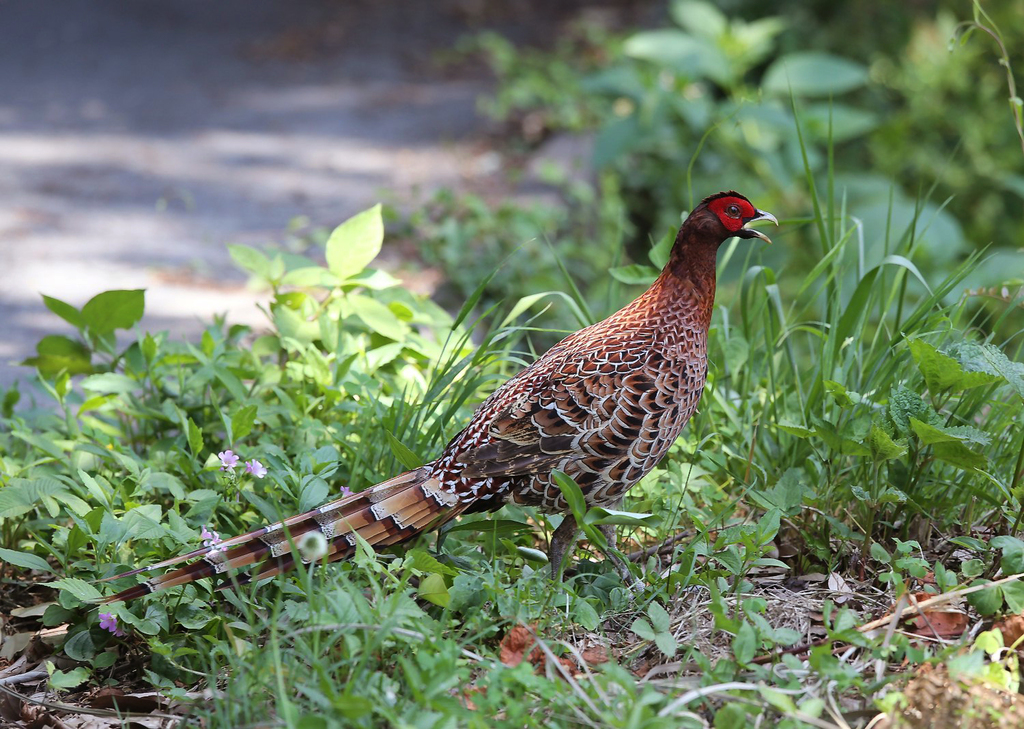
It is a large pheasant with a rich coppery chestnut plumage, yellowish bill, brown iris, and red facial skin. The female is a brown bird with greyish brown upperparts and buff barred dark brown below. The male has short spurs on its grey legs, while the female has none. Males are between 87.5 centimetres (34.4 in) and 136 centimetres (54 in) long, including the tail, while the female is between 51 centimetres (20 in) and 54 centimetres (21 in) (subspecies scintillating copper pheasant, scintillans). Juveniles have similar plumage to the females. The plumage of the chicks is, overall, chestnut, with some darker patches of brown on the back of the neck and cream-coloured feathers on the face. Darker stripes of cream and dark brown run along their face and neck.
Range & habitat
The copper pheasant is distributed in and endemic to the hill and mountain forests of the Honshū, Kyūshū, and Shikoku islands at elevations of up to 1,800 metres (1.1 mi). It typically confines itself to deciduous forest floors with extensive vegetation. However, members of the species also lives in conifer forests. They often nest on the edges of grasslands. It naturally occurs only south of the Blakiston's Line, and this species' distribution was originally cited as evidence for the line's existence. Copper pheasant populations have been established on Hokkaido and Sado Island.
Wikipedia: “Distribution and habitat”
What it does
The bird is not heavily vocal, only occasionally making a "kuk-kuk"-like call when breeding or threatened. These pheasants are known to sunbathe, especially when living in grasslands. They roost in trees, and are a non-migratory bird.
Breeding. The copper pheasant's mating season occurs between March and July, with the exact month depending local climate. During this time, males perform their wing-whirring display and fight other males in an attempt to secure a mate. It is unknown if the species is monogamous. Male copper pheasants exhibit aggressive behaviour in captivity, sometimes killing their mates. It is usual for this species to be bred in captivity by means of artificial insemination. Copper pheasants typically nest on the ground, but have also been recorded nesting in trees. They often build their nests in hollows sheltered by fallen trees. Captive birds have a clutch of ten to twenty eggs, while wild birds have a clutch of seven to thirteen eggs. The cream-coloured or tan eggs take twenty five days to hatch, and the chicks are able to walk within hours of hatching. After all the chicks have hatched, they abandon the nest and stay at their mother's side until adulthood. Occasionally, the male pheasant is seen near his offspring and mate, but young are raised primarily by their mother. …
Wikipedia: “Behavior and ecology”
Listen
Looking for field recordings…
Where it lives
Recorded sightings
—
geo-referenced records in GBIF, from museums, herbaria and field observers.
Drag the globe to turn it. Dots are where records exist, not a range map; darker means more records.
In the stacks
Searching the stacks…
Every page naming Syrmaticus soemmerringii in the Biodiversity Heritage Library →
This page is assembled live from iNaturalist, GBIF, Wikipedia, the Source Library and the Internet Archive. It is not yet part of the hand-edited codex. iNaturalist taxon 1159.