- Animals
- ›Chordates
- ›Vertebrates
- ›Birds
- ›Perching Birds
- ›Ovenbirds and Woodcreepers
- ›Miners and Leaftossers
- ›Sclerurus
On eBird ↗
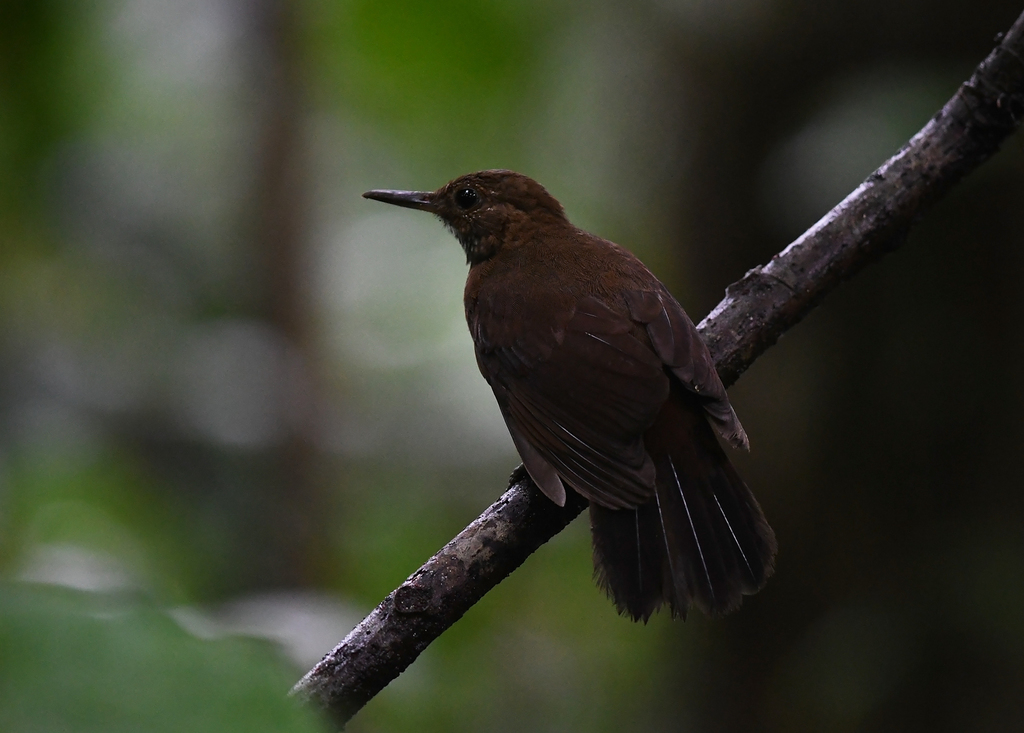
Scaly-throated Leaftosser
Live sightings near you, the range map, bar charts of when it is seen, and Macaulay Library photos and recordings.
Scaly-throated Leaftosser
Sclerurus guatemalensis
The scaly-throated leaftosser (Sclerurus guatemalensis) is a species of bird in the family Furnariidae. It is found in Belize, Colombia, Costa Rica, Ecuador, Guatemala, Honduras, Mexico, Nicaragua, and Panama. Its natural habitats are subtropical or tropical moist lowland forests and subtropical or tropical moist montane forests.
From the article Scaly-throated leaftosser on Wikipedia (CC BY-SA), quoted section by section
Description
The scaly-throated leaftosser is 16.5 to 18 cm (6.5 to 7.1 in) long and weighs about 35 g (1.2 oz). The sexes are alike. Adults of the nominate subspecies have a dark brown crown and nape with a scalloped appearance. Their back is dark brown, their rump and uppertail coverts reddish brown, and their tail is a darker brown than their back. Their flight feathers are dusky. Their face is shades of brown. Their chin and throat feathers are whitish with darker margins that give a scaly appearance. The sides of their neck and their upper breast are tawny brown and the rest of their breast is dull reddish brown with narrow rufous streaks. Their long thin bill has a dark maxilla and a bicolored mandible. Their iris is dark brown to brown and their legs and feet are blackish brown. Juveniles are similar to adults but are overall darker, and sometimes have an ochraceous tinge on their breast. Subspecies S. g. salvini is a darker and more sooty brown and less reddish than the nominate. The streaks on its breast are narrower and less apparent than those of the nominate. S. g. ennosiphyllus is somewhat paler and grayer than the nominate and also less reddish. Its flight feathers have somewhat olive edges.
Range & habitat
The nominate subspecies of the scaly-throated leaftosser is found from Veracruz in southern Mexico south along the Caribbean slope through Belize, Honduras, and Guatemala into Nicaragua, on the Pacific and Caribbean slopes of Costa Rica, and on the Caribbean slope of western and central Panama. Subspecies S. g. salvini is found from eastern Panama into northwestern Colombia and also in western Ecuador between the provinces of Esmeraldas and Guayas. S. g. ennosiphyllus is found in northern Colombia between Antioquia and Bolívar departments. The scaly-throated leaftosser inhabits humid lowland evergreen forest, favoring primary forest with little undergrowth under a closed canopy. It also occurs locally in mature secondary forest and montane evergreen forest. In addition, in Ecuador it occurs in lowland cloudforest. In northern Central America it ranges up to 1,200 m (3,900 ft), in Colombia to 1,000 m (3,300 ft), and in Ecuador to 800 m (2,600 ft).
Wikipedia: “Distribution and habitat”
What it does
The scaly-throated leaftosser forages mostly on the ground, flipping aside leaves and pecking at leaf litter and rotting logs while hopping rather than walking. It typically forages alone or in pairs but occasionally joins mixed-species foraging flocks. Though its diet has not been described in detail it is known to mostly be insects and other small invertebrates.
Wikipedia: “Feeding”
Listen
Looking for field recordings…
Where it lives
Recorded sightings
—
geo-referenced records in GBIF, from museums, herbaria and field observers.
Drag the globe to turn it. Dots are where records exist, not a range map; darker means more records.
In the stacks
Searching the stacks…
Every page naming Sclerurus guatemalensis in the Biodiversity Heritage Library →
This page is assembled live from iNaturalist, GBIF, Wikipedia, the Source Library and the Internet Archive. It is not yet part of the hand-edited codex. iNaturalist taxon 11649.