- Animals
- ›Chordates
- ›Vertebrates
- ›Reptiles
- ›Snakes and Lizards
- ›Snakes
- ›Atractaspidid Snakes
- ›Burrowing Asps and Striped Harlequin Snakes
- ›Atractaspis
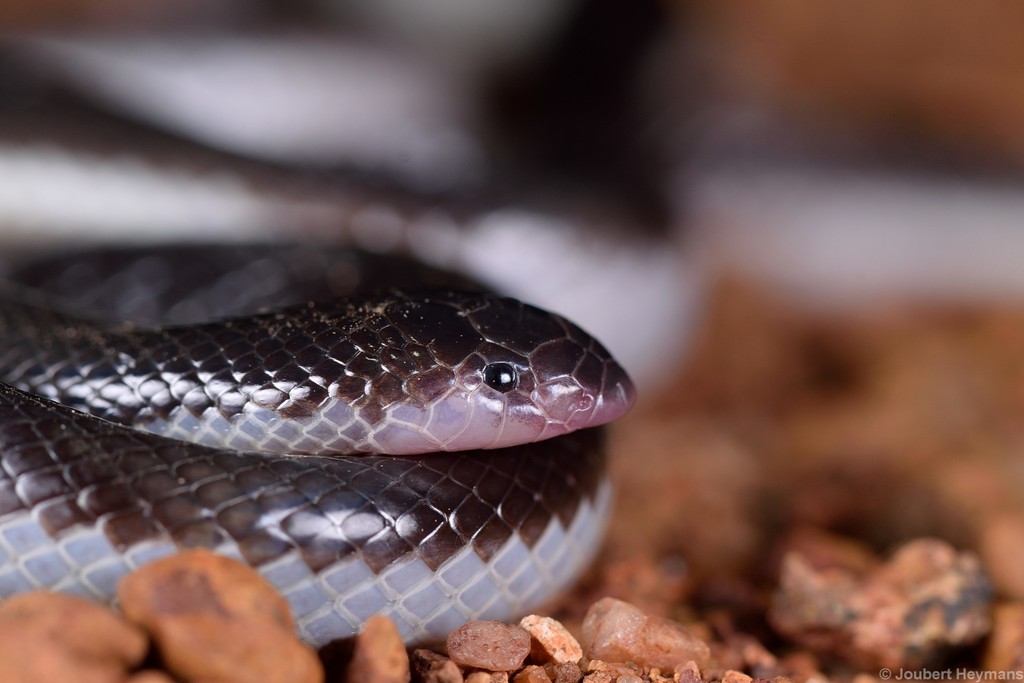
Beaked Burrowing Asp
Atractaspis duerdeni
Atractaspis duerdeni, commonly known as the beaked burrowing asp, Duerden's burrowing asp, and Duerden's stiletto snake, is a species of venomous snake in the family Atractaspididae. The species is native to southern Africa.
From the article Atractaspis duerdeni on Wikipedia (CC BY-SA), quoted section by section
Description
In his original description Gough described A. duerdeni as being cream-colored above and below, referring to a faded specimen stored in alcohol. In life A. duerdeni is uniformly blackish-brown or gray dorsally, and it is white or creamish-pink ventrally. The dorsal scales are in 21 rows at midbody. The ventrals number 199; the anal is entire; and the subcaudals number 22, all except the first entire. The snout is prominent and subcuneiform. The rostral has a rounded horizontal edge, and the portion visible from above is a little longer than its distance from the frontal. Females may attain a snout-to-vent length (SVL) of 51 cm (20 in), and males, which are smaller, may attain 44 cm (17 in) SVL.
Range & habitat
A. duerdeni is found in southeastern Botswana, Namibia, and northern South Africa.
Wikipedia: “Geographic range”
Toxicity
A venomous species, A. duerdeni can inflict a serious bite requiring medical attention, but no human fatality has been recorded.
Wikipedia: “Venom”
In human culture
The specific epithet, duerdeni, is in honor of James Edwin Duerden (1865–1937) of the Albany Museum, Grahamstown, South Africa.
Wikipedia: “Etymology”
Where it lives
Recorded sightings
—
geo-referenced records in GBIF, from museums, herbaria and field observers.
Drag the globe to turn it. Dots are where records exist, not a range map; darker means more records.
In the stacks
Searching the stacks…
Every page naming Atractaspis duerdeni in the Biodiversity Heritage Library →
This page is assembled live from iNaturalist, GBIF, Wikipedia, the Source Library and the Internet Archive. It is not yet part of the hand-edited codex. iNaturalist taxon 116502.