- Animals
- ›Chordates
- ›Vertebrates
- ›Reptiles
- ›Snakes and Lizards
- ›Snakes
- ›Atractaspidid Snakes
- ›Stiletto snakes
- ›Xenocalamus
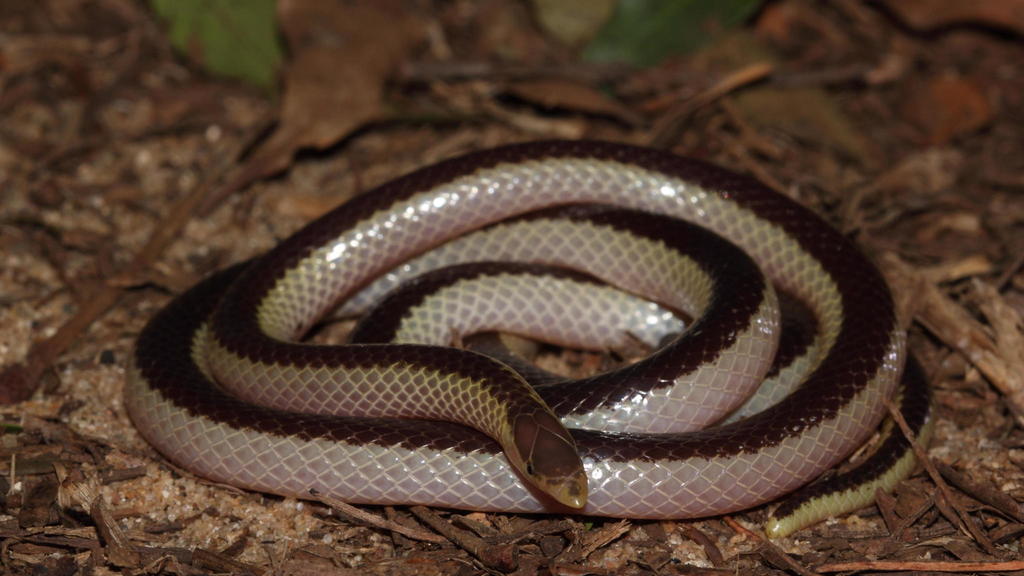
Slender Quill-snouted Snake
Xenocalamus bicolor
Xenocalamus bicolor, also known commonly as the bicoloured quill-snouted snake and the slender quill-snouted snake, is a species of mildly venomous rear-fanged snake in the family Atractaspididae. The species is endemic to Africa. Four subspecies are recognized as being valid.
From the article Xenocalamus bicolor on Wikipedia (CC BY-SA), quoted section by section
Description
X. bicolor exhibits the following characters: Black dorsally. White ventrally including the upper lip and the first two rows of dorsal scales on each side. Total length 43 cm (16+7⁄8 in); tail 3 cm (1+1⁄8 in). Dorsal scales smooth, without apical pits, arranged in 17 rows. Ventrals 218; anal plate divided; subcaudals 24, also divided. Portion of rostral visible from above nearly half as long as the frontal. Frontal extremely large, more than half as long as the shielded part of the head. Internasals large, forming a short median suture. Supraocular very narrow. One large elongate preocular, contacting the posterior nasal, the internasal, the frontal, and the third upper labial. One minute postocular. One temporal. Six upper labials, the first very small, third and fourth entering the eye, the fifth very large and contacting the parietal. One pair of narrow chin shields. Three lower labials in contact with the chin shield. Third lower labial extremely large. (Nota bene: the description above is a description of the species X. bicolor. The subspecies listed below vary somewhat from this description.)
Range & habitat
X. bicolor is found in Angola, Botswana, Democratic Republic of the Congo, Mozambique, Namibia, Republic of South Africa, and Zimbabwe.
Wikipedia: “Geographic range”
What it does
X. bicolor is terrestrial and fossorial, burrowing in aeolian and alluvial sands.
Wikipedia: “Behaviour”
Where it lives
Recorded sightings
—
geo-referenced records in GBIF, from museums, herbaria and field observers.
Drag the globe to turn it. Dots are where records exist, not a range map; darker means more records.
In the stacks
Searching the stacks…
Every page naming Xenocalamus bicolor in the Biodiversity Heritage Library →
This page is assembled live from iNaturalist, GBIF, Wikipedia, the Source Library and the Internet Archive. It is not yet part of the hand-edited codex. iNaturalist taxon 116565.